

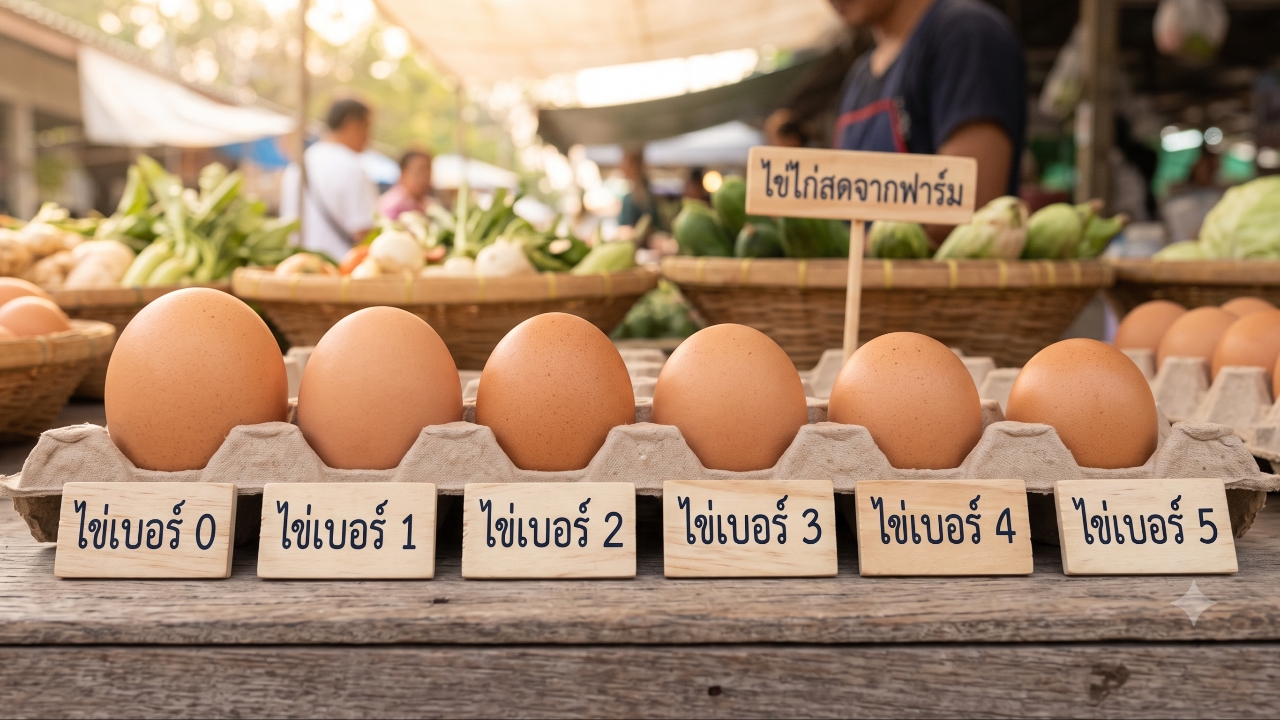
Chicken eggs are a staple food at home, but do you know which egg size offers the best value? Let's compare sizes, weights, and prices per gram to help you buy eggs more economically and get the most for your money.
"Chicken eggs"are a common household ingredient found in almost every family's refrigerator. But have you ever wondered, when you go to the market or supermarket and see eggs arranged from size 0 to size 5, how do you choose"which egg size gives the best value"when compared to the amount of money you pay?
If you look only at the price per tray, smaller eggs are cheaper than larger ones. But if you calculate based on the actual weight of the egg content you receive, the result might not be what many expect.
According to agricultural product standards (Department of Livestock Development and Ministry of Agriculture and Cooperatives), chicken egg sizes are classified by weight per egg as follows:
Egg size | Average weight per egg (grams) | Characteristics and highlights |
Size 0 | 70 grams or more | Extra large, suitable for dishes that require larger quantity |
Size 1 | 65 - 69 grams | Large size, easy to find |
Size 2 | 60 - 64 grams | Medium size, very popular in the market |
Size 3 | 55 - 59 grams | Medium to small size affordable price |
Size 4 | 50 - 54 grams | Small size, suitable for small portion dishes or baking |
Size 5 | Less than 50 grams | Smallest size, usually from young hens |
Analyzing value per gram (price per weight) and the hen’s laying nature reveals interesting information:
Comparing average price per gram, size 2 eggs (60–64 grams) and size 3 eggs (55–59 grams) generally have the lowest price per gram compared to other sizes because they are standard sizes most commonly produced by farms, reflecting a balanced market mechanism.

Size 0 eggs often have an added price premium as extra-large eggs, resulting in a price per gram slightly higher than medium sizes.
Agricultural data indicates that the size difference in eggs mainly comes from the amount of"egg white"which increases with the hen’s age, while the size of the"egg yolk"in sizes 1, 2, and 3 is quite similar. Therefore, if you want to focus on yolk nutrition, choosing medium sizes like size 2 or 3 is the most cost-effective.
Besides choosing the most cost-effective egg size, selecting fresh eggs and proper storage can help reduce unnecessary money loss.
Choosing eggs for value is not always about the cheapest price but about getting the appropriate amount of egg content for the money spent. For most consumers, size 2 and size 3 eggs are the best choices in terms of price per weight and nutrient proportion, while size 0 eggs suit dishes that require larger quantity and more appealing presentation.