

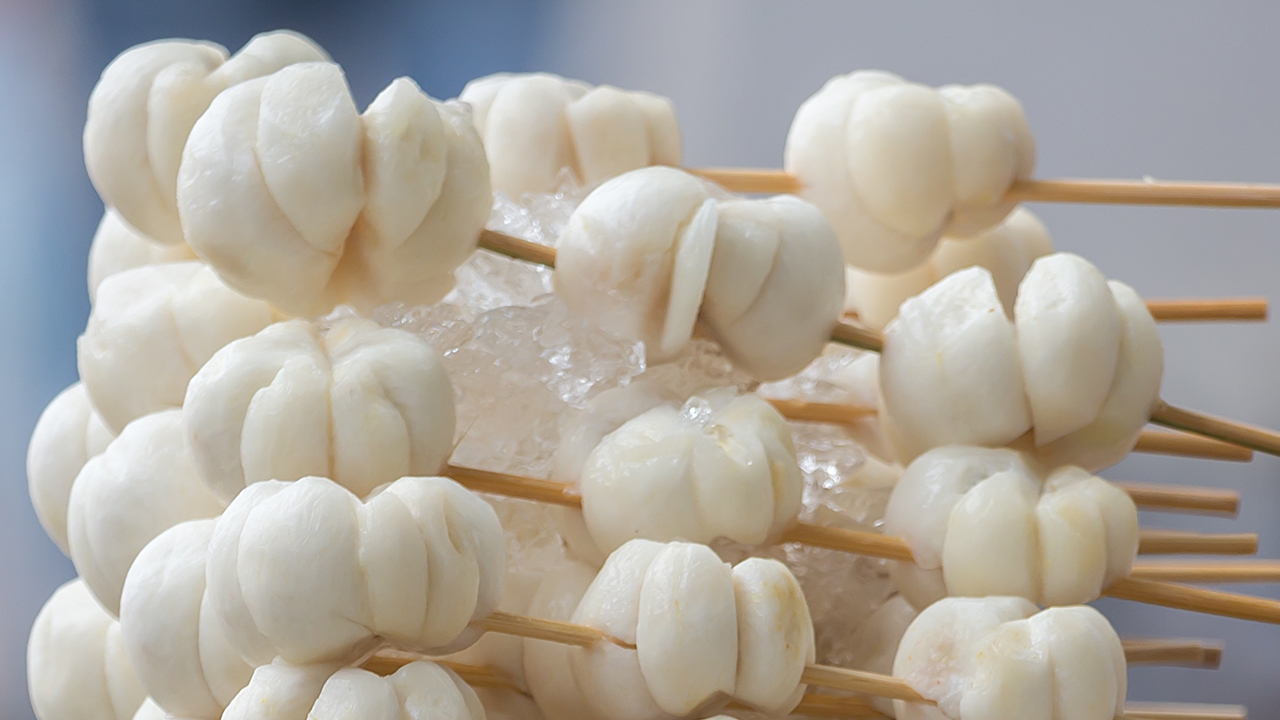
Introducing “ Mangkhut Kad ,” a rare and renowned snack from Nakhon Si Thammarat province. It consists of a whole mangosteen fruit peeled to reveal a creamy white interior, then skewered for easy eating. The flesh is firm and crisp, with a sweet-tart flavor distinct from ripe mangosteen’s softer, sweeter flesh. Nowadays, it is not widely sold and tends to be relatively expensive. Thairath Online explores what “Mangkhut Kad” is, why it commands a high price, and where to find it.
Mangkhut Kad is not a specific variety, but refers to mature yet unripe mangosteen, which has a green, firm shell, carefully peeled to preserve the inner flesh’s shape and clean whiteness. The latex is washed away and the fruit undergoes preparation steps according to each producer’s recipe before being skewered for sale. At this stage, the flesh is firm, the seeds still soft, making nearly the entire fruit edible. It offers a unique sweet-tart taste and crisp texture, and can also be used in local dishes such as sour curry or coconut milk curry.

The word “ Kad ” in the southern dialect means to peel or remove the skin. Thus, “ Mangkhut Kad ” means mangosteen that has been peeled, not selected by size or quality.
Mangkhut Kad is a local delicacy long associated with Nakhon Si Thammarat and is now recognized as one of the province’s distinctive food products. Legend has it that this dish originated when orchard workers peeled fallen unripe mangosteen blown down by storms and discovered its delicious taste, giving rise to the Mangkhut Kad known today.
Fresh Mangkhut Kad is not easy to find year-round because it depends on seasonal fruit and skilled peeling. The mangosteen must be mature yet unripe, with a firm green shell—not every unripe fruit is suitable. The peeling requires care to avoid latex contaminating the flesh or cutting into the inner fruit.
After peeling, Mangkhut Kad retains freshness only briefly; its color darkens and crispness fades quickly. It must be freshly prepared and sold promptly. These factors contribute to higher costs in raw materials, time, and labor compared to selling whole mangosteen.
Prices vary by size, number of fruits per skewer, season, origin, and yield. Some sell by the skewer, with about three fruits per skewer priced between 50 to 100 baht. When sold by kilogram, prices can reach several hundred baht.

Mangkhut Kad has a firm, crisp texture with a sweet-tart flavor, distinct from ripe mangosteen’s soft, juicy sweetness. Though its appearance might remind some of pickled fruit, traditional Mangkhut Kad is not fermented, preserving the fresh natural taste of unripe mangosteen. Importantly, the seeds can be chewed without hardness, a unique charm that many find delightful.

Mangkhut Kad is typically available in season, mainly from May to August. After peeling, its color darkens and crispness fades quickly, one reason fresh Mangkhut Kad is rarely found year-round, especially outside Nakhon Si Thammarat.
Mangkhut Kad is a source of pride for Nakhon Si Thammarat residents, transforming unripe fruit into an excellent snack. Although the process is laborious and results in higher prices, its crisp, delicious taste and rarity keep Mangkhut Kad in demand among local food lovers and markets.