

Thairath Online
Thairath Online

How Long Can Takeaway Sushi Be Stored? A Checklist for Safe Storage to Avoid Food Poisoning

Food02 Sep 2026 11:53 GMT+7

Share

How Long Can Takeaway Sushi Be Stored? A Checklist for Safe Storage to Avoid Food Poisoning

Many people have experienced buying takeaway sushi during a great promotion, filling their bags, but then hesitating about how long the sushi tray can be kept before eating. Especially in Thailand’s hot and humid weather, leaving sushi in the wrong place for just a few hours can unknowingly become a breeding ground for bacteria and germs. Today, Thairath Online’s lifestyle team summarizes safe time limits and storage tips for sushi clearly for you to check.

How long can takeaway sushi be stored? Leaving it in the wrong place risks spoilage sooner than expected.

Japanese cuisine like sushi is a favorite for many, but since it contains fresh, raw ingredients with delicate textures, taking it home requires special care regarding temperature and cleanliness.

How long can takeaway sushi be left outside the fridge?

According to food safety principles, temperatures between 4 and 6 degrees Celsius are considered the "Danger Zone," where bacteria can multiply rapidly.

  • Typical room temperature (international): Should not be left out of the fridge for more than 2hours.
  • In Thailand’s climate (hotter than 32°C): The safe time decreases to no more than 1 hour. Beyond this, the risk of bacteria like Vibrio parahaemolyticus or Salmonella multiplying is very high. How many days can sushi be stored in the fridge? (Raw vs Cooked)

If you realize you cannot finish it, refrigerating (at 1 to 4 degrees Celsius) is the best method. However, the safe storage duration varies by sushi type.

Types of sushi

Left outside the fridge (Thai climate)
Refrigerated in normal compartment (1 to 4 degrees Celsius)
Raw-topped sushi
(Salmon, Tuna, Hamachi, Tobiko)
No more than 1 hour
Consume within 24 hours
Cooked-topped sushi
(Boiled shrimp, Sweet egg, Unagi eel)
No more than 1–2 hours
Can be stored 1–2 days
Sushi rolls with sauce/mayonnaise
No more than 1 hour

Consume within 24 hours
Advice:
  • Freezing sushi is not recommended because although it prolongs shelf life, the rice texture becomes hard and soggy after thawing, and raw fish flavor deteriorates severely. 4 mistakes that cause sushi to spoil faster due to improper placement

Leaving it in the car:

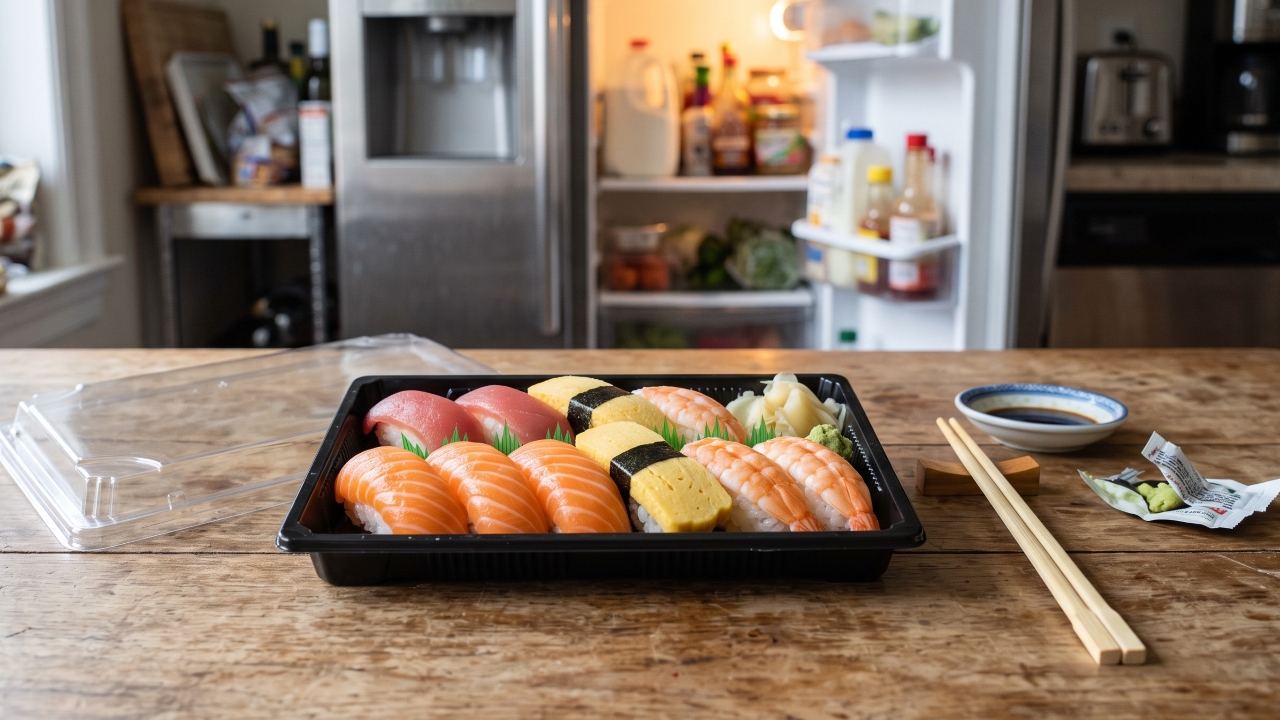
ภาพจาก AI

  1. Many people put sushi in their car after purchase while running errands. The heat buildup inside the car greatly accelerates bacterial contamination. Placing near heat-emitting appliances:
  2. Putting sushi boxes next to microwaves, refrigerators, or rice cookers raises the surrounding temperature without realizing it. Storing on the fridge door shelves:
  3. The fridge door is the most temperature-variable area due to frequent opening and closing. It’s better to place sushi on the middle or deepest shelves. Not sealing the container tightly:
  4. Leaving sushi in an open plastic box in the fridge allows cold air to dry out the rice and risks cross-contamination from other foods. Warning signs! How to tell if sushi is spoiling?

Before eating refrigerated sushi, observe these danger signs. If any appear, discard immediately without hesitation.

Smell:

ภาพจาก AI

  • Strong fishy odor, abnormal sour smell, or ammonia-like scent. Texture:
  • Fish flesh becomes slimy or unusually soft and mushy; sushi rice becomes sticky and slimy. Color:
  • Raw fish color fades, looks dull, or shows gray/green patches. Takeaway sushi is best eaten immediately for optimal taste and safety. If storage is necessary, follow the rule "raw toppings no more than 24 hours, cooked toppings no more than 2 days," and refrigerate tightly as soon as you get home to prevent food poisoning or stomach upset.

References: U.S. Food and Drug Administration (FDA), United States Department of Agriculture (USDA), Department of Health, Ministry of Public Health, Thailand.