

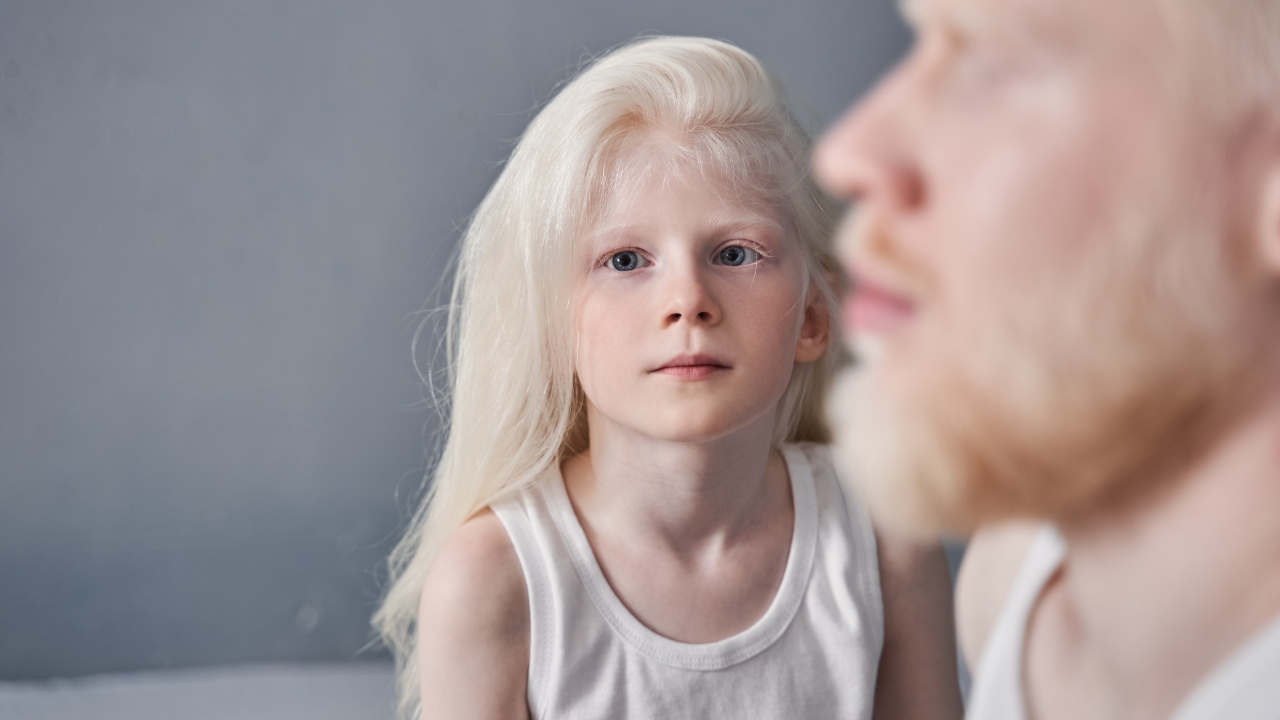
Some parents may have seen children with white or yellow hair, white skin and hair, and grayish eyes and wondered about this condition. Children with these traits are called “ children with albinism .” We will explore the causes and care methods together.
Albinism is a group of disorders inherited through recessive genes caused by a deficiency of an enzyme called tyrosinase, which converts tyrosine into melanin pigment responsible for hair, skin, and eye color. Without this enzyme, tyrosine cannot produce melanin, leading to abnormal hair, skin, and eye colors. In Caucasians, the eyes are not blue; in Thai people, black eyes appear grayish. Hair, body hair, and skin are white or yellow, differing from family members.

can be divided into several groups, mainly:
1. Complete albinism group where the entire body is affected — hair, skin, and eyes. This includes those with no tyrosinase enzyme, remaining completely white for life, and those with some enzyme activity, starting white but gradually producing more pigment with age, causing slight darkening of the skin and hair turning bronze. Eye symptoms include gray or brown irises, light sensitivity (photophobia), involuntary eye movement (nystagmus), and reduced visual acuity. These symptoms occur equally in boys and girls.
2. Ocular albinism only where only the eyes lack pigment, causing light sensitivity and squinting in bright light. Without proper care, severe cases may lose vision. This type is inherited via the X chromosome and affects only boys.
3. Albinism with easy bleeding (Hermanski-Pudlak syndrome) involves easy and prolonged bleeding caused by abnormalitiesin genescontrolling melanosome andplatelet production,inherited recessively.This type is rare and more common with consanguineous marriages. Initially, hair may be white, gradually turning yellow, as does the skin. Eye color may initially be absent but some iris pigment may develop after six months.Children in this group also experience bleeding tendencies and may have lung fibrosis causing breathing difficulties or gastrointestinal problems like indigestion and susceptibility to infections. Parents must be very careful to prevent falls or injuries that cause bleeding, provide vitamin C, and avoid medications that impair platelet function, as bleeding can be hard to stop.
Parents may wonder if their child can have albinism without family history. Medically, albinism can occur because it is a recessive genetic disorder. Parents may be carriers without symptoms, and the gene can skip generations. When both parents carry the recessive gene, the child has a chance of having albinism.
How to care for children with albinismSkin careChildren with total albinism and no melanin require strict sun protection because melanin protects skin cells from UV damage. When taking children outside, dress them in long sleeves and pants, wear hats, avoid sunlight from 10 a.m. to 2 p.m., and apply sunscreen with at least SPF 30 frequently. Prolonged sun exposure damages skin and greatly increases skin cancer risk, the leading cause of death in children with albinism. Those with skin abnormalities should see a dermatologist for skin cancer screening.
Eye careBesides skin, eye care is crucial. Children with albinism have light sensitivity, blurred vision, and symptoms like nearsightedness; severe cases risk vision loss. They should wear sunglasses outdoors and see an ophthalmologist starting at 4–6 months old, followed by check-ups every 3–4 months during the first two years, then every 6 to 12 months to monitor eye health.Mental health care

Information provided by
Samitivej International Children's Hospital