

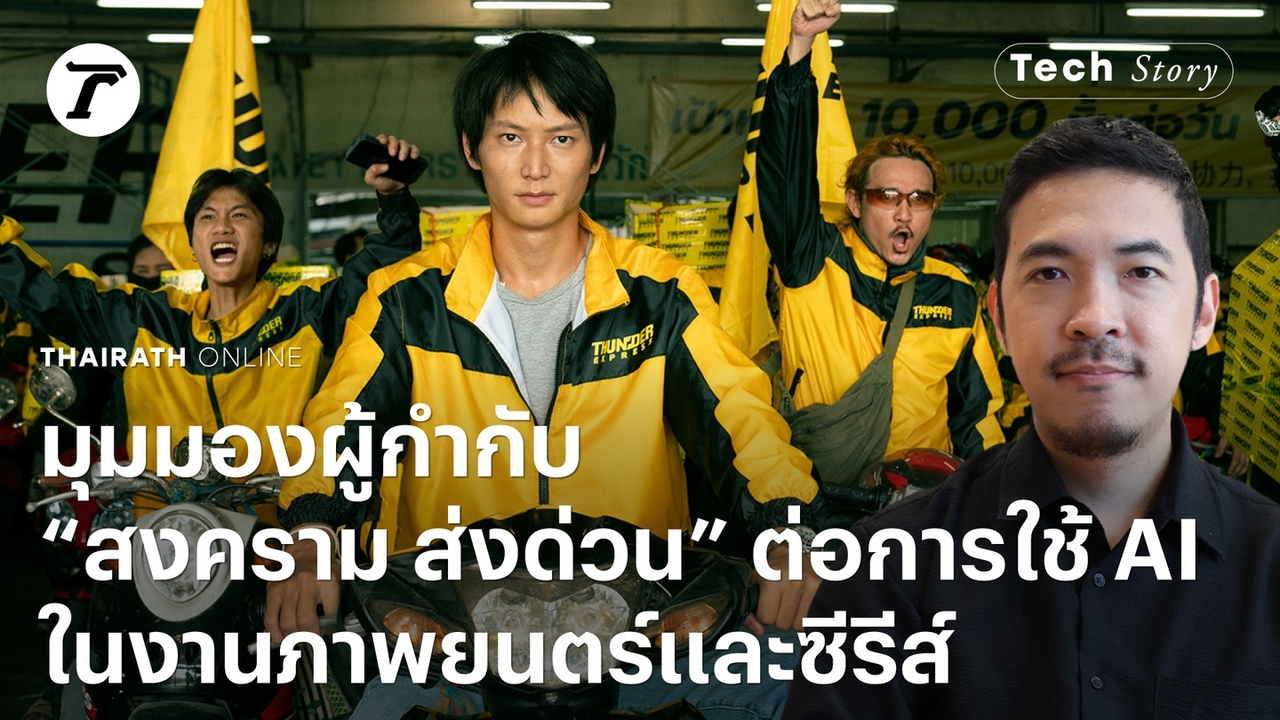
We live in an era where artificial intelligence, or AI, plays a role in nearly every aspect of life, including work where AI helps facilitate many tasks across various professions. This includes behind-the-scenes work on the popular Netflix series "War Delivery," also known as Mad Unicorn. Director Kai-Nataphol Boonprakob told Thairath Online's lifestyle team that he also incorporates AI into his work.
“I think AI significantly shortens the time needed for many tasks. Does AI take jobs? I believe it might replace some positions that anyone can do—jobs that don’t require specific skills only humans can provide. For example, I have used AI for scriptwriting to find in-depth information that’s hard to find online. Since character dialogue or situational scripts require deep contextual understanding, AI can assist effectively in this area,” said Kai-Nataphol.
He cited his latest work, the series "War Delivery," which took four years to produce. During that period, AI tools like ChatGPT, Claude AI, and others started playing a bigger role. He used AI to help write character scripts related to business and technology themes, which were quite unfamiliar to him. AI helped quickly gather information before writing, significantly reducing work time.

He took the initial AI-generated data to create a framework, then verified its accuracy with experts in the relevant fields. Afterwards, he adapted the information to fit the context of Thai society as closely as possible.

Additionally, he used AI to generate images of locations that closely matched his imagination, which helped the crew find real places resembling those ideas. AI also assisted in drafting character descriptions to aid the casting team in finding actors with similar traits.

When asked about AI’s growing role behind the scenes in series and film production and whether it affects workers, Kai-Nataphol shared his perspective.
“I feel filmmaking is about human-to-human connection. I don’t know if someday AI will become so perfect that we can’t tell if a work is by a human or not. It might even understand humans better than humans themselves. But for now, as we still shoot films with cameras and haven’t fully shifted to AI-generated prompts, the connection between creators and audiences remains tangible through the work. It will likely take quite some time before this gap is fully bridged.”

He mentioned a post by Ter-Nawapol Thamrongrattanarit, who once asked, “Can AI replace filmmakers?” Kai-Nataphol sees this as a question for the audience, noting that most people still prefer films told by humans rather than AI. Even if the plot is exciting, if made by AI, the desire to watch might lessen.

“We want to speak to people, not AI. We might want to hear AI’s answers to some questions, but we don’t want to form a real connection with AI the way we do with people. If that happens, it might be an escape from reality, thinking that talking to AI can replace human interaction. Ultimately, though, deep down everyone wants to connect with others, and I believe films serve as a medium for those connections,” Kai-Nataphol concluded thoughtfully.