

On 8 December 2025 GMT+7, the situation at the Thailand-Cambodia border flared up again after the 2nd Army Area confirmed heavy clashes at “Chong An Ma” and “Anupong Base,” prompting Thailand to send F-16 fighter jets to intercept.
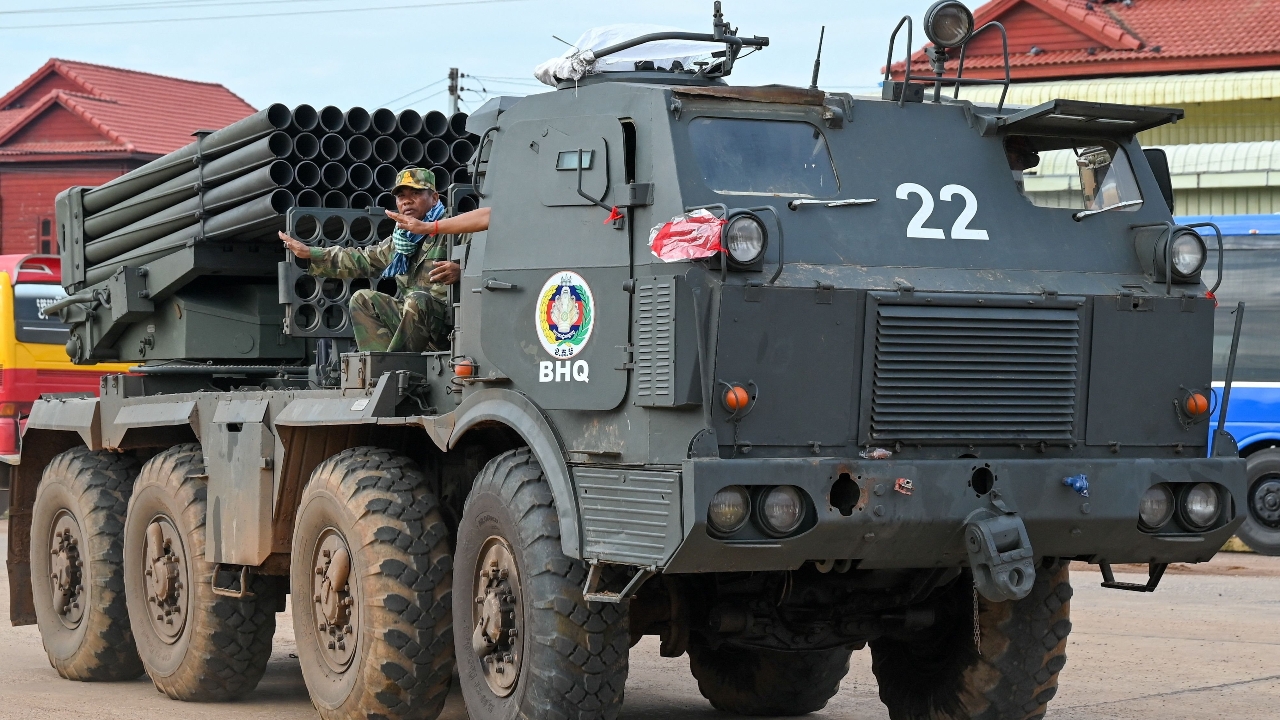
The main target of this airstrike was to destroy the “ long-range support weapons.” These posed a serious threat, among them the BM-21 Grad. Here is an in-depth look at why this weapon is so fearsome and why deploying F-16s is a necessary measure.
Early on 8 December, Cambodia launched a heavy weapons barrage—including artillery and rocket launchers—against the Thai operational base (Anupong Base, Nam Yuen District, Ubon Ratchathani Province), causing one Thai soldier to be killed and several wounded. In response, the Royal Thai Air Force deployed F-16s on an airstrike mission to immediately destroy these weapons sites, as allowing them to remain could extend their destructive power into civilian areas.

This weapon is essentially Cambodia’s main armament. The BM-21 (Boyevaya Mashina) is nicknamed “Grad” (hail) in Russian and was developed by the Soviet Union. Its tactical danger lies in its ability to fire a barrage instantly. The BM-21 is a truck-mounted launcher with 40 tubes that can fire all rockets within just 20 seconds.
These 40 explosive rockets land simultaneously across an area the size of a football field. It is designed to erase everything within the targeted grid coordinates, whether soldiers or structures. Immediately after firing, the truck can move away from the launch site within minutes, making it difficult to counterattack with conventional artillery.
Experts highlight the most concerning aspect: the “inaccuracy” of the BM-21. Thairath Online shared insights from Professor Dr. Jesada and other experts who pointed out that the weapon’s greatest worry is its “lack of precision.” You can read more here.

Most BM-21 rockets lack guidance systems; their direction depends on the firing angle and wind. The focus is on volume rather than pinpoint accuracy. They are not designed to strike a small military base specifically but to cover a wide area. This becomes a serious issue near border communities, as the inaccuracy greatly increases the risk of rockets missing military targets and hitting homes, schools, or gas stations, as previous civilian damage reports have shown.
Thailand’s use of F-16 fighter jets to respond indicates that the threat exceeds what artillery alone can handle. The F-16’s precision-guided bombs can accurately target enemy rocket launcher locations without causing unnecessary damage to surrounding areas.
Because the BM-21 is highly mobile, the F-16 is the best option to chase and destroy it before it fires another salvo. Intelligence also reports that Cambodia possesses the Chinese Type 90B rocket launcher with computer control and the PHL-03 long-range rocket system with a 130 km range. The F-16 is the answer to halting these long-range weapons before they can inflict deeper damage within Thai territory.
Therefore, the use of the BM-21 signals a high-level danger to rear areas, and the deployment of F-16s is a clear declaration by the Royal Thai Armed Forces that “they will not tolerate any more attacks on Thai people from these launch positions.”
Sources: Army Guide, Defence Technology Institute