

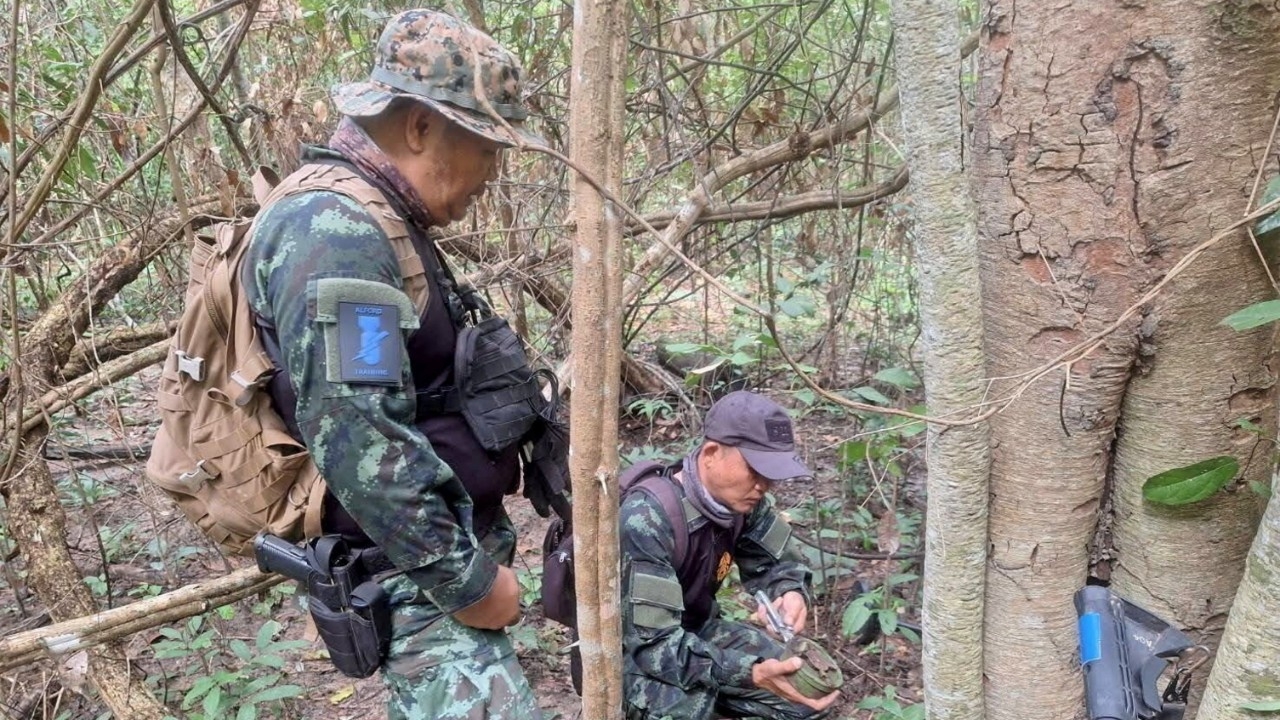
Amarin Khaowngam, a former paramilitary soldier from 2011, shares insights on the significance of Hill 350, a commanding high ground that determines the Thailand-Cambodia border, while honoring the memory of heroes Sergeant Ko and Sergeant Bo.
Amid escalating tensions along the Phanom Dong Rak mountain range, efforts to reclaim sovereignty around Prasat Ta Kwai have once again captured Thai public attention. However, from the perspective of a veteran soldier, the decisive objective is not just the stone temple itself but the strategic terrain known as "Hill 350," which serves as a natural fortress controlling those positioned below.
Geographically, Hill 350 is a plateau approximately 350 meters above sea level, located on the cliff line of the Phanom Dong Rak mountain range, which functions as a natural border ridge or watershed. This terrain is critically important for military positioning because it offers comprehensive visibility over the surrounding area, especially overlooking Prasat Ta Kwai, which is situated at a tactical disadvantage below.
Amarin Khaowngam, a former paramilitary operative on the Ta Kwai battlefield in 2011, describes the area's difficulty based on firsthand experience. He explains that ascending Hill 350 is extremely challenging due to obstacles like thorny bushes and newly laid Cambodian landmines along the path. To illustrate, he compares it to running uphill against an enemy positioned atop an anthill.
"They are on top of the anthill, and we have to climb up it. Those on top naturally have the advantage because they shoot downward, while we shoot upward. We have to run toward the target, but they remain stationary at the top," he explained.
Today, Hill 350 is no longer just natural terrain but a fortified base far more prepared than in the past. The opposing forces have spent years constructing bunkers, tunnels, and permanent strongholds. Amarin notes this transformation, saying,
"Comparing 2025 to 2011, their preparedness is very different because they have made continuous efforts to build stable, strong, and permanent defenses. Even when no active conflicts occurred, they persistently advanced in the areas they aim to control along the entire front."

From his point of view, capturing Prasat Ta Kwai without securing Hill 350 is essentially futile. The temple currently lacks cover because the opposing side uses this strategic position to deploy heavy weapons, such as BM-21 artillery, to pressure Thai forces and prevent them from firmly holding the temple. Amarin mentioned that there have been as many as nine heavy artillery barrages targeting the surrounding area.
Looking back at the major clash in 2011, although the Thai military demonstrated its might by regaining control within six hours (from 06:00 to 12:00), the advantage held by the high ground of Hill 350 tragically claimed the lives of brave Thai soldiers.
Amarin recounted the losses, noting that his company lost two soldiers: Sergeant Ko and Sergeant Bo. Their sacrifice serves as a solemn reminder that as long as the enemy controls the commanding heights above Prasat Ta Kwai, Thai soldiers below remain at constant risk. Securing only parts of the area without controlling the true high ground could lead to repeated losses.
Pushing opposing forces off the watershed ridge and Hill 350 is not merely a military victory but the establishment of an internationally recognized border that permanently upholds Thailand's sovereignty. Without control over this high ground, maintaining sovereignty over Prasat Ta Kwai below will be difficult and continuously vulnerable to further losses.