

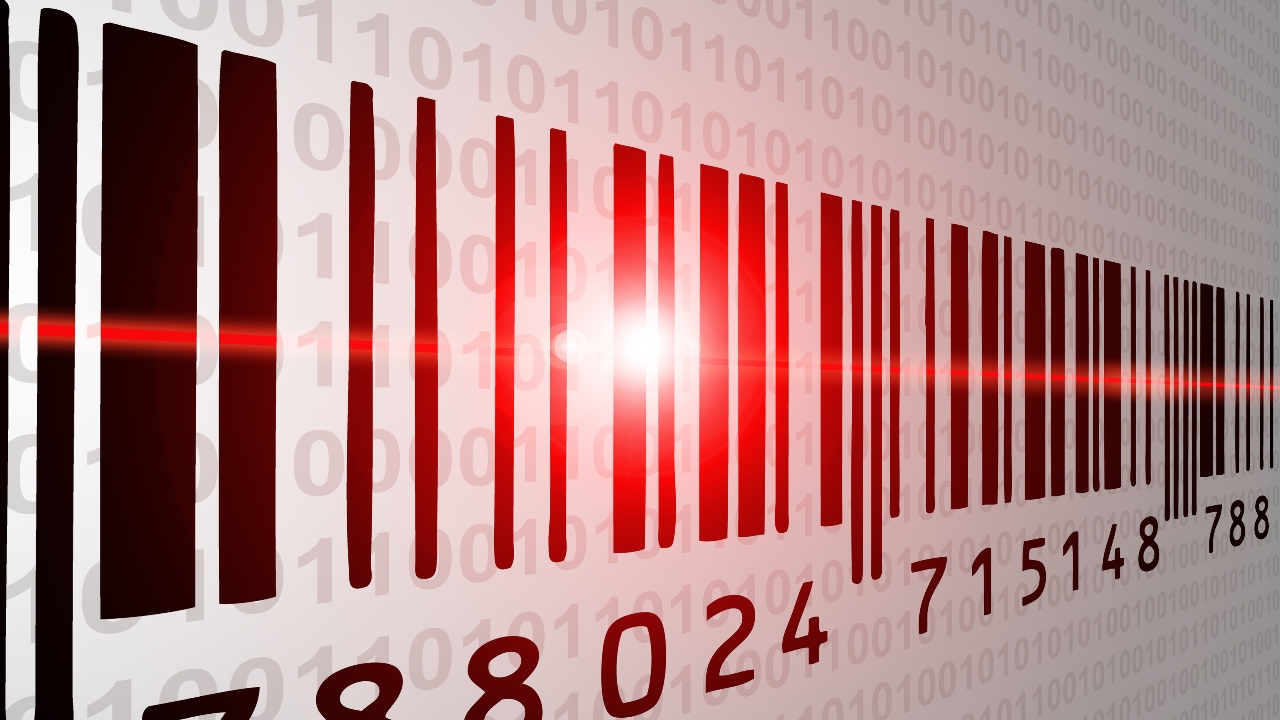
Amid the heated battle of the recent elections, a controversy as intense as the vote count itself is the debate over the "barcode" prominently displayed on the party-list MP ballots.
The black-and-white stripes we commonly see on snack packages, known as a technology with a long history of being "honest and accurate," have become a social scapegoat after concerns arose that these barcodes might not only prevent counterfeit ballots but could serve as a "map" leading to the identity of the voter.
Thairath Online takes you back through the history of barcode technology and delves into the hot topic shaking the Election Commission's confidence: Is the barcode truly a shield against fraud or a loophole that compromises ballot secrecy?
Barcodes have a history of attempts to create automated systems dating back to 1932 when Wallace Flint, a Harvard student, proposed using punched cards to manage stock. However, the idea was shelved due to technological limitations until 1948, when a breakthrough occurred. Bernard Silver, a student at Drexel Institute of Technology, overheard a grocer complaining about slow checkout times. Along with his friend Norman Joseph Woodland, they began innovating a solution to this problem.
Their initial idea was to use ultraviolet (UV) fluorescent ink, but this failed due to the ink fading quickly and being too expensive. One day, while Woodland was relaxing on a Miami beach, he drew lines in the sand inspired by Morse Code he had learned. The moment he drew a long line down was when he thought, "What if we stretch the dots and dashes of Morse Code into thick and thin lines?" This was the origin of the barcode.
Did you know the first patented barcode in 1952 was not the rectangular stripes we see today but instead consisted of concentric circles resembling a dartboard, known as the Bullseye Code, so scanners could read it from any direction? However, it wasn't until the 1970s, when IBM and retailers seriously adopted the system, that the design changed to rectangular bars (UPC) for easier printing. The new era began on June 26, 1974, at a Marsh supermarket in Ohio, when the world's first scanned item, producing a "beep," was a Wrigley's Juicy Fruit chewing gum.
Common barcodes are one-dimensional (1D), encoding data in binary through black-and-white stripes. Thailand began serious use in 1993 under the 13-digit EAN standard.
As the world required storing more data, two-dimensional (2D) barcodes emerged. The most familiar is the QR Code (Quick Response), developed by Japan's Denso Wave in 1994 for the automotive industry, which then spread worldwide due to its fast reading speed and vast data capacity.
What makes barcodes an enduring technology is their "verifiable standard." Whether you scan the same bottle of water at any store, the machine reads the same code every time—no "discretion," no "damaged card," and no "counting errors." This nearly eliminates human error.
However, when barcodes were applied to "election ballots," confidence wavered. Online communities and IT experts questioned anomalies, such as unique IDs, because each pink ballot's barcode has different numbers, even within the same booklet, unlike products that share identical codes by batch.
Experts stated that by applying mathematical formulas to the barcode numbers, one could potentially determine "which booklet" and "which ballot number" the card came from. The concern is the "ballot stub," which shows the sequence and the voter's signature. Anyone matching the ballot data with the stub could access personal information, revealing who voted for which candidate and thus breaking ballot secrecy immediately.
Following this controversy, the Election Commission firmly stated that barcodes are intended solely for logistics management and counterfeit prevention under Regulation 129, which authorizes special secret codes. They emphasized that barcodes cannot identify voters.Read more here
Meanwhile, Somchai Srisutthiyakorn, a former EC member, offered an insightful opinion that the costly ballots (over 1 baht each) incorporate many advanced anti-counterfeiting features such as UV watermarks and microtext. However, having a system that allows "traceability" might conflict with the law's intent to keep voting confidential.
This issue is not merely technical but a matter of election credibility. If concerns about voter identification prove true, it could violate the constitution and render the election invalid.
The story of barcodes on election ballots is a compelling case study of how technology designed for "accuracy" and "transparency"...
...can, if misused or poorly communicated, become a tool that breeds the greatest "suspicion."
Information from: NSTDA and Sahawicha.com