

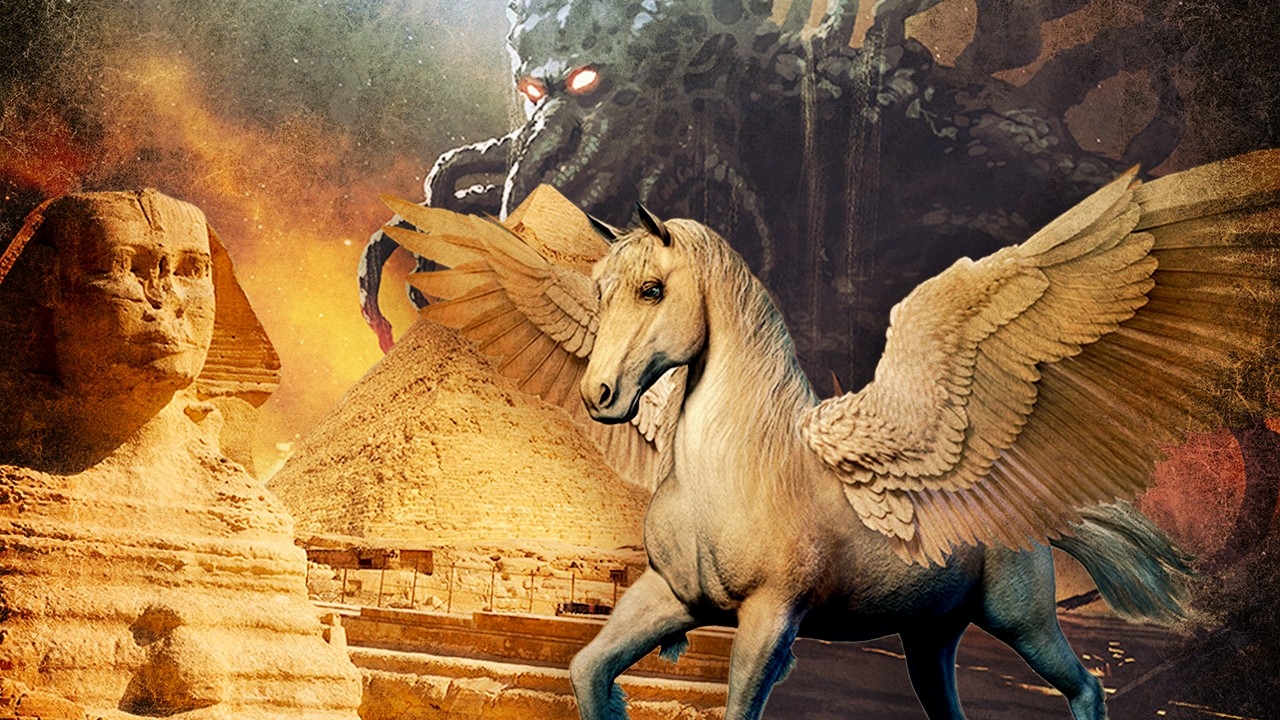
Program I Want to Believe on the channel Thairath Studio hosted by Pueak Pongsathorn presents the story “Hard to believe but many want to believe” It features stories of certain creatures that appear in myths or ancient legends from mythologies around the world, or that have been seen in fantasy films and numerous literary works. Many are familiar with these so-called legendary creatures. These creatures differ in origin and appearance from animals we find in the real world and often possess fantasy-like qualities beyond the natural realm, including the phoenix, mermaids, unicorns, and dragons, all considered part of the category of legendary creatures.
The beliefs about these legendary creatures have existed for thousands of years, even before scientific perspectives and frameworks emerged. As these stories have been retold repeatedly through various entertainment media over decades, some enthusiasts of fantasy stories have hypothesized and sought to find if it is possible that these creatures were not just myths but might have actually existed. Today, the team has selected three legendary creatures that many people might recognize or at least know their names, beginning with
Known as a monster that has terrified sailors for hundreds of years, the oldest evidence of Kraken appears in the records of King Sverre of Norway in 1180 CE. He described this monster as one of the most fearsome creatures of the deep sea. Initially, Kraken was not necessarily imagined as a giant squid; sailors described it variously as a massive whale-like creature or even an entire living island. The turning point that shaped the common image of Kraken as a giant squid occurred around 1539 CE during the Age of Exploration when Swedish priest Olaus Magnus published Carta marina, a sea map featuring many sea monsters. One image showed a strange fish-like creature with tentacles and fiery eyes between Norway and Iceland, which sailors believed was the Kraken.

In 1646, Christen Jensøn became the first person to record the word Kraken in a Norwegian dictionary, describing it as a multi-armed monster capable of dragging ships to the ocean floor. Later, in 1752, the story became widely known across Europe through the book The Natural History of Norway by Erik Pontoppidan, who played a key role in shaping the modern image of the Kraken.
Though originally a horror folklore shared mainly among European sailors, the advent of the internet spread Kraken stories worldwide, inspiring many entertainment media. For example, the Pirates of the Caribbean movies incorporated the Kraken into pirate adventures, making the story more exciting. Also, American horror writer H.P. Lovecraft used Kraken tales as inspiration for his monsters. Kraken has thus become embedded in pop culture, leading some to speculate whether it might still be hiding somewhere in the ocean depths.
Next is the second legendary creature, representing purity: Pegasus, a name many may recognize. Pegasus first appeared in the Greek mythological epic Theogony, written by the poet Hesiod around 700 BCE. This work narrates the creation of the world and universe, introduces the Olympian gods, and the human race, systematically organizing Greek myths. Essentially, the stories of the Greek gods many know from films originate from this work.

Theogony tells that Poseidon, god of the sea and horses, fell in love with the beautiful priestess Medusa. Poseidon seduced and secretly violated her in the temple of Athena, goddess of wisdom and protector of Athens. Athena viewed this as a severe desecration but punished only Medusa by turning her into the Gorgon, a monster with snakes for hair whose gaze could turn people to stone.
While Medusa was pregnant with Poseidon's child, the hero Perseus, son of Zeus, was tasked with killing the Gorgon. Using his cunning, Perseus avoided Medusa's deadly gaze and succeeded in beheading her. At that moment, the winged white horse Pegasus suddenly sprang from Medusa's body. Hesiod described Pegasus as the most beautiful white horse, able to run swiftly and fly with elegant wings.
Pegasus could also create sacred springs wherever his hooves touched the earth and was immortal. Though Pegasus's origin story is part of Perseus's adventures, the myth that solidified Pegasus's fame involves Bellerophon, hero of Corinth. Bellerophon was assigned the nearly impossible task of killing the Chimera, a fire-breathing monster with a lion's head, goat's body, and snake's tail. Unable to defeat it, he prayed to Athena, who appeared to him in a dream and gave him a golden bridle. Upon waking, he found Pegasus drinking nearby, tamed the horse with the bridle, and rode it to battle the Chimera. Pegasus enabled Bellerophon to attack from the air, a Chimera's blind spot. Bellerophon killed the Chimera by thrusting a lead-tipped spear into its fiery mouth; the heat melted the lead, blocking its airway, killing the beast. Bellerophon and Pegasus became symbols of heroism, inspiring many Greek artworks and sculptures, often depicting them together as an ideal for Greek-Roman warriors.
However, the myth takes a turn when Bellerophon grows arrogant, believing he deserves to be a god. He rides Pegasus to Mount Olympus to meet the gods. Zeus, displeased by his hubris, sends a swarm of insects to disturb Pegasus, causing the horse to throw Bellerophon to the earth. Though Bellerophon survived, he became blind and crippled, wandering alone until his death. Pegasus, however, flew on to Olympus, where Zeus assigned him the role of bearing thunder and lightning, Zeus's weapons, making Pegasus a permanent figure in Greek mythology.
The last legendary creature may be debated as to whether it is truly an animal, given its lion-like body but human head — the Sphinx. Archaeological studies in Egyptology suggest the Sphinx was first created around 2,500 BCE, about 4,500 years ago, during the reign of Pharaoh Khafre. It was part of his funerary complex of tombs and temples. The Egyptians viewed the Sphinx as a symbol combining mercy and protective power, with a lion's body and a male human head believed to be the pharaoh's. Interestingly, archaeologists classify Egyptian Sphinxes into three types based on head shape.
The first typehas a pharaoh's head, called Androsphinx.
The second typehas a ram's head, Ram being a sacred animal in Egyptian belief, called Criosphinx.
The third typehas a falcon's head, a bird symbolizing triumph over evil in Egyptian lore, called Hieracosphinx.

A notable historical episode involving the Sphinx occurred during Pharaoh Thutmose IV's reign, involving the Dream Stele placed between the Sphinx's front paws at Giza. The stele states that while Thutmose was a prince and not the direct heir, he rested under the Sphinx's shade, then buried in sand except for its head. In a dream, the Sphinx appeared as a god, promising Thutmose the throne if he cleared the sand from its body. After waking, Thutmose removed the sand and later became pharaoh, despite not being the official heir. This story has led some enthusiasts to speculate the Sphinx was not just a symbolic statue but a real entity with divine powers. Historians also suggest the tale was possibly propaganda crafted by Thutmose's supporters to legitimize his rule, using the sacred monument's power. The Dream Stele, discovered in 1818 by Italian archaeologist and treasure hunter Giovanni Caviglia during Giza excavations, is believed to be about 3,500 years old. Its direct reference to the Sphinx makes it critical evidence for theorists who believe the Sphinx was built to honor a real legendary deity.
Follow the program "I WANT TO BELIEVE" every Monday and every other Monday at 19:00 on YouTube channelThairath Studio