

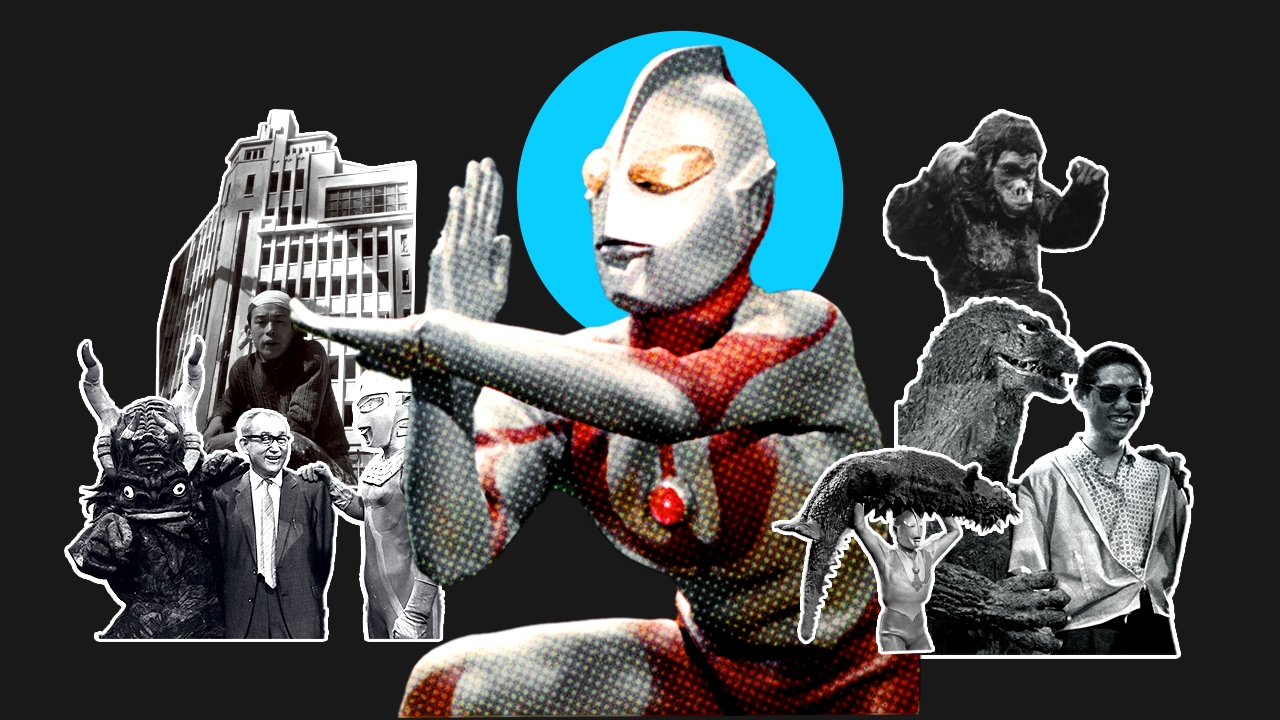
Many people are familiar with Ultraman, the giant hero from Japan who has captivated children around the world for 60 years. But did you know that at one point, the copyright to Ultraman was actually held by a Thai person?
Introducing a new show "Tee Lang Wat" Hosted by Tee and Wat This program invites you to discuss a variety of topics that arepop culturefrom the past, which we have shared experiences with. Some things that were once trendy in the past aren't justfashionthat simply passed, but many contain interesting stories and meaningful content. For those who want to feel nostalgic and hear tales that combine history andfun facts,or stories many might not have known before,
as children, everyone probably hada superheroin their hearts—through cartoons, movies, and more. But today, we'll talk about Ultraman, the superhero from the M78 star cluster, where every episode features monsters invading. The image is of the Earth Defense Force always losing. Ultraman can fight for only three minutes, after which he must unleash his light attack. There are many Ultraman characters forming a family, and there's also a long-standing copyright drama between Thailand and Japan that has finally concluded.
The first Ultraman series leans more toward science than fantasy, fitting into the sci-fi genre. Each monster appearing in the story has a lore that feels plausible—such as prehistoric creatures said to be survivors from ancient times or certain types of dinosaurs. Some arerobots,or aliens from outer space.
There are many Ultraman characters, but the first series featured only one. New series introduce new Ultramen, though sometimes older ones reappear. Scenes where Ultraman siblings unite are spectacular—showing grand, dramatic flair. As kids, we were amazed, but as adults, we realize these are the creations of imaginative adults—sometimes even more imaginative than children themselves.
Let's get to know the man considered both the father of Ultraman and globally recognized as the father oftokusatsu films,Eiji Tsuburaya. Understanding this man helps us better grasp Ultraman's identity.As a child,he was already watching,
Eiji Tsuburaya, was born in 1901 into a family involved in malted rice business. Originally, he dreamed of becoming a pilot and attended aviation school. However, before graduating, the school closed due to the death of its director, leading him to switch to electrical engineering studies. This shift gave him skills in invention and craftsmanship.
Over time, he began working in film. In 1919, he started as an assistant cameraman and developed new filming techniques such as double exposure and slow-motion photography, showcasing his highly creative mind.He was an extremelycreative individual.
While working in film, he saw the 1933 version of KING KONG, a black-and-white stop-motion movie, which inspired him to create monster films.
Eventually, he joined Toho Studios during World War II. On December 7, 1941, the Imperial Japanese Navy Air Force launched a surprise attack on Pearl Harbor. The Japanese government wanted propaganda films to convince citizens of victory in the Pacific War. Tsuburaya contributed as the special effects supervisor.Thisproject
resulted in a large-scale war film called "The War at Sea from Hawaii to Malaya" the next year. His realistic recreation of the Pearl Harbor attack was so convincing that Allied forces occupying Japan after the war reportedly mistook footage for actual Defense Ministry newsreels.
This wartime experience honed his skills in creating miniature sets andexplosion effects,which later became the foundation for "Godzilla"at Toho Studios. Tsuburaya also contributed to Godzilla's production, which became a legendary global phenomenon. As a special effects cinematographer, he was among Japan's leading figures during that era. In 1963, he founded his own company, "Tsuburaya Productions," where the Ultraman legend began.. . .
Fans of Ultraman might have heard the drama claiming “Ultraman actually belongs to Thailand.” This is a delicate matter.
We need to know a man named Somphot Saengdueanchai. As a child, Somphot worked as a photo shop employee and then became a photographer for the Siam Rath newspaper starting at age 15. He had a lifelong interest in photography and filmmaking. The story truly begins in 1962 when Somphot received a scholarship from Thailand's Government Savings Bank and Japan's Mitsui Bank to study film production and special effects at Toho Studios—the creators ofGodzilla.
At that time, Toho was the center of the " tokusatsu " industry, making Somphot's opportunity to study there invaluable. During this period, he met Eiji Tsuburaya, then the special effects director at Toho.Somphotformed a close bond with Tsuburaya, described in interviews as more than teacher and student—they had a father-son-like relationship.
Upon returning to Thailand, Somphot founded his own company, Chaiyo Films, in 1966 (B.E. 2509). This was the same year Ultraman first aired. The name "Chaiyo" was given by M.R. Kukrit Pramoj, who had been a photographer for Siam Rath, which M.R. Kukrit owned, so they were quite close. Later, the company was renamed Chaiyo Productions, the name familiar to many today.
Meanwhile, in Japan during the 1970s, Tsuburaya Productions faced difficulties following Eiji Tsuburaya's death. His second son, Noboru Tsuburaya, inherited significant debts. The company was also impacted by the global oil crisis, which greatly increased the production costs of tokusatsu films, causing accumulated debts across generations.Between 1973 and 1974, Noboru Tsuburaya traveled to Thailand to invite Somphot, with whom he was already acquainted, to collaborate on film projects. This led to two historically significant films: "Yak Wat Jaeng Meets Jumbo Ace" and "Hanuman Meets the Seven Ultra Brothers," both highly successful. Noboru entrusted Somphot and Chaiyo Productions with the rights to distribute and broadcast the Ultraman series in Thailand.This confirms that Tsuburaya and Somphot had a relatively good relationship.However, as time passed, in 1996, a year after Noboru's death, Somphot Saengdueanchai presented a one-page document claiming it was a contract signed by Noboru on March 4, 1976. The document stated that Noboru, as company chairman, granted Somphot and Chaiyo Productions "perpetual" rights to seven early Ultraman series (the first Ultraman siblings set), the Jumbo Ace series, and rights to co-produced films, "covering all territories outside Japan."Somphot claimed this massive right was granted because, during the mid-1970s, Tsuburaya Productions faced severe financial problems. He said he provided significant financial support—about 200 million yen—in loans or investments to sustain the company. In his view, Noboru repaid this by permanently granting overseas rights to Chaiyo Productions.Looking at the Thai court's decision, Tsuburaya filed a lawsuit against Somphot, and the court sided with Tsuburaya, agreeing the contract wasnonsensical.The dates Somphot cited for Noboru signing the contract did not match Noboru's passport records. Several factors led the Thai court to believe the contract was forged. In 2008, the court ruled in favor of Tsuburaya—so the score was tied at 1–1.The decisive battle was in the U.S. courts, which differ greatly from Japanese and Thai courts, especially regarding the "discovery" process requiring both parties to disclose documents, communications, and witnesses in detail during trial.
This case dragged on until 2020—nearly 20 years—when the U.S. court ruled that the contract Somphot claimed was fake. This ruling ended the international dispute (beyond this, the only option would be to take the case to outer space). It prohibited Somphot's group from claiming any Ultraman rights, revoked all copyrights back to Tsuburaya, including the nationally treasured film "Hanuman Meets the Seven Ultra Brothers," and ordered Somphot to pay over $4.5 million in damages and legal fees to Tsuburaya.In summary, despite past claims that Ultraman's copyright belonged to Thailand, the latest and globally accepted legal conclusion is that Ultraman belongs to Japan.Today, Ultraman is truly aniconic
figure of its era. New Ultraman characters continue to be created, delighting children of new generations.As for"Tee Lang Wat,"the next episode will cover a different topic. Stay tunedevery Thursday, except alternate Thursdays, at 7:00 p.m.
on the YouTube channel
Thairath Studio Channel.
Watch the full clip here.