

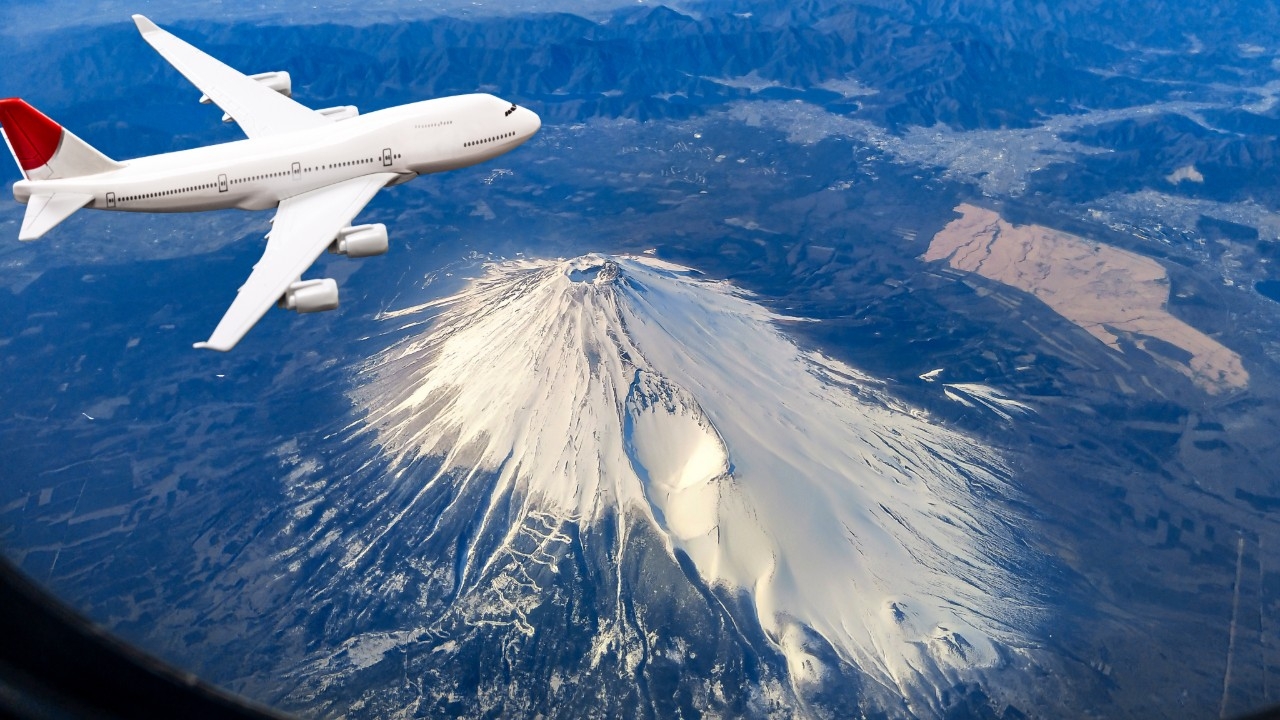
For those planning to visit Japan in 2026 and want to experience the beauty of the national symbol " Mount Fuji " from the sky, a common question arises: " Which side of the plane offers a view of Mount Fuji? " for both the outbound and return flights—information airlines might not have shared before.
Thairath Online has compiled information and tips on choosing airplane seats for flights on the Bangkok-Tokyo and Tokyo-Bangkok routes, to help you book seats in advance and guarantee beautiful photos ofMount Fuji or " Fujisan " like no other.
Mount Fuji (Mt. Fuji) sits between Yamanashi and Shizuoka prefectures. Standing 3,776 meters tall, it is Japan’s highest mountain. Choosing a seat to see Mt. Fuji depends on the flight’s direction. The most popular route is from Bangkok to Tokyo, landing at one of two main airports: Narita (NRT) or Haneda (HND). The details are as follows:
Outbound (Bangkok - Tokyo) : Choose a seat on the left side. As the plane enters Japanese airspace and descends toward Tokyo, Mt. Fuji appears on the left side window. On daytime flights or those arriving in early morning, passengers seated on the left side have the best chance to see Mt. Fuji clearly.
Return (Tokyo - Bangkok) : Choose a seat on the right side. Conversely, when departing Tokyo to return to Thailand, the flight path positions Mt. Fuji on the right side of the aircraft. Booking a window seat on the right side allows you to say farewell to Fujisan with beautiful photos from the airplane window before heading home.
In summary, answering the question "Which side of the plane shows Mt. Fuji?" For the Bangkok-Tokyo route: Sit on the left side outbound. Sit on the right side inbound. Knowing this tip and booking early increases your chance to begin your Japan trip with an impressive aerial view of Mt. Fuji that’s hard to find elsewhere.

The optimal time to spot Mt. Fuji from the plane is early to late morning (approximately 06:00 to 10:00). It should be a clear day with minimal clouds or haze.
Recommended flights are overnight departures from Bangkok arriving at Narita or Haneda airports in the morning. This timing coincides with sunrise, casting sunlight perfectly on the mountain’s peak. Morning weather tends to be stable, with fewer clouds forming compared to afternoons, greatly enhancing the chance to see Mt. Fuji.
The season offering the clearest and most beautiful views of Mt. Fuji is winter (December through February). During this time, the skies are usually clear of rain clouds, and importantly, Mt. Fuji’s summit is capped with snow—a classic and stunning image. Next best viewing periods are late autumn (November) and early spring (March to April).

Even if you choose the right side and travel in the right season, good preparation helps capture great photos. Examples include:
1. Avoid "window seats over the wing".
Even if you book a window seat on the left side (outbound) or right side (inbound), if your seat is directly over the wing (mid-plane), the wing may block your view of Mt. Fuji. It’s best to book seats either forward of or behind the wing.
2. Prepare 30-40 minutes before landing.
Mt. Fuji won’t be visible the entire flight. On flights toward Tokyo, it usually becomes visible about 30-40 minutes before landing. Have your window shade open and your camera ready during this time.
3. Listen for announcements from the captain.
On clear-weather flights with good visibility, many captains kindly announce over the speaker to notify passengers to look out the window. If you hear this announcement near landing,immediately look for Mt. Fuji.4. Clean your window.
Though a small detail, some airplane windows have scratches or smudges. Gently wiping the inside of the window before taking photos can reduce reflections and improve image clarity.
However, even with the right seat and preparation, you might not always see Mt. Fuji due to factors like weather, season, flight time, and route changes caused by wind direction or weather conditions, which can alter your view.