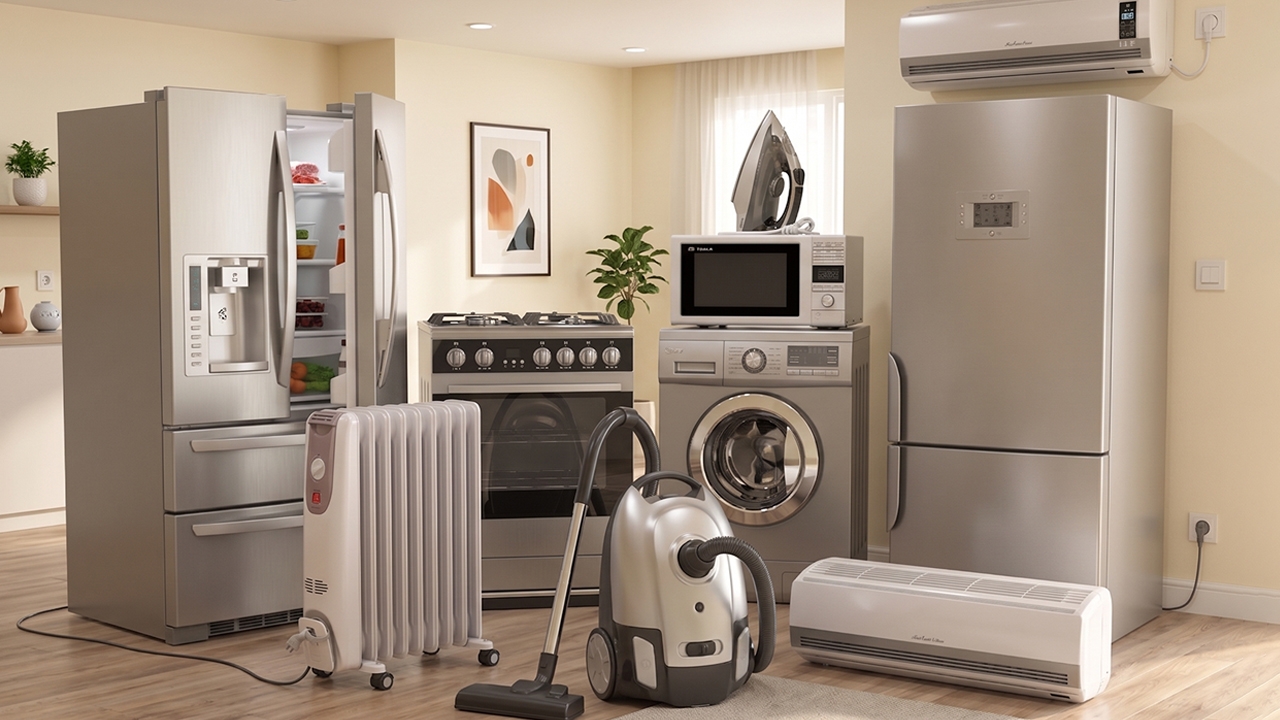
The issue of "high electricity bills" often troubles every household, especially when using appliances without knowing their actual energy consumption. Thairath Online takes a deep dive into this topic. The top 10 household appliances that consume the most electricity. Based on maximum power consumption (watts), ranked from lowest to highest, so you can identify the main causes of high electricity bills, along with "power-saving tips" for each appliance you can apply immediately.
Top 10 electricity-consuming appliances with power-saving tips.
Rank 10: Rice cooker (consumes about 500 - 1,000 watts).
Although a staple kitchen appliance in Thai households, leaving it plugged in constantly can also cause your electricity bill to rise.
- Power-saving tips. Cook just enough rice for the number of diners, unplug immediately once done, and regularly clean food residue on the heating plate at the pot's bottom to improve heat transfer efficiency.
Rank 9: Microwave oven (consumes about 1,000 - 1,500 watts).
This appliance provides convenience but draws significant power in a short time.
- Power-saving tips. Avoid putting frozen food directly into the microwave; let ice melt first to reduce heating time. Use microwave-safe containers that help distribute heat evenly.
Rank 8: Electric skillet / induction cooker (consumes about 1,000 - 1,500 watts).
Popular cooking devices for dormitory and condominium residents, requiring high heat.
- Power-saving tips. Prepare ingredients before turning on the stove. When cooking is nearly finished, turn off the switch early; the residual heat will complete cooking without extra electricity.
Rank 7: Vacuum cleaner (consumes about 1,000 - 2,000 watts).
Its motor requires high power to generate effective suction.
- Power-saving tips. Sweep up large debris first with a broom. Regularly empty the dust bag and clean the air filter, as a full bag makes the machine work harder and consume more power.
Rank 6: Hair dryer (consumes about 1,000 - 2,200 watts).
A small appliance but with significant power use due to heating elements and fan motor.
- Power-saving tips. Towel-dry hair thoroughly before use and select an appropriate heat level; it's not always necessary to use the highest setting.
Rank 5: Electric kettle (consumes about 1,500 - 2,500 watts).
An essential item for coffee and instant noodle lovers, but boiling cold water requires a lot of energy.
- Power-saving tips. Boil only the amount of water you need; avoid filling the kettle fully if making just one cup of coffee. Unplug immediately once water boils.
Rank 4: Electric iron (consumes about 1,000 - 2,800 watts).
An appliance that requires continuous high heat; the longer you iron, the more power it uses.
- Power-saving tips. Iron a large batch of clothes at once, starting with fabrics that need lower heat. Unplug the iron 2-3 minutes before finishing and use the residual heat to iron thinner fabrics.
Rank 3: Washing machine (with hot water system) / dryer (consumes about 2,500 - 3,000 watts).
Standard washing machines consume only a few hundred watts, but those with hot water functions or dryers use much more power.
- Power-saving tips. Load clothes to a suitable capacity, choose normal water temperature washing, and if weather permits, air dry clothes instead of using the dryer.
Rank 2: Air conditioner (consumes about 1,200 - 3,300 watts).
The main factor driving Thai electricity bills sky-high in summer; cooling large spaces requires a powerful compressor.
- Power-saving tips. Set temperature to 25-26°C, use oscillating fans to distribute cool air, clean air filters at least twice a year, and turn off the AC 30 minutes before leaving the room.
Rank 1: Water heater (consumes about 3,000 - 8,000 watts).
The "champion" of household electricity consumption, using high-heat coils to rapidly warm water as it flows through.
- Power-saving tips. Choose a model with wattage appropriate for your area's climate, set the heat to a moderate level—not too hot—and importantly, switch off both the power and water valve immediately when not showering. Avoid leaving water running while soaping or shampooing.
Being aware of the energy consumption rates of the "highest electricity-consuming appliances" is an important first step in managing household expenses. By making small behavioral changes following the power-saving tips above, you can not onlysave money in your walletbut also help the nation reduce energy consumption.