

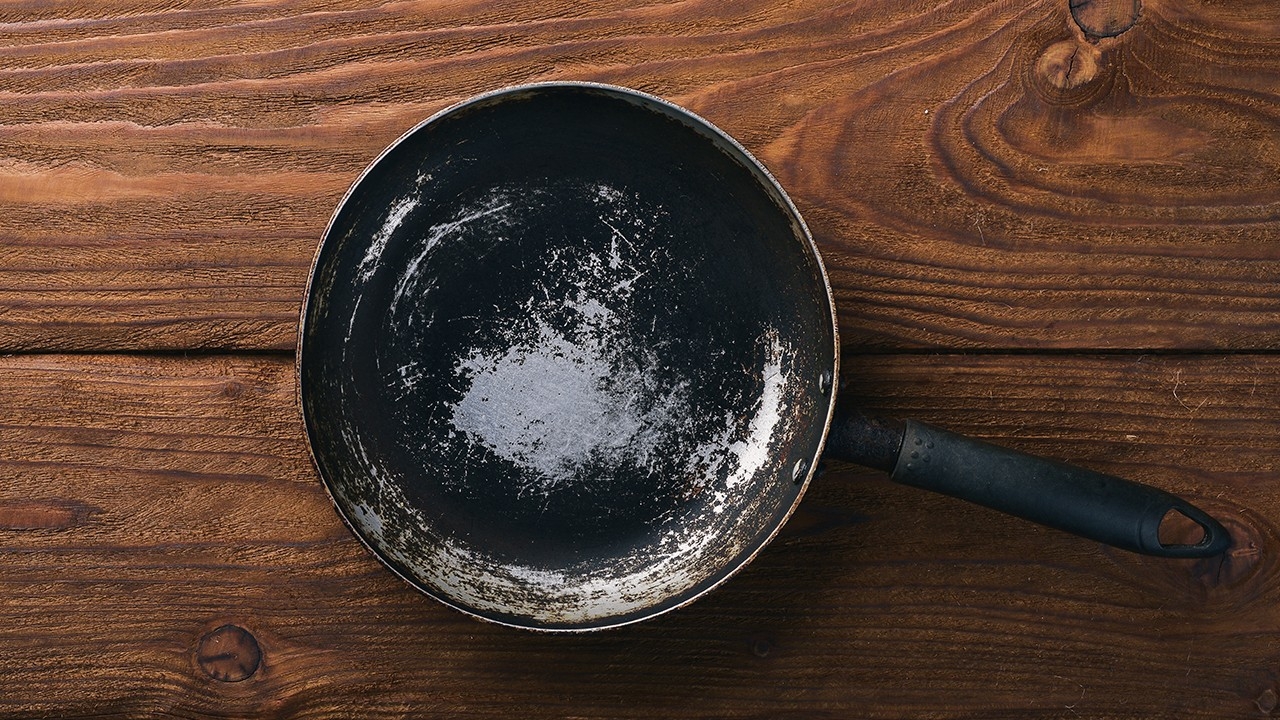
Clearing up doubts "Is flaking Teflon dangerous?" If you accidentally ingest flakes of the coating, is there a cancer risk? Check the medical facts along with advice on whether to keep using or discard your pan once it starts to deteriorate.
Many people may have experienced their favorite kitchenware, like a "Teflon pan," getting scratched or its coating peeling off, raising concerns such as "Is flaking Teflon dangerous?" If fragments of Teflon mix into food and are accidentally eaten, does that increase cancer risk? Thairath Online has gathered medical facts and expert recommendations to share.
Teflon is the trade name for a polymer compound chemically known as Polytetrafluoroethylene (PTFE). It is highly heat resistant, chemically stable, and extremely slippery. Therefore, it is commonly used as a coating on cookware surfaces to prevent food from sticking, making cleaning easier and reducing the amount of oil needed.

Regarding the question "If the coating flakes off and contaminates food, is it harmful to the body?" Associate Professor Dr. Jesada Denduangboripant, a biology lecturer at the Faculty of Science, Chulalongkorn University, stated that Teflon (PTFE) is highly stable and does not react with the human body. If flakes are swallowed, the body cannot absorb this substance, and it will be excreted normally. Therefore, Teflon flakes entering the body are not harmful and are not directly toxic.
What many worry about is the carcinogen issue. Information from the National Cancer Institute, Department of Medical Services, clarifies that the Teflon coating on pans is not a carcinogen. However, in the past, the manufacturing process of Teflon sometimes involved using PFOA (Perfluorooctanoic Acid), a PFAS chemical linked to health problems and certain cancers. Today, the U.S. Environmental Protection Agency (EPA) and industry worldwide have phased out PFOA use in cookware production between 2013 and 2015. Thus, new Teflon pans on the market are free from this substance.
Although Teflon flakes are not toxic, continuing to use a damaged pan may pose other health risks, including:
If the pan has only minor scratches, it may still be used temporarily with caution, avoiding metal utensils. But if the coating peels off in sheets or the metal surface is clearly visible, experts recommend "replace it immediately." You should not hesitate or force continued use, for the sake of your family's health.
Regarding the question "Is flaking Teflon dangerous?" The answer is that swallowing flakes of Teflon coating is not harmful and the substance is not absorbed by the body. However, using deteriorated pans negatively affects food quality, causing sticking and burnt food, and may risk heavy metal contamination. Therefore, when your pan flakes or degrades, replace it with a new one. Choose cookware that meets safety standards and clearly states it is free of harmful chemicals for maximum safety.