

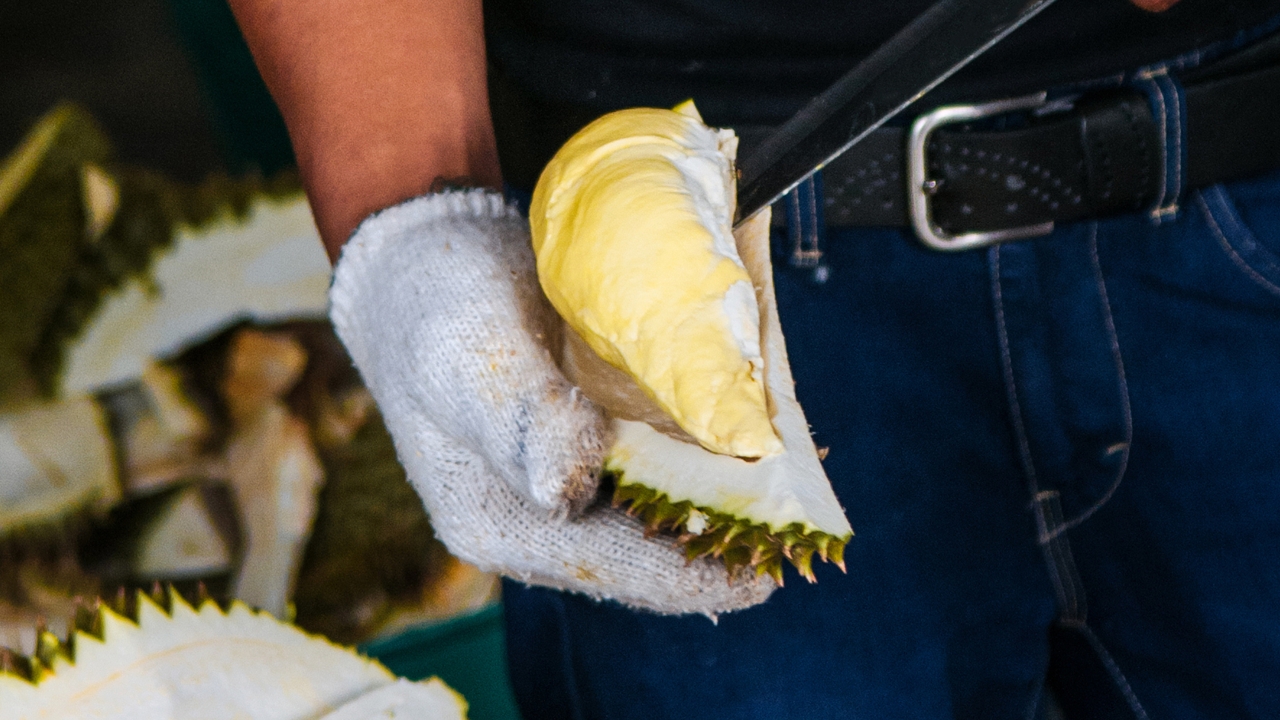
Every durian season, the dilemma durian lovers face at the stall is whether to choose between "whole fruit sold by weight" or "pre-shelled flesh."Whole durian sold by weight.Or paying more to buy only the "pre-shelled durian flesh." Many believe buying the whole fruit yields more edible flesh and better value, but is that really true? Today, Thairath Online will break down the equation and reveal the hidden costs clearly.
Before looking at the numbers, we need to understand the structure of durian. Statistically, one durian consists of about 70% "shell and seed" and only around 30% "edible durian flesh" (this may vary slightly depending on shell thickness and seed size).
Suppose you want exactly 1 kilogram of pure durian flesh. Let's compare based on average market prices. Option 1: Buy pre-shelled durian flesh. Ready-to-eat type, averaging about 600 - 800 baht per kilogram in the market, giving you 1 kilogram of pure durian flesh.
Option 2: Buy durian sold by weight (whole fruit). Market price averages about 150 - 200 baht per kilogram. To get 1 kilogram of edible flesh (based on the 30% rule), you must buy a whole durian weighing about 3.3 kilograms. Calculating the price, assuming 150 baht per kilogram: 3.3 x 150 equals 495 baht for 1 kilogram of durian flesh.
Certainly,in terms of "amount of money spent," buying whole durian by weight is about 20% - 30% cheaper than buying pre-shelled flesh, saving roughly 100 - 300 baht per kilogram of durian flesh. Although the numbers show buying whole fruit is cheaper, in reality, purchasing by weight carries risks and "hidden costs" you may not expect, as follows.
Most importantly, the quality risk. Because when buying a whole durian, you can't see the flesh of every segment 100%. Sometimes you might get a 'jackpot' of a thick shell like the Great Wall of China, large seeds, little flesh, or a hard core flesh resembling a kidney stone. If that happens, the initial value calculation instantly turns negative.
Also, consider your labor and time. Peeling durian requires skill, effort, and caution. Without the right tools or knowledge, you might end up with injuries instead. And troublingly, there's waste management. The 70% leftover shell is large, spiky waste that occupies trash bins and can emit unpleasant odors if left overnight. So which option suits you best?
Buying "whole durian by weight" suits those skilled at checking ripeness by tapping, who have trusted regular sellers offering guarantees, possess peeling skills and tools, and want to save the most money.
Certainly, if you lack skill or confidence in selecting durian, buying "pre-shelled flesh" is advisable.Ifyou want 100% certainty of perfectly ripe flesh to your liking, prefer to avoid peeling hassle, want no waste problems, and consider the extra 100-200 baht as "convenience and risk insurance cost,"
then value isn't always measured by the cheapest price but by your satisfaction and personal eating lifestyle.