

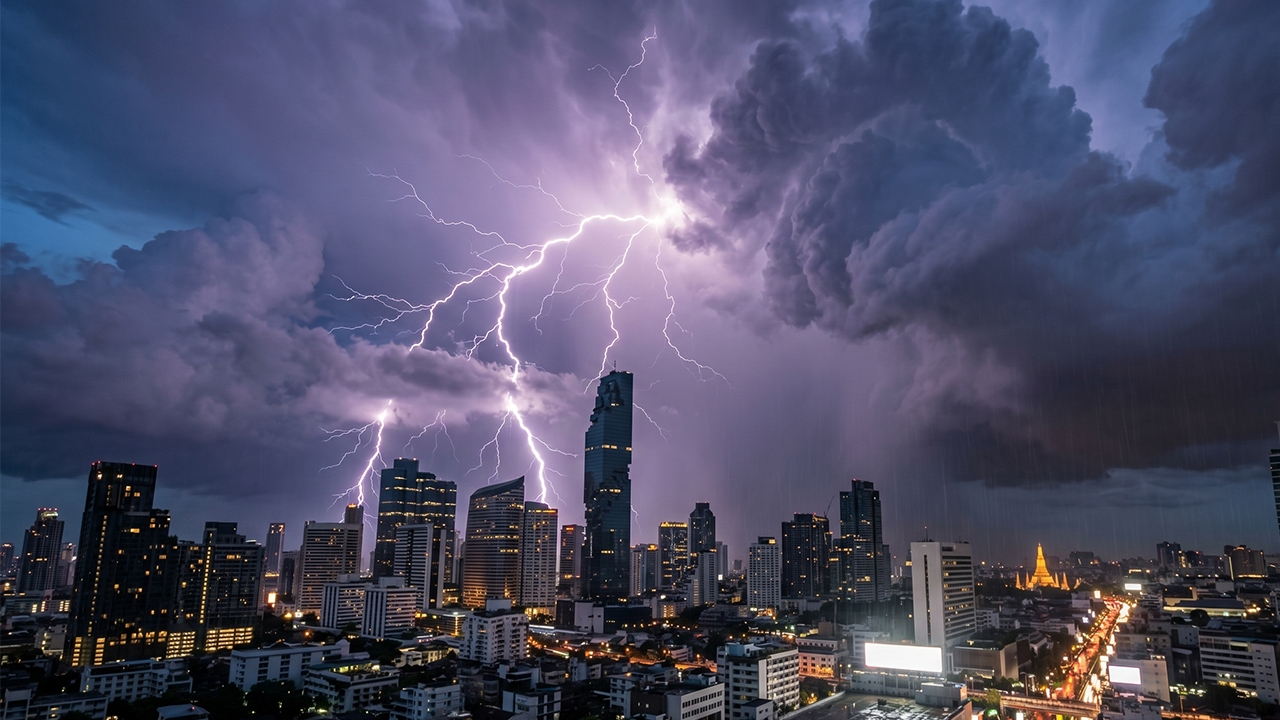
Whenever the rainy season arrives, many people often wonder "What causes lightning?" This natural phenomenon results from electrical discharges in clouds. Thairath Online will help find the answer, clarify whether wearing a gold necklace actually attracts lightning, and share ways to protect yourself from lightning dangers.
During the rainy season, a natural phenomenon commonly seen alongside thunderstorms is "lightning." Many people may still wonder exactly what causes lightning.
Information from the Meteorological Department states that lightning is a natural phenomenon caused by the release of electrical charges in the air, originating from "cumulonimbus" clouds, or thunderstorm clouds. Within these clouds, strong air currents cause water droplets and ice particles to rub against each other, generating electrical charges.
When the electrical potential difference reaches a certain point, a rapid transfer of charges occurs to balance the difference. This sudden transfer produces a spark, which we call "lightning flash" and "lightning strike."

Electrical charge transfer can occur in several forms, divided into three main types:
1. Intra-cloud lightning occurs when electrical charges move between positive and negative regions within the same cloud. This is the most common type.
2. Cloud-to-cloud lightning happens when electrical charges transfer from one cloud to another.
3. Cloud-to-ground lightning is caused by electrical charges moving from the base of the cloud (negative charge) to the ground (positive charge). This type is the most dangerous to human life and property.
The answer is no. Wearing a gold necklace or other metal jewelry does not attract lightning or cause it to strike you, contrary to common belief. The main factors causing lightning strikes are "height" and being a prominent point in an open area, providing the shortest path for electrical current from the cloud to the ground.
When thunderstorms occur, the most important thing is not to worry about quickly removing gold necklaces but to seek safety, such as taking shelter inside a fully roofed building or a car (with windows closed), and avoiding open spaces, large trees, or bodies of water.
Knowing what causes lightning, the key is learning how to respond safely. The National Institute for Emergency Medicine recommends the following precautions during thunderstorms:
The phenomenon "What causes lightning" can be explained by basic scientific principles of friction and electrical charge transfer within thunderstorm clouds. Although it is a natural occurrence that cannot be prevented, having knowledge and strictly following safety advice can reduce risks and protect lives and property.
Read related articles