

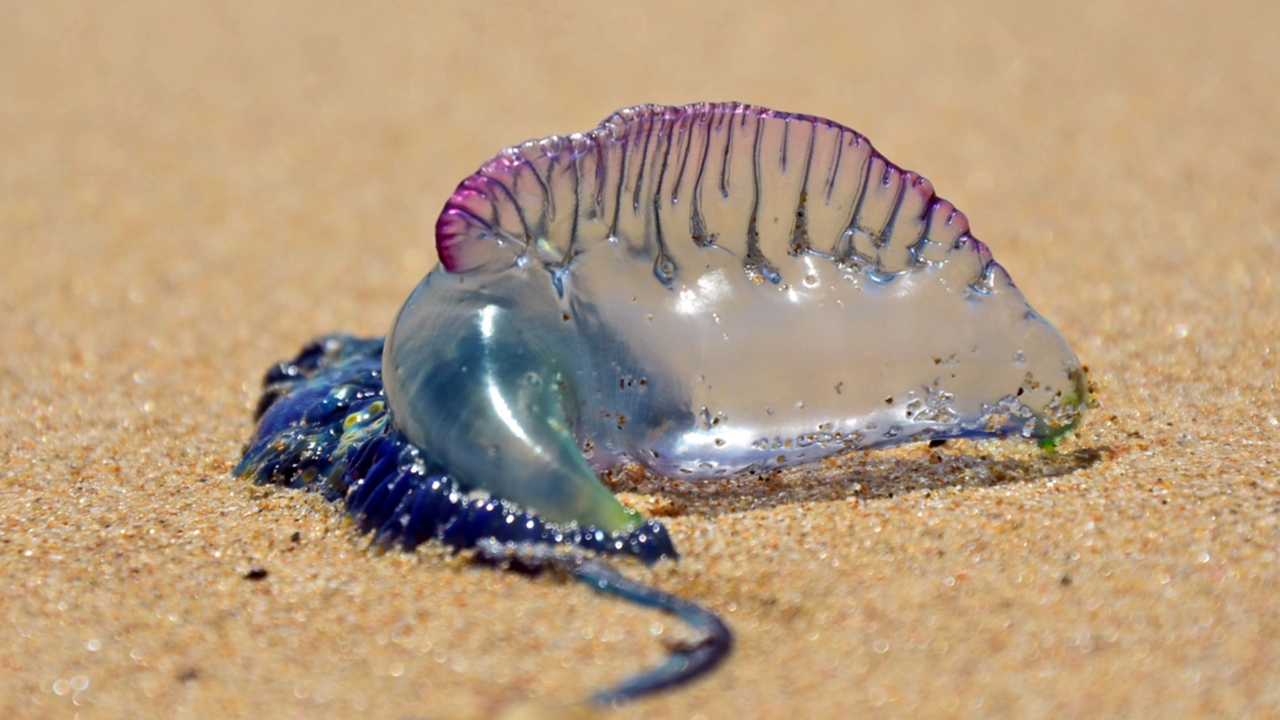
Regarding the case of the Portuguese Man o' War jellyfish being washed ashore at Laem Tonod Beach in Mu Ko Lanta National Park, Ko Lanta District, Krabi Province, authorities have temporarily closed the beach and warned tourists not to touch it under any circumstances.
When it comes to marine animals that are beautiful in appearance but carry hidden dangers, the Portuguese Man o' War jellyfish is one creature tourists should be especially cautious of. Although it resembles an ordinary jellyfish, it is actually a highly venomous marine animal that can cause intense burning pain and, in some cases, can be life-threatening.
The Portuguese Man o' War jellyfish (English: Portuguese Man o' War) is a marine creature notable for its floating part, which is blue or purplish-blue in color and resembles a small balloon or sail. This distinctive shape is why it is called the Portuguese Man o' War, named after the resemblance to the hats worn by Portuguese sailors in the past. It has long tentacles hanging beneath the water used to catch prey.

The Portuguese Man o' War jellyfish has a floating section like a balloon or sail, colored blue, purple, or pinkish-blue, clearly visible on the sea surface. Its tentacles below may extend several meters and are the venomous part used to capture prey and defend against natural predators.
In Thailand, it can be found in both the Gulf of Thailand and the Andaman Sea, especially during the monsoon season or periods of strong currents and winds, which may carry them close to shore or strand them along coastlines. Swimmers should closely follow official warnings.
The danger lies in its tentacles, which are covered with tiny venomous cells. Upon skin contact, these cells immediately release venom, causing severe burning pain similar to being scalded. Common symptoms include:
Proper first aid is crucial because incorrect care can trigger more venom release. If stung, the following initial steps should be taken:
1. Get out of the water immediately. If stung while swimming, exit the water as quickly as possible to reduce the risk of drowning or further tentacle contact.
2. Avoid rubbing or scratching the affected area. Do not rub, scratch, or scrub the sting site, as this can cause the venom cells to rupture and release more venom.
3. Rinse with seawater. Gently rinse the affected area with seawater to wash away any remaining tentacles. Avoid using freshwater, which may stimulate more venom release.
4. Carefully remove tentacles. Use tweezers, gloves, or a protective barrier to carefully remove any tentacles stuck to the skin.
5. Apply heat compress. After removing tentacles, soak or apply a warm compress at approximately 40-45 degrees Celsius for 20-45 minutes to help relieve pain and lessen venom effects.
6. Seek medical attention immediately if symptoms worsen. If experiencing chest tightness, difficulty breathing, fainting, loss of consciousness, or unusually severe pain, promptly go to a hospital.

The Portuguese Man o' War jellyfish is a strikingly beautiful marine animal but carries potent venom in its long tentacles that can cause injuries. Learning how to identify it and administer proper first aid is essential to ensure safe sea travel and reduce risks.
Related news