

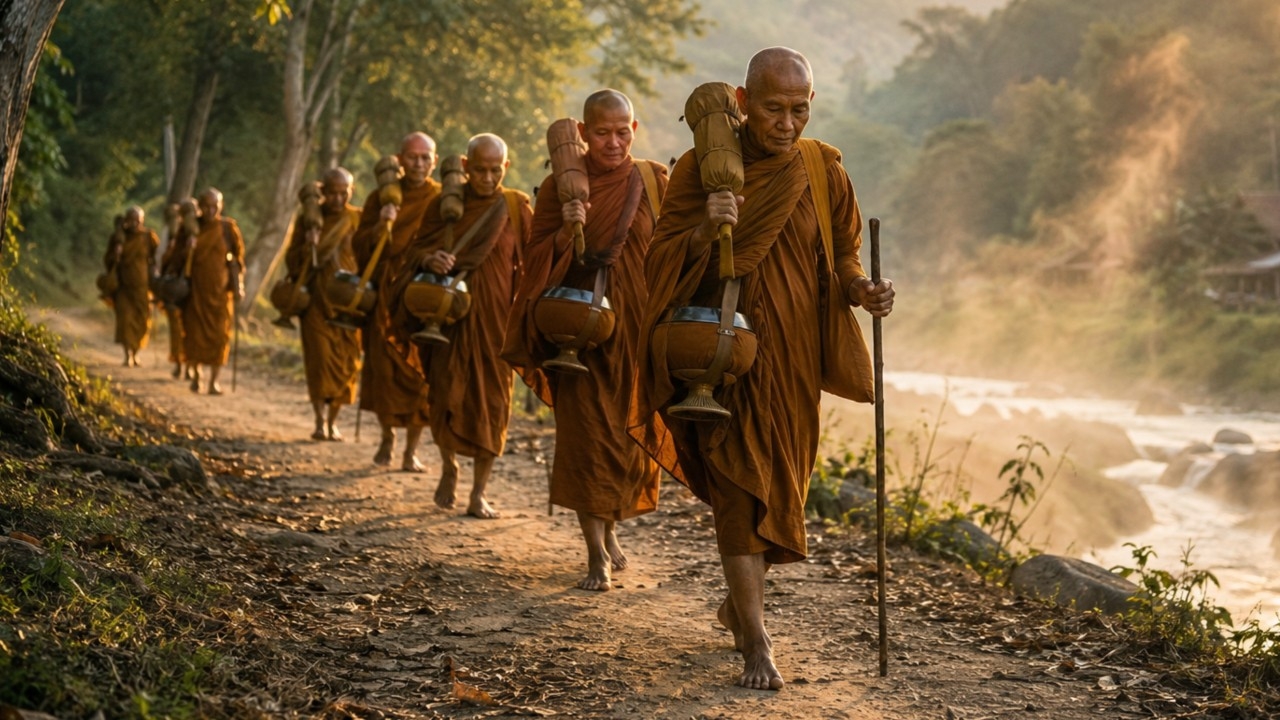
When the term" Phra Thudong "is mentioned, many people often picture monks carrying patched cloaks, walking barefoot into forests, crossing mountains, or traveling to various places. However, this common perception is just a familiar image. In Buddhism, the term" Thudong "has a deeper meaning than just traveling and does not mean that every monk practicing Thudong must live in the forest or travel constantly.
According to the book" Thudong: What, Where, and Why? ? "by Phra Brahmakhunaporn (P.A. Payutto), published as a Dhamma teaching resource, the meaning of Thudong is clearly explained. Thairath Online has compiled this information for readers.
The term" Thudong "comes from the Pali word" Thutangka "which combines the words" Thut "meaning to refine defilements, and" Angka "meaning component or practice.
Therefore, Thudong means a practice to refine defilements or qualities of those who train themselves to live simply, frugally, contentedly, and conducive to Dhamma practice.
The main purpose of observing Thudong is not to seek hardship but to reduce attachment to life's necessities, allowing time and focus to study and practice Dhamma fully.

Although living in the forest is one of the Thudong rules, it does not mean that every monk who observes Thudong must reside in the forest continuously. The measure of a Thudong monk lies in voluntarily adopting practices to refine defilements, not merely living in the forest.
In Buddhist teachings, there are 13 Thudong rules covering lifestyle aspects such as robes, meals, and residence, with living in the forest being only one of them.
Moreover, observing Thudong is voluntary; monks can decide the duration—from a few days, several months, one rainy season retreat, to a lifetime. It is a personal commitment to self-discipline, not a ritual requiring others' permission.
The common image of monks carrying patched cloaks walking through forests arises from some monks adopting the practice called" Rukkhamulikangka "or living at the roots of trees, as well as" Aranyikangka "meaning living in the forest.
After the end of the rainy season retreat, monks observing these practices often travel to various places, resting under tree roots, which requires constant movement. This leads the public to think travel is the essence of Thudong, but in reality, walking is not the core of Thudong; it is merely a result of choosing to observe certain practices.

The 13 Thudong rules are practices monks may choose to adopt based on their capacity and suitability; they are not required to observe all, and some rules cannot be held simultaneously. According to the Information and Library Division, Sukhothai Thammathirat Open University, the details are as follows: 1. Pang Sukulikaṅka: Observing wearing robes made from discarded cloth.
Using cloth from rubbish piles, dust heaps, discarded by others after childbirth, or used to wrap corpses—not cloth given by laypeople. Thudong monks collect, wash, and sew these fabrics into robes.
2. Tejiworikaṅka: Observing wearing only the three robes.
Using only the three necessary robes: the lower robe (sanghati), the upper robe (uttarasanga), and the outer robe (sanghati) used for warmth, sitting, sleeping, dusting, or as a substitute when washing other robes.
3. Spatanajariṅka: Observing going on alms rounds.
Going on alms rounds to laypeople who offer food daily in sequence, without skipping or choosing alms, regardless of wealth or food quality, and accepting offerings from anyone in order.
4. Bindhapatkaṅka: Observing eating only food obtained on alms rounds.
Eating only the food received during alms rounds; not accepting other food offerings from laypeople.
5. Ekasanikaṅka: Observing eating once daily at one sitting.
Sitting and eating only once a day, finishing the meal completely without eating or drinking anything else except water afterward.
6. Pattabindhikaṅka: Observing eating from only one container (the alms bowl).
Eating all food collected in the alms bowl, whether savory or sweet, to avoid attachment to specific tastes.
7. Khlupatchapattikaṅka: Observing refusing additional food once enough has been accepted.
Once a monk decides they have enough food, they will not accept any further offerings, even if the food is appealing.
8. Aranyikaṅka: Observing living in the forest.
Practicing meditation exclusively in the forest, avoiding communities to prevent distractions, thus protecting against accumulating defilements.
9. Rukkhamulikangka: Observing living at the roots of trees.
Residing only under trees, not in huts or buildings, avoiding any constructed roofs or shelter.
10. Apphogasikaṅka: Observing living in the open air.
Living only outdoors, not under any shelter including tree roots, to avoid attachment to dwellings.
11. Sosanikaṅka: Observing living in cemeteries.
Dwelling in cemeteries, avoiding comfortable accommodations, to constantly contemplate death and avoid negligence.
12. Yathasanthatikaṅka: Observing accepting any dwelling offered without seeking comfort.
Not seeking comfortable or preferred residences; accepting and staying wherever provided.
13. Nesajjikaṅka: Observing sitting (not lying down).
Only sitting, standing, or walking; abstaining from lying down or reclining so that the back does not touch the ground. If very sleepy, monks may sleep sitting to avoid indulgence in sleep.
What are the benefits of monks observing Thudong?

training monks to live simply, reducing worries about basic needs, and refining their defilements to aid in meditation practice. Living frugally and contentedly provides more time and freedom to study, practice Dhamma, and develop the mind. This simple lifestyle also enables monks to travel to communities to spread Dhamma and guide people in remote areas. Although the familiar image for Thai people is monks carrying patched cloaks walking into forests, in truth,
"Thudong " does not only mean traveling or living in the forest. It is a set of practices to refine defilements, train oneself to be frugal and content, and live simply to facilitate study and practice of Dhamma.Sources:
Wat Yannawasakawan,Information and Library Division, Sukhothai Thammathirat Open University