

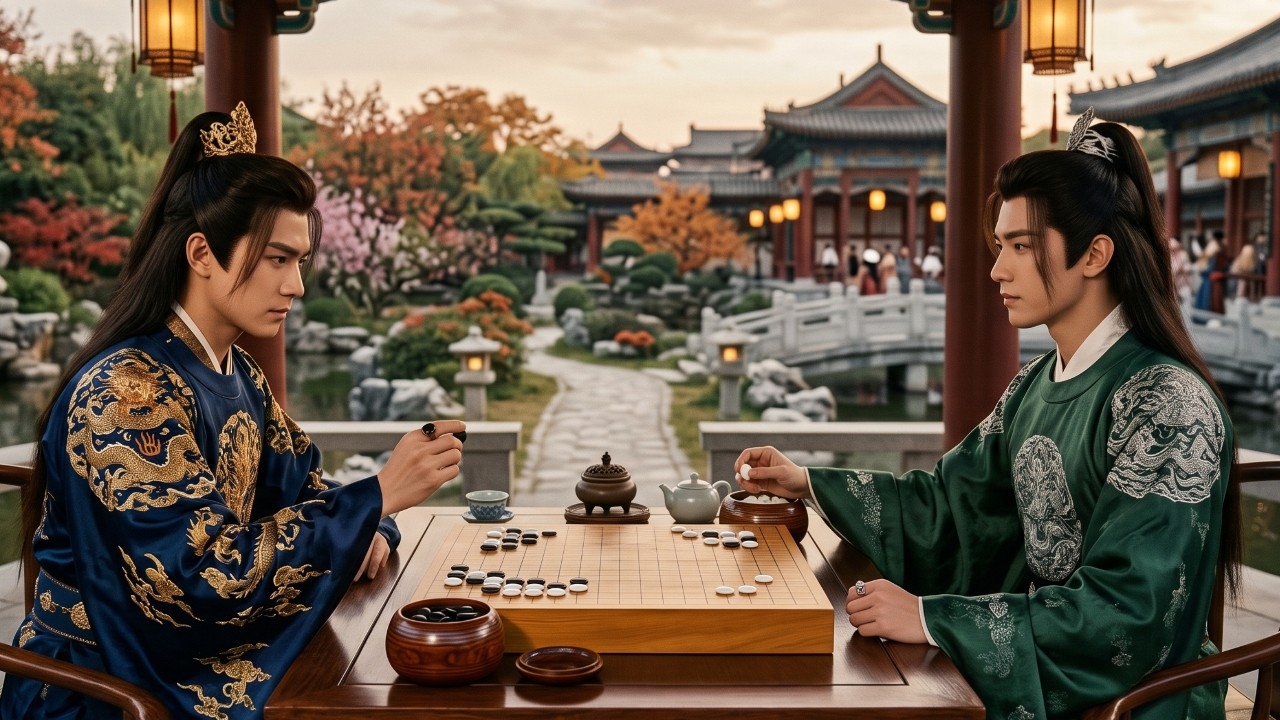
A closer look at " the Go board in Chinese series ", a classic prop frequently appearing in strategy and immortal genres, decoding four key hidden meanings that reveal it as more than a board game but a heated battlefield of war and politics.
For fans of period Chinese series—whether immortal tales, martial worlds, or palace throne struggles—a familiar scene is characters from opposing sides sitting face-to-face in a pavilion with a " Go board in Chinese series" placed centrally, accompanied by the clear sound of stones hitting the board.
This ancient board game is not included merely for scene aesthetics. In Chinese culture, Go, or "Weiqi" (围棋) is one of the four high arts of ancient Chinese scholars (alongside zither playing, chess, calligraphy, and painting).
Historical records show Chinese Go has a history exceeding 3,000 years, originating before the Common Era. According to ancient Chinese legend, Emperor Yao invented Go to teach his son discipline, emotional control, and systematic thinking.
Later, it became a tool to train the intellect of emperors, generals, and scholars. Thus, characters playing Go in series immediately signal to viewers that they are educated, refined, and wise individuals.

Careful observation shows Go board scenes often occur at pivotal story moments because the board symbolizes these elements.
1. A simulated battlefield of "war and politics"
In strategy or historical series such as "The Advisors Alliance" or "Joy of Life," emperors, princes, or military strategists sit face-to-face intensely playing black and white stones. The square board represents "the world’s territory" with clearly defined borders,
while the stones symbolize "military forces" or "pieces in hand" of the powerful. Each move is not just about capturing opponent stones but about encircling territory and weakening enemies, reflecting palace politics and battlefield strategies.
2. A psychological game of mind-reading and probing
In many memorable scenes of popular series, protagonists and antagonists use the Go table as a place for negotiation or testing each other. Their surface conversation might be casual, about weather or general topics, but their moves are fierce and laden with hidden meanings.
The style of play reveals "personality traits" and "strategies" of the characters. Quick, reckless moves indicate impatience and exposed weaknesses; calm, deliberate play shows masterful planning. Sometimes "sacrificing a stone" signals political surrender or a warning in real life.
3. Ancient Go puzzles as turning points in fate
In immortal, fantasy, or martial world series, plots often involve "ancient Go puzzles"—boards left unsolved for centuries. The protagonist, a genius, makes a few moves to "break the puzzle," symbolizing overcoming great obstacles, unlocking family secrets, or accessing heavenly truths unreachable by ordinary people.
4. Modern series portray Go as a sport of intellect
Go boards are no longer confined to period dramas. Contemporary Chinese series have made Go a central theme as a professional sport and e-sport, as seen in acclaimed series like "Hikaru no Go" or "Go Into Your Heart." These modern stories use Go to reflect determination, friendship, and the growth of a new generation, transforming the old image of political intrigue into a space for intellectual competition and pure dreams.
The exquisite ancient board games featured in major productions often reveal their status through the materials used for the board and stones.
Next time you watch your favorite Chinese series and see a Go playing scene, pay attention to the characters’ eyes, their gestures placing stones, and their dialogue, as it may mark a crucial plot twist subtly crafted by the director for viewers to share the suspense.