

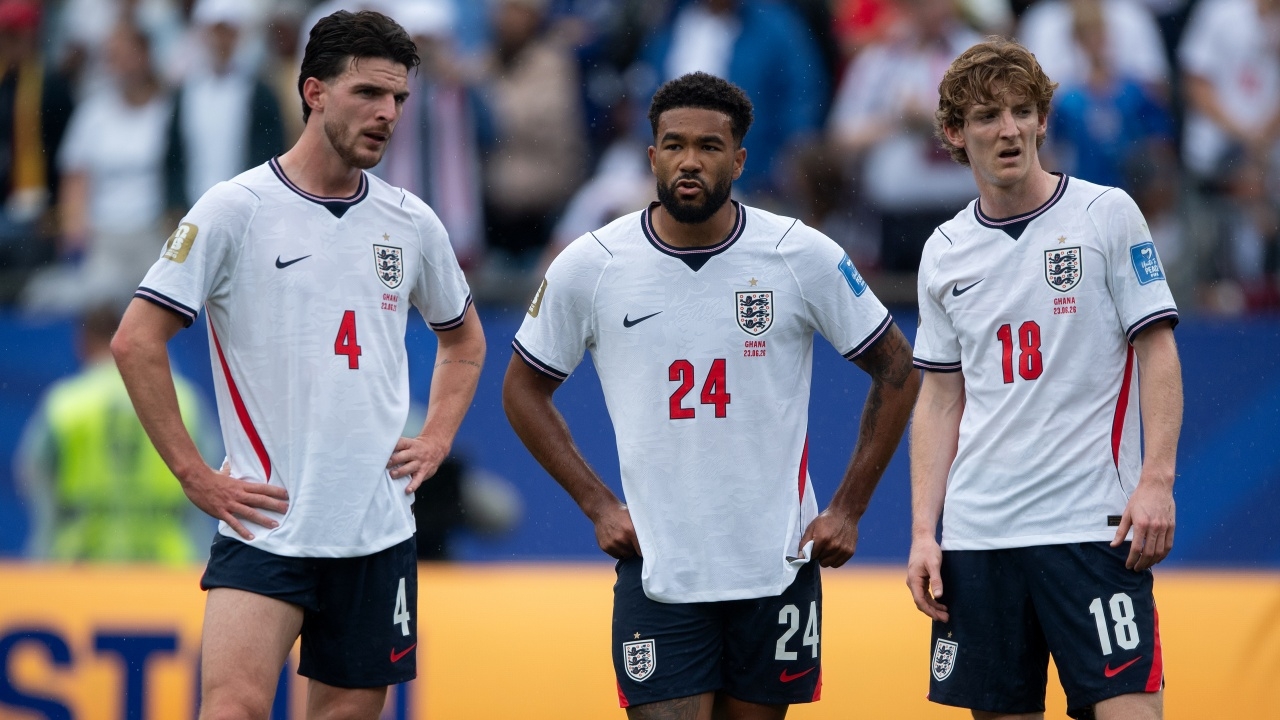
From Declan Rice to Ronaldo: Decoding footballers' behavior of pulling up their shorts during matches.
The Athletic news agency published an article titled "Ronaldo, Neymar, Rice: Why do male footballers pull up their shorts during matches?" which can be translated as: Why do Ronaldo, Neymar, and Rice like to pull their shorts up during the game?
The Athletic observed that many players in the 2026 World Cup frequently pull or fold their shorts up until they become very short—a sight familiar to football fans. For example, in England's 0-0 group stage draw against Ghana, England midfielder Declan Rice from Arsenal rolled up one leg of his navy shorts before walking to the corner flag, exposing his thigh muscles. This behavior sparked various online theories, suggesting Rice's shorts length might be a secret signal related to how he would deliver the ball or the ball placement position.
Upon examining FIFA's equipment regulations—a document over 100 pages long—it was found that the section specifically about shorts spans five full pages.
The regulations detail the approved structure of shorts, forbidding zippers, pockets, or strings hanging outside the shorts. They also prohibit the use of multiple primary colors or player names and require the player's number to be clearly visible on the front of the shorts when the shirt is untucked.
However, FIFA does not set any limits on the shorts' length. This gap benefits players who prefer their thighs to be exposed to air for personal reasons.
Besides Rice, many famous players like Jack Grealish from Manchester City, former Germany international Lukas Podolski, former Brazilian left-back Marcelo, Leeds United's Dominic Calvert-Lewin—who requests smaller shorts for a tighter fit—Brazilian star Neymar, and most of the U.S. women's national team players also favor pulling up their shorts or wearing especially short ones.
The motivations behind pulling up shorts are complex and varied, with one of the most important factors being psychological and confidence-building aspects.
Martin Turner, a sports psychologist, explained that football involves open skills, which are free and expressive, and closed skills, which are controlled and still movements, like free kicks, penalties, or corner kicks.
Thus, adjusting or arranging shorts acts as a way to focus attention and calm the mind, helping players tap into their sports subconscious. Although this behavior may not directly affect performance, it helps alter the psychology of execution, stemming from the desire to control high-pressure, uncertain situations. This is similar to fishing communities' rituals, where the farther from shore, the more ceremonies are performed. When these rituals reduce anxiety and produce good outcomes, players repeat them until they become ingrained routines, often without conscious thought, serving as mental anchors.
Beyond rituals, outward appearance significantly impacts self-confidence. Turner noted that if athletes cannot express their true selves, they cannot perform at their best.
For example, Cristiano Ronaldo, preparing to take a free kick, pulls up his shorts to reveal his strong thigh muscles, reflecting his desire to appear powerful and intimidating on the field.
Another intriguing theory involves secret signaling. A set-piece coach from the UK's Women's Super League (WSL) shared that folding shorts might convey tactical signals, similar to baseball and American football signals used to communicate ball-throwing plans.
Functionally, footballers seek unrestricted movement. For instance, Stuart Pearce, former left-back for England and Nottingham Forest, requested shorter shorts in an era when most players wore baggy ones for mobility. Similarly, Joe Cole, former England and Chelsea midfielder, chose smaller shorts than teammates—adopting tactics from Italian legend and former teammate Paolo Di Canio—to reduce fabric space and prevent defenders from grabbing them easily.
Apart from tactical reasons, Rob Warner, former creative director and chief designer at Puma, pointed out that players' preferences often align with fashion trends of their era.
In early football history, shorts reached mid-calf in line with contemporary fashion. In the 1960s and 1970s, lengths rose above the knee. In the 1980s, shorts became tight and very short, sometimes inconvenient for play, to emphasize style, as seen in the eras of Peter Beardsley and Paul Scholes.
Then, from the 1990s to early 2000s, influences from hip-hop culture and Umbro's retro designs during the Premier League's early days shifted trends toward larger, baggier shorts.
Regarding current designs, Warner—who led the patenting of shorts for Italy's 2006 World Cup team—stated that shorts are designed with the back longer than the front to increase leg circumference for wider movement. This results in a fitted shape suitable for players with large thighs.
Additionally, Nike and adidas technologies have developed waistband elastics that rise higher at the back, keeping fabric away from the skin to reduce sticking when sweating in heat.
Ultimately, despite innovations in shorts design, footballers will continue adjusting how they wear them—pulling, rolling, or folding—for comfort or as secret signals to bring good luck on the pitch.
Source:The Athletic