

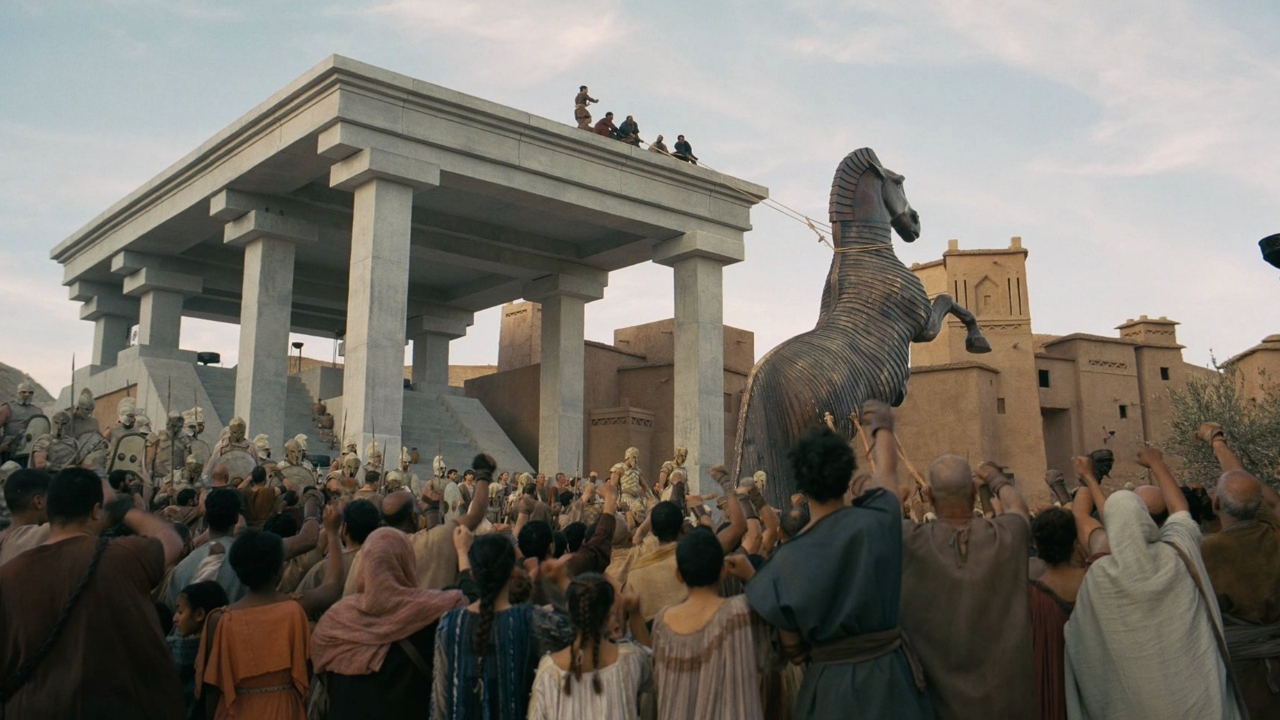
After the film The Odyssey (2026), the latest work by renowned director Christopher Nolan, which has attracted global movie fans, the name " Troy " has returned to public discussion. Many have begun to wonder whether the ancient city that served as the backdrop for the legendary Greek war actually existed in history or was merely a fictional setting in literature.
Although the epic The Odyssey by the ancient Greek poet Homer is filled with gods, heroes, and supernatural events, over the past 150 years archaeologists have uncovered significant evidence that brings us closer to answering this question. Today, "Troy" is recognized as one of the world's most important archaeological sites.
Troy is a key city appearing in ancient Greek epics, especially The Iliad, which narrates the events of the Trojan War, and also in the epic The Odyssey, which tells the long journey of the hero " Odysseus " after the war ended.
According to legend, the Trojan War began when " Prince Paris " of Troy took " Helen, the queen of King Menelaus of Sparta, back to Troy, prompting a large Greek army to unite and attack the city. This led to a prolonged war and the story of the " Trojan Horse, " which became one of the most famous legends worldwide.
Though the epics contain many mythical elements, Homer’s work became a crucial starting point inspiring explorers and archaeologists to search for Troy’s location for centuries.

Archaeologists believe that " the city of Troy did exist, " currently located in modern-day Turkey, although the details of the war in the epics may have been embellished for literary effect.
A turning point came in 1870 with excavations at the Hisarlik mound, in the northwest of Turkey, where remains of an ancient city built over multiple layers were found. Archaeologists uncovered city walls, buildings, and evidence of continuous habitation spanning thousands of years.

Further studies showed this area was once a significant city near the Dardanelles Strait, a strategic location for trade and navigation, matching many descriptions of Troy in ancient Greek literature.
Today, most scholars accept that the ancient ruins at Hisarlik are likely the site of " legendary Troy, " even though it is still impossible to prove that all events in the epics happened exactly as told.
The archaeological site of Troy is considered historically and archaeologically valuable and was designated a UNESCO World Heritage Site in 1998, reflecting the development of multiple ancient civilizations and its lasting influence on Western literature and culture.

The city discovered by archaeologists is at the Archaeological Site of Troy, at the Hisarlik mound in Çanakkale province, northwest Turkey.
Excavations show this site has been continuously inhabited for over 4,000 years, with multiple city layers built on top of one another, illustrating civilization changes from the Bronze Age through the Roman period.
UNESCO states this archaeological site is crucial for understanding interactions between Mediterranean and Anatolian civilizations and has inspired literature, art, and culture for millennia.

The Odyssey(2026), directed by Christopher Nolan, does not directly depict the Trojan War but focuses on the events following its conclusion.The epic follows the journey of "
Odysseus, king of Ithaca, who spends many years trying to return home after fighting in the Trojan War. Along the way, he faces natural obstacles, supernatural challenges, and numerous trials. Thus, the Trojan War is only the starting point for everything in The Odyssey because without that war, Odysseus’s long journey would not have occurred, linking the stories of "
Troy " and " The Odyssey " inseparably. Although Homer’s epics blend myth and imagination, current archaeological evidence has led scholars to accept that Troy likely existed historically, connected to the site at Hisarlik in Turkey, which is a UNESCO World Heritage Site.

The release of the film
The Odyssey has not only revived interest in the story of the Greek hero but also encouraged people to revisit history, archaeology, and the enduring question of how "legend" and "truth" may be closer than we think. References:UNESCO World Heritage Centre