

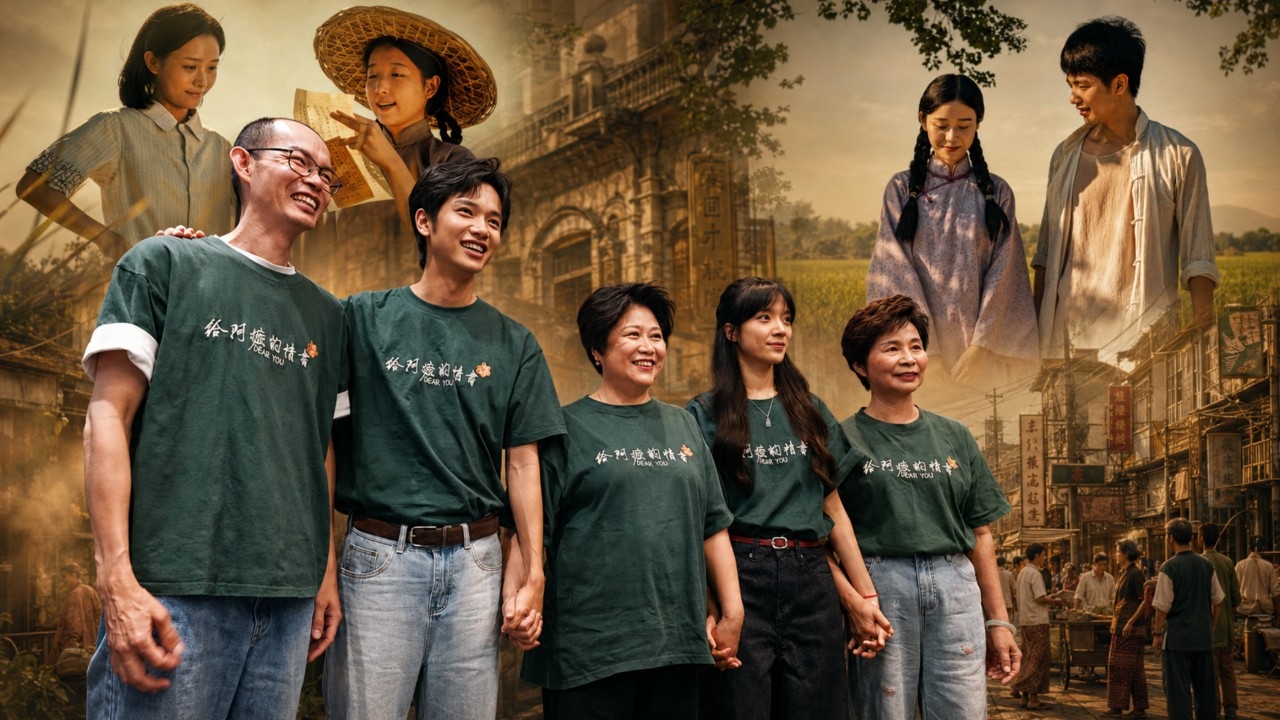
The year's hottest Chinese film, "Dear You" Dear You (Chinese: 给阿嬷的情书) has stirred audiences to tears across China with its warm story about family, longing, and intergenerational bonds, grossing over 1.9 billion yuan (approximately 9.3 billion baht) and earning a 9.3 out of 10 rating on Douban.
Thairath Online invites you to talk with Lan Hongchun the director of this year's hit Chinese film Dear You and the Chinese cast, who share behind-the-scenes insights into conveying stories of love, sacrifice, and family ties that have warmed hearts and moved audiences across Asia.

Xiao Wei, a young man traveling to Thailand to search for his grandfather, who has long lost contact with the family. During his search, he uncovers a secret within the "Poy Kuan" or "Qiaopi," letters used by overseas Chinese to send remittances with brief messages full of longing back to families in China. The long-hidden truth gradually reveals that the sender of the letters and money reaching Grandma might not be Xiao Wei's grandfather as everyone believed. His quest to find his grandfather becomes a journey uncovering stories of love, sacrifice, and bonds between generations, reflecting Teochew culture and the lives of overseas Chinese. Interview with Lan Hongchun, director of "Dear You" (2026), and the cast 1. The story of overseas Chinese occurs worldwide. Why was Thailand chosen as the main setting for this film? Director Lan Hongchun:
Although Chinatowns exist in many countries, Thailand's Chinatown is especially charming and full of life, which attracted me greatly. I incorporated characteristics and stories of overseas Chinese from various regions into the film, not limiting it solely to Thailand, to give the story greater depth. Teochew city (in Guangdong Province, China) refers to Siam as "Siam Lo," a shared memory among Teochew people. When thinking of Southeast Asia, many first think of Thailand, which symbolizes something everyone easily understands and relates to.

Director Lan Hongchun:
I believe basic human emotions are the same everywhere — love for family, duties, and roles each person has toward their relatives. I hope this film helps viewers appreciate these bonds and continue to cherish and pass down family love and connections. 3. "Dear You" is distinctive in its use of language and portrayal of Teochew culture. What inspired the director, and how might the film strengthen China-Thailand ties?
Director Lan Hongchun: The film's inspiration came from many sources, but importantly from reading the "Qiaopi" or Poy Kuan letters — documents and remittance proofs sent by overseas Chinese back home in China. Many overseas Chinese at the time were illiterate, so they relied on literate individuals to write letters for them. The letters went through multiple steps before reaching China, sometimes causing parts of the message to be lost or misunderstood.

While filming a documentary in Thailand, I encountered many such stories. The Poy Kuan letters could cause misunderstandings. Some Teochew people chose to share only happy news and hid sad stories from families, such as deaths, which were omitted from letters.
These shared memories reflect many families' experiences, making the story relatable. The feelings and stories of grandparents moved and impressed me deeply, inspiring me to share them with viewers. 4. How did the cast feel about filming some scenes in Thailand? Any special moments or impressions?
Li Sitong:
Although my character lives in Thailand, I did not film there; all my scenes were shot in Teochew city. For experiences filming in Thailand, you should ask the director, who actually traveled there. Director Lan Hongchun: Only the actor playing Xiao Wei, the grandson, filmed in Thailand. Other actors shot their scenes in Teochew city, which has old districts resembling Chinatowns or Yaowarat in Thailand. The crew added signage and decorations to make locations look more like foreign Chinatowns. 5. Actor Wang Yantong, who plays Tai Bakseng, was initially considered too handsome for the role and had to adjust his image to look more like a hardworking person. How did he change himself during that time?
Wang Yantong:

At that time, I was looking for work and working outdoors, which made me lose some weight and look closer to Bakseng. Over about six months, I exercised and changed my physique to fit the role and cut my hair short to change my look. It was an interesting experience for me.
6. The film features letter writing to distant loved ones. If you could write a letter to anyone, who would it be?

Li Sitong:
If I could write one letter, it would be to my family. We haven't met in a long time. I'm in Thailand, and my family is in China, so I feel similar to the character in the film. Zong Xiaoxiang:
I would write to my younger self because I didn't have a chance to study as a child. If I could write back, I'd encourage myself to study hard despite difficulties, as I regret not learning to read and write. Li Dekyu:I would also write to myself, regretting not studying much in the past. But now I love and accept myself more and want to encourage myself to pursue dreams, do what I want, and become the best version of myself.7. How do you feel about being part of "Dear You," a high-grossing film and phenomenon of the year?

Li Dekyu:
I never thought at my age I'd have the chance to act in a film. I feel very lucky and grateful to director Lan Hongchun for the opportunity. Zong Xiaoxiang:

I'm very thankful to director Lan Hongchun for casting me despite my limited education. I've worked with him before, including in "Back to Love" where I played a mother. In this film, I play an elder relative or aunt.
8. The Thai film "Lan Ma" and "Dear You" share similarities, both highlighting Teochew Chinese stories and succeeding as low-budget films. Thai actress Ama Taew-Usa Samkham also stars in "Dear You." Did "Lan Ma" inspire the director for this film? Director Lan Hongchun:
"Lan Ma" deeply encouraged me. We began shooting "Dear You" in late 2024, coinciding with "Lan Ma"’s release in China. I watched it in theaters, was moved to tears, and at that time we hadn't yet found suitable actors. After seeing "Lan Ma," I immediately thought Ama Usa would be perfect for our film. Our team was not well-known then, so I worried whether she would agree. We translated our script into Thai and sent it to her. She was touched by the story and gladly traveled to China to film with us.
An older Chinese actress playing grandma couldn't fly abroad for filming, so I worried about the authenticity of shooting Thailand scenes in China. But with Ama Usa joining, we were lucky to find a house in China reflecting Thai and Southeast Asian atmosphere for the final scenes. I feel "Lan Ma" and this film are connected by their humanity. The success of "Lan Ma" across Asia inspired me to believe that sincere storytelling can truly resonate with audiences.

9. Overseas Chinese live worldwide, and the Chinese saying “饮水思源” (When drinking water, remember its source) applies. How do you feel being part of helping overseas Chinese remember their ancestors through this film?
Zong Xiaoxiang: I believe we should never abandon or forget what our ancestors built and passed down, as it was gained through their struggles and sacrifices. They fought hard and faced life and death to create a solid foundation for future generations.
The film Dear You

premiered in Thailand. Director Lan Hongchun and his team spent years gathering data from over 300 families and interviewing more than 120 Teochew people, making over 90% of the film based on true events. They also selected teenage actors who speak Teochew from over 1,000 applicants. The story unfolds through "Poy Kuan," real letters from overseas Chinese, which UNESCO registered as a Memory of the World heritage in 2013, reflecting history, society, and the filial spirit of Teochew overseas Chinese.


