

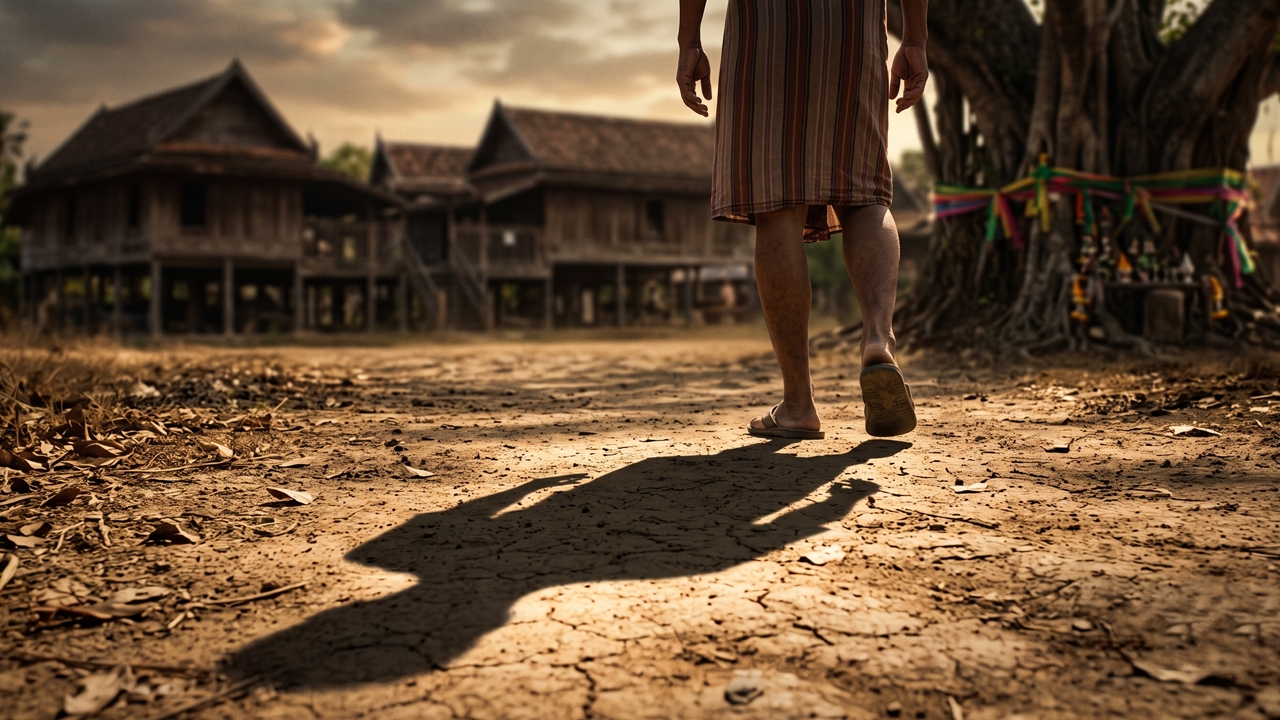
"No Shadow on the Head" According to ancient Thai beliefs, this is considered a fatal omen signaling a broken fate, believed to be caused by the "kwan" (life spirit) floating away from the body. This article reveals the reasons behind this superstition and introduces three traditional remedies to avert misfortune and extend lifespan.
"No Shadow on the Head" is one of the oldest, most mysterious beliefs that has long instilled fear in Thai people. According to ancient customs, if the shadow of someone's head suddenly disappears while sunlight remains and other parts of their body still cast shadows, it is considered a serious omen predicting death.
Why did ancient people regard this as a grave sign of a broken fate? From the perspective of traditional beliefs and lifestyle, several reasons explain this:
In ancient Thai belief, the head is sacred and the dwelling place of the "kwan," a spirit that resides in the body bringing good fortune (different from the soul that leaves the body after death).
Ancients did not see shadows merely as a light phenomenon but as a "replica of the soul" that follows us constantly.
They often warned not to let anyone step on the head's shadow or play with shadows at night, as shadows are linked to the spiritual realm. The disappearance of the head's shadow is thus a warning from the supernatural that a vital part of the soul has extinguished, leaving only the physical body awaiting demise.
It is often said that people predicted to have "no shadow on the head" tend to meet a sudden misfortune shortly after, such as
This has made the phrase "no shadow on the head" a symbol of impending death.

Since it is one of the most serious omens, if anyone is told or notices that they or someone close has no shadow on the head, traditional urgent remedies exist to prolong life, such as:
1. Cutting clothing to make a shadow. Taking the person's clothing to cover a large tree or making a clay figure to perform a ritual that deceives spirits and deities into thinking the person has already died.
2. Ordination as monk or Brahmin nun. Changing one's state by entering monkhood to rely on the merit and blessings of the Buddhist faith to protect the life at risk.
3. Making merit to extend life. Donating to save large animals like cattle or buffalo or releasing fish to generate strong merit supporting one's fate.
"No Shadow on the Head" is not merely about bad luck but a warning from the sacred and nature that one's fate is at its lowest, the kwan has left the body, and life expectancy is ending. This belief has been passed down as one of the gravest omens among Thai people.