

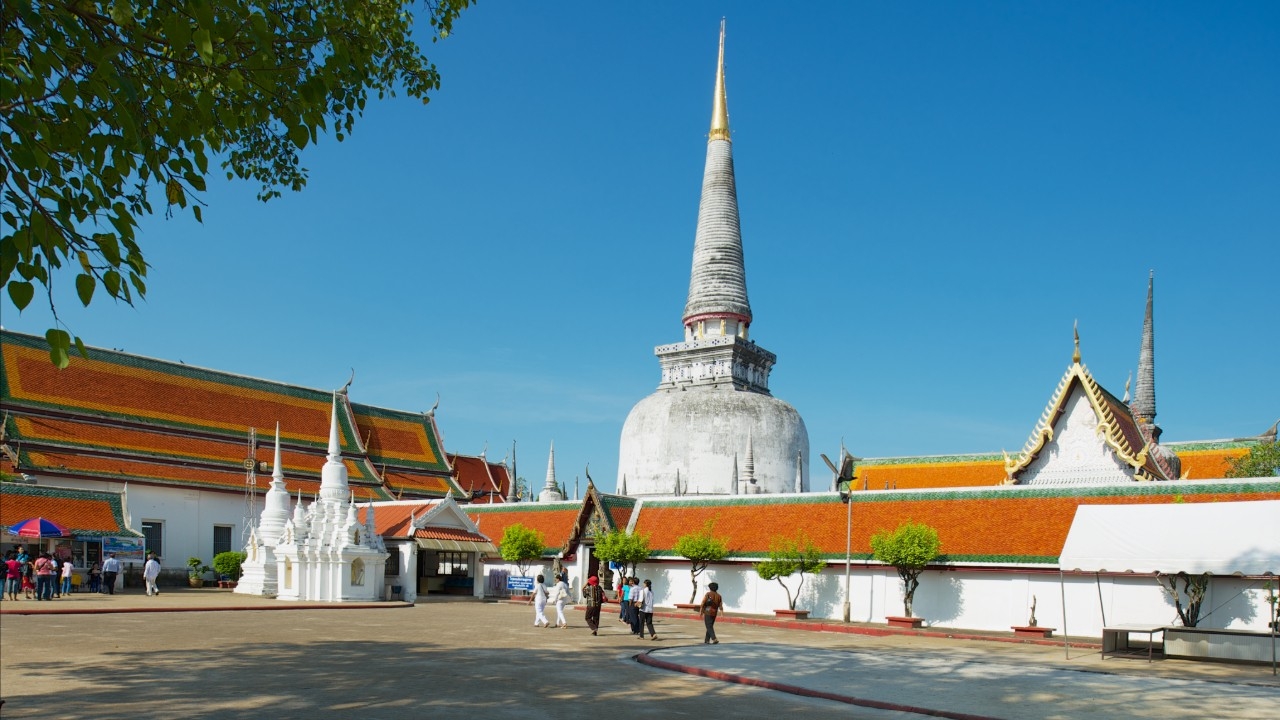
The United Nations Educational, Scientific and Cultural Organization (UNESCO) has decided to register"Wat Phra Mahathat Woramahawihan"in Nakhon Si Thammarat Province as a cultural World Heritage site. It is the first World Heritage site in southern Thailand and a source of pride for the country, reflecting the outstanding value of religious and cultural heritage that remains vibrant to this day.
When speaking of the spiritual center for the people of southern Thailand, the name"Wat Phra Mahathat Woramahawihan"is undoubtedly one of the most well-known places. It is not only a first-class royal temple but also an ancient site that reflects the history, spread of Buddhism, and cultural exchanges of people in the Asian region over a millennium.
Wat Phra Mahathat Woramahawihan, also commonly known as"Wat Phra That Nakhon,"is a prominent temple of Nakhon Si Thammarat with a long history of about 1,200–1,300 years. It is believed to have been built during the 13th–14th Buddhist centuries, a period when Nakhon Si Thammarat thrived as a major port city of the Malay Peninsula and a trading hub between India, Sri Lanka, China, and Southeast Asian lands.

Its location on ancient trade routes brought cultural and religious influences from various civilizations, including Brahman-Hinduism, Mahayana Buddhism, and Theravada Buddhism, before it developed into one of the most important centers of the Lankawong Buddhist sect in the region, which later played a key role in spreading Buddhism throughout Thailand. The beginning of the temple's construction is linked to the Phra Borommathat Stupa,

the temple's most sacred monument. According to legend, Prince Thontakumara and Lady Hemchala brought the Buddha's relics (specifically the tooth relic or sacred canine) to Nakhon Si Thammarat. Subsequently, a stupa was built to enshrine these relics, and over time, the area expanded into what is now Wat Phra Mahathat Woramahawihan. Over several centuries, the temple has been restored and expanded by various kings and rulers, while preserving the distinctive inverted bell-shaped Lanna-style stupa, which remains a key symbol of Nakhon Si Thammarat and a spiritual center for Buddhists both in Thailand and abroad. The Phra Borommathat Stupa, the heart of faith, crowned with 600 kilograms of gold.
The Phra Borommathat Nakhon Si Thammarat is the most important monument of Wat Phra Mahathat Woramahawihan. It features an inverted bell-shaped Lanna architectural style, standing 37 wa tall with a square base measuring 18 wa, 1 sok, and 15 inches on each side.

and it has 52 rings (plong chai nai). Inside, it enshrines the Buddha's relics (tooth relic or sacred canine), which have been venerated by Buddhists for many centuries.
Legends and beliefs surrounding "Wat Phra Mahathat Woramahawihan" passed down through generations. Locals of Nakhon Si Thammarat believe that paying respects at the Phra Borommathat Stupa at least once in a lifetime is a great blessing and a significant accumulation of merit. The golden stupa's covering is a result of the devotion of monarchs, royal family members, and Buddhists who have continuously donated gold and precious items, making it a symbol of faith that has accompanied Nakhon Si Thammarat for over a thousand years.

What makes Phra Borommathat Nakhon Si Thammarat stand out is not just its beautiful ancient architecture but also its role as the center of important traditions that have been continuously preserved. One of these is
Why did UNESCO designate "Wat Phra Mahathat Woramahawihan"
as a World Heritage site?
The temple's inscription as Thailand's latest World Heritage site in 2026 is not solely due to its age but because of its Outstanding Universal Value.

Being registered as a cultural World Heritage site marks an important milestone for Thailand. It not only elevates the conservation of this ancient monument to international standards but also promotes cultural tourism, generates income for local communities, and opens opportunities for people worldwide to learn more about Nakhon Si Thammarat's long history.
Wat Phra Mahathat Woramahawihan
