

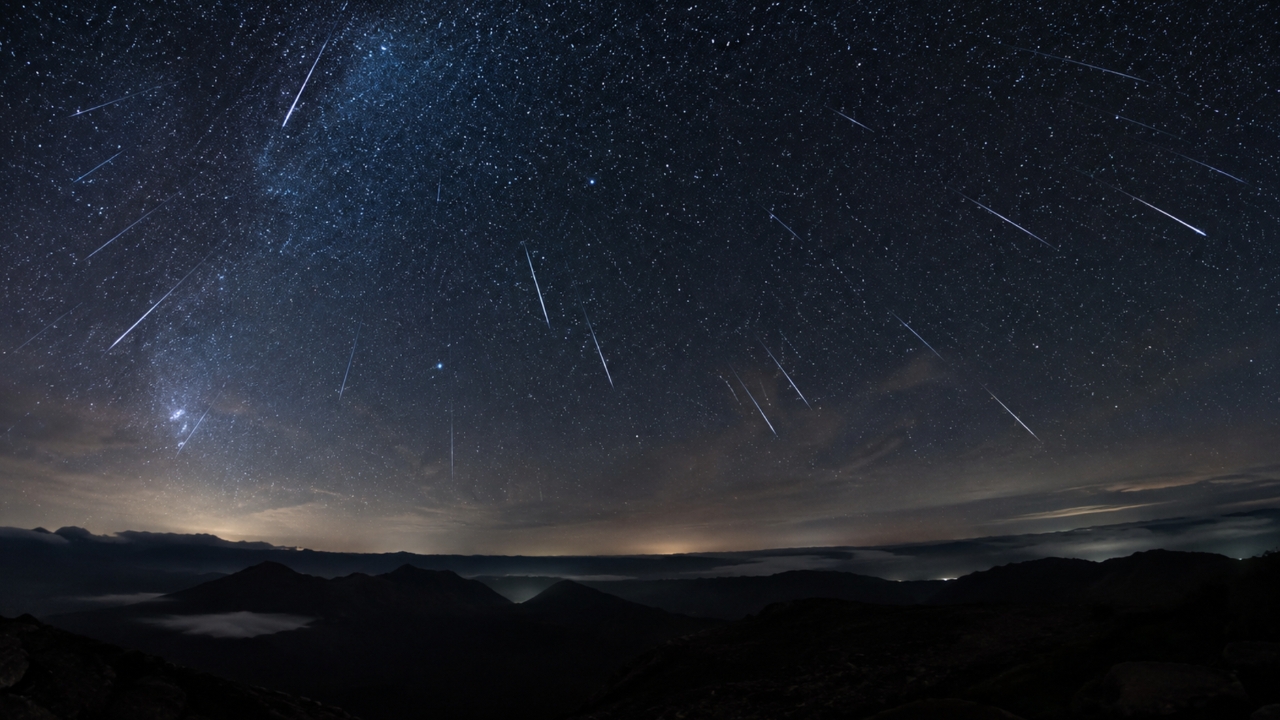
" The "12 August Meteor Shower" Tonight, the Thai sky will feature an astronomical event worth watching, namely the " Perseids Meteor Shower ", also widely known as the " Mother's Day Meteor Shower " which returns for viewing again. If skies are clear and rain-free, it can be seen with the naked eye across Thailand. This year, the peak rate is expected to be around 100 meteors per hour.
The Perseids Meteor Shower (English: Perseids Meteor Shower) is an annual meteor shower observable roughly from 17 July to 24 August, with peak activity usually on 12–13 August. This timing explains why Thais often call it the " Mother's Day Meteor Shower ".
The National Astronomical Research Institute of Thailand (NARIT) states that the Perseids are the second brightest meteor shower after the Leonids, with the radiant—the apparent origin point of the meteors—located in the Perseus constellation (Perseus). From Earth's perspective, it appears as if many meteors are radiating from the same spot in the sky.

This meteor shower originates from dust debris left along the orbit of comet Swift-Tuttle (109P/Swift-Tuttle). As Earth passes through this debris trail, particles enter the atmosphere and burn up, creating bright flashes known as " meteors ". This is a natural phenomenon with no impact on Earth.
Thailand has a chance to see the "Perseids Meteor Shower" across the country if skies are clear without clouds or rain blocking the view. The shower on 12 August may reach a peak rate of about 100 meteors per hour.
However, the figure of 100 meteors per hour represents the predicted maximum average rate. Not everyone in every location will see that many due to factors like sky conditions, clouds, rain, and light pollution.
People in Thailand can look forward to viewing the Perseids Meteor Shower on the night of 12 August 2026 through the early morning of 13 August 2026, with the radiant centered in the Perseus constellation. It will start near the northeastern horizon around 11:00 p.m. and remain visible until dawn. Those wishing to watch the Perseids on 12 August should note key times as follows:
Around 11:00 p.m. on 12 August 2026, begin observing the northeastern horizon.

The most important factor on the night of 12 August is the "weather conditions" since Thailand is in the rainy season and many areas may experience rain. Heavy clouds or rain could block visibility even though the meteor shower occurs as usual.
Source: National Astronomical Research Institute of Thailand (Public Organization)