

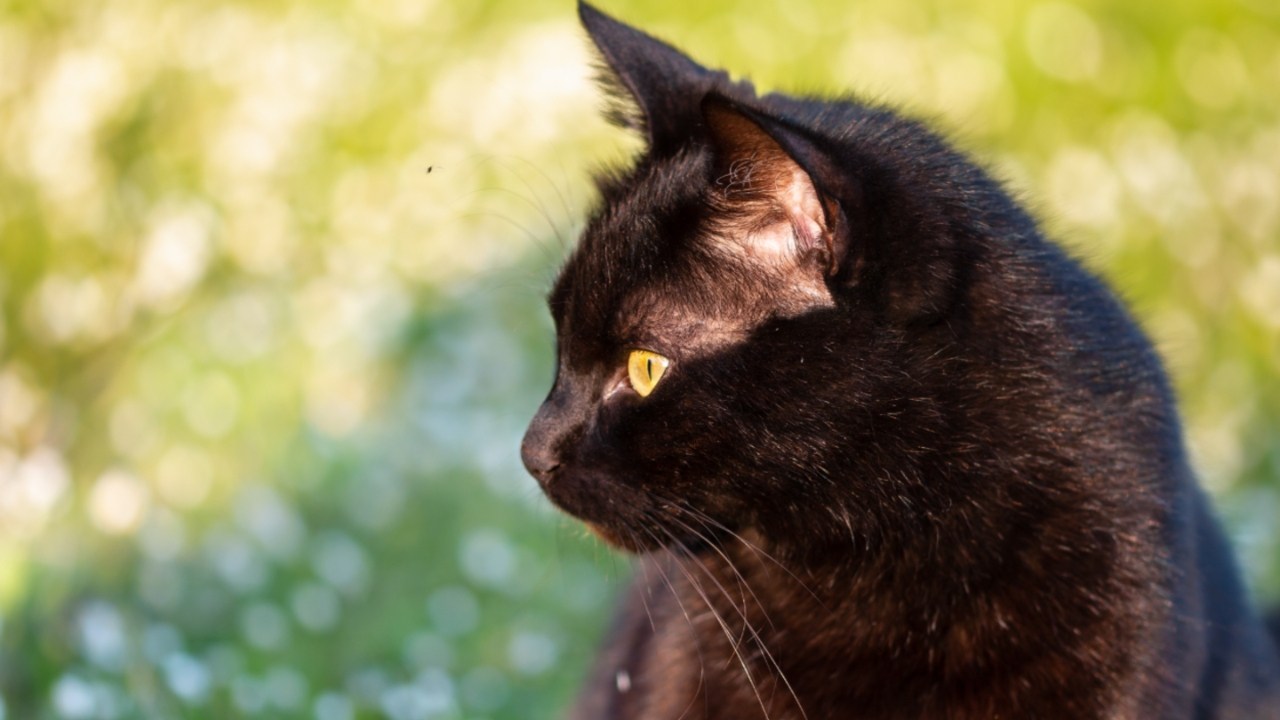
Many cat owners have wondered why black cats appear bald Some have sparse eyebrows or thinner fur around their ears compared to other areas. Especially in black or dark-colored cats, the skin in these spots stands out clearly, raising concerns about fur loss, fungal infections, or skin diseases, and whether treatment is necessary.
Why do black cats look bald? If a black cat has thinning fur only between the eyes and ears, with normal-looking skin and no itching, this condition is naturally occurring in cats and is known as “Preauricular alopecia”which is not a skin disease and generally does not require treatment.

This thinning of fur in front of the ears may appear as a concave area or“bald spots at the temples.”Such features on both sides are normal in many cats, especially short-haired breeds, and are often observed in black, brown, or dark-furred cats because the skin color contrasts sharply with the fur, making the thinning more noticeable than in lighter-colored cats.
Therefore, if you notice that your black cat has“thin eyebrows”or sparse fur near the front of the ears as it grows, there's no need to worry immediately, as this may be a natural trait rather than a sign of illness.
If the thinning fur in front of the ears isnatural,owners can easily observe that the skin is normal and not inflamed, and the cat does not feel pain or itchiness. Typical signs include:
If your cat shows these traits, most owners do not need to apply medication or try to regrow fur, as this is not“baldness”caused by disease.

In fact, black cats are not necessarily balder than other cats; rather, their dark fur color makes thinning more visible. Cream, white, or light-colored cats may have thinning in the same places, but owners often don’t notice it, which explains why the idea of“black cats are bald”or“black cats have thin eyebrows”stands out, even though it is often just a natural characteristic.
Although thinning fur near the ears can be normal, if you see redness, scales, wounds, bumps, peeling skin, or increasing fur loss, along with itching, scratching, or excessive licking, you should take your cat to a veterinarian for diagnosis.,Fur loss in cats can be caused by various issues such as fungal infections, parasites or mites, fleas, allergies, skin inflammation, and other conditions that require professional examination to determine the cause.


However, a simple way to differentiate is to look at“the skin and behavior”more than the amount of fur. If the skin is smooth, without wounds or scales, and the cat is not itchy or scratching, the thinning is likely natural. But if fur loss spreads, the skin changes, or the cat starts scratching and licking more, veterinary evaluation is needed to rule out skin disease.
So, before teasing your black cat about being“bald,”observe carefully. Sometimes it’s not illness or hair loss, but a natural, distinctive fur pattern unique to your cat.
Thank you for the information: Facebook page“Dog Care with the Vet”