

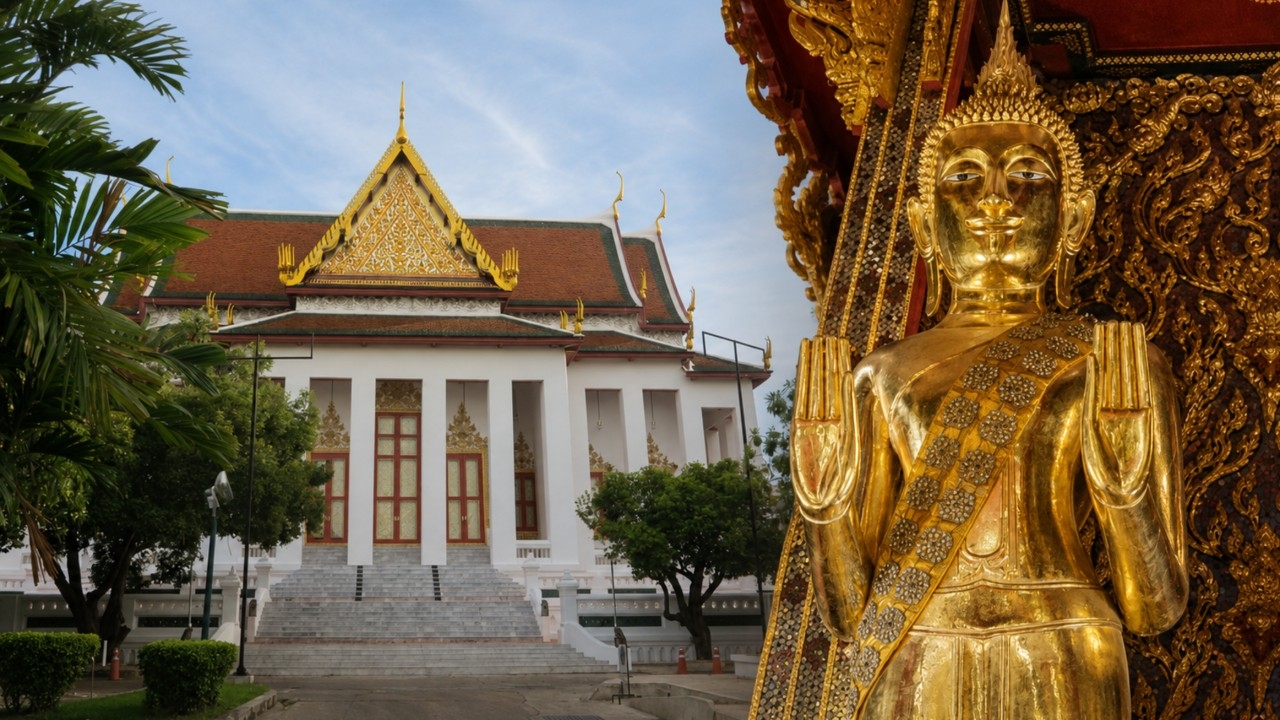
Anyone interested in Thai history and art should not miss the chance to visit “ Wat Phra Kaew Wang Na ” or “ Wat Bowon Sathan Sutthawat ,” an important historic site that is not often open to the public. This time, the ubosot is open for free visits with guided tours until 20 September 2026 only. Check details here.
Wat Bowon Sathan Sutthawat — commonly known as “ Wat Phra Kaew Wang Na ,” is located within the Bunditpatanasilpa Institute in Phra Nakhon district, Bangkok. Historically, it was part of the Bowon Sathan Mongkhon Palace or “ Wang Na .” It is now near Thammasat University’s Tha Pra Athit gate.
This temple’s status is similar to Wat Phra Si Rattana Satsadaram (Wat Phra Kaew) within the Grand Palace, meaning it is within the royal palace grounds and has no resident monks. Currently, the site is used for cultural ceremonies such as teacher homage and important rites for dancers, musicians, and agencies under the Fine Arts Department.
Wat Bowon Sathan Sutthawat or “Wat Phra Kaew Wang Na” is located inside the Bowon Sathan Mongkhon palace grounds and thus, like Wat Phra Si Rattana Satsadaram, has no resident monks.
Originally, this area was the site of “ Wat Luang Chi ,” built during King Rama I’s reign. It fell into disrepair and was demolished during King Rama II’s era to create a rabbit garden. Later, Prince Bowon Ratcha Mahasakdi Phra Sappha, the Bowon Sathan Mongkhon palace director in King Rama III’s reign, ordered the construction of a new temple to honor Buddha and celebrate the suppression of the Vientiane rebellion, naming it “ Wat Bowon Sathan Sutthawat .”
The ubosot was built as a four-sided structure housing the principal Buddha image in the ‘granting forgiveness’ posture. Construction was incomplete at the prince’s death, but King Rama IV continued it and commissioned murals depicting the legend of the Phra Phuttha Sihing Buddha image and 28 past Buddhas.
Though plans to enshrine the Phra Phuttha Sihing atWat Bowon Sathan Sutthawatwere eventually abandoned, King Rama IV ordered the completion of construction.

A highlight of the temple is its large four-sided ubosot, built on a three-tiered base with a tiled roof and ‘mouth of fish’ style chofah decorations, differing from the ‘mouth of bird’ chofah typical in royal architecture.
Inside houses a standing Buddha image in the granting forgiveness posture with both hands raised, or Subduing Mara posture, commissioned by Prince Bowon Ratcha Mahasakdi Phra Sappha and completed later.

Another key feature is the murals covering all four walls, painted by several artists during King Rama IV’s reign, illustrating Buddhist history, divine assemblies, the Phra Phuttha Sihing legend, and past events and beliefs.
The ubosot’s doors and windows are adorned with images of deities, scenes from the Ramakien, the ten avatars of Narayana, and the Bharatanatyam treatise, making the temple a repository of craftsmanship and history in one place.

Wat Bowon Sathan Sutthawat (Wat Phra Kaew Wang Na) is open to the public for visits to the ubosot from now until 20 September 2026, daily from 09:00 to 16:00, free of charge.
Visitors can enter freely without prior registration or booking and can walk in during opening hours. The Fine Arts Department has increased guided tour sessions according to this updated schedule:
Wat Phra Kaew Wang Na through its architecture, murals, and history, this special opportunity should not be missed, as it is open only until 20 September 2026. Visitors should verify announcements from the Fine Arts Department before visiting, as tour schedules or open areas may change as needed. Source of information: