

If you're looking for a place to visit in Bangkok where you can stroll and immerse yourself in history, try marking your map for the National Museum, Phra Nakhon. Within this space lies a hidden collection of national treasures ranging from ancient artifacts thousands of years old to exquisite art pieces that have withstood multiple eras. Each item is not only beautiful and ancient but also holds stories of people, beliefs, and cultures from the past.
The museum’s contents are not mere "old things" for display but cultural treasures that have endured through generations. Preserving and learning about these artifacts is a vital way to pass down the nation’s heritage for future generations to appreciate and understand.

The “Roman oil lamp,” made of bronze, was excavated in Phong Tuek subdistrict, Tha Maka district, Kanchanaburi province. The lamp’s lid depicts Silenus, and its handle is decorated with palm leaf and paired dolphin motifs. Currently displayed in the Asia room of the Mahasurasinghanat building, the discovery of Roman artifacts in Thailand serves as compelling evidence of ancient travel, trade, and interaction between local communities and the Western world.

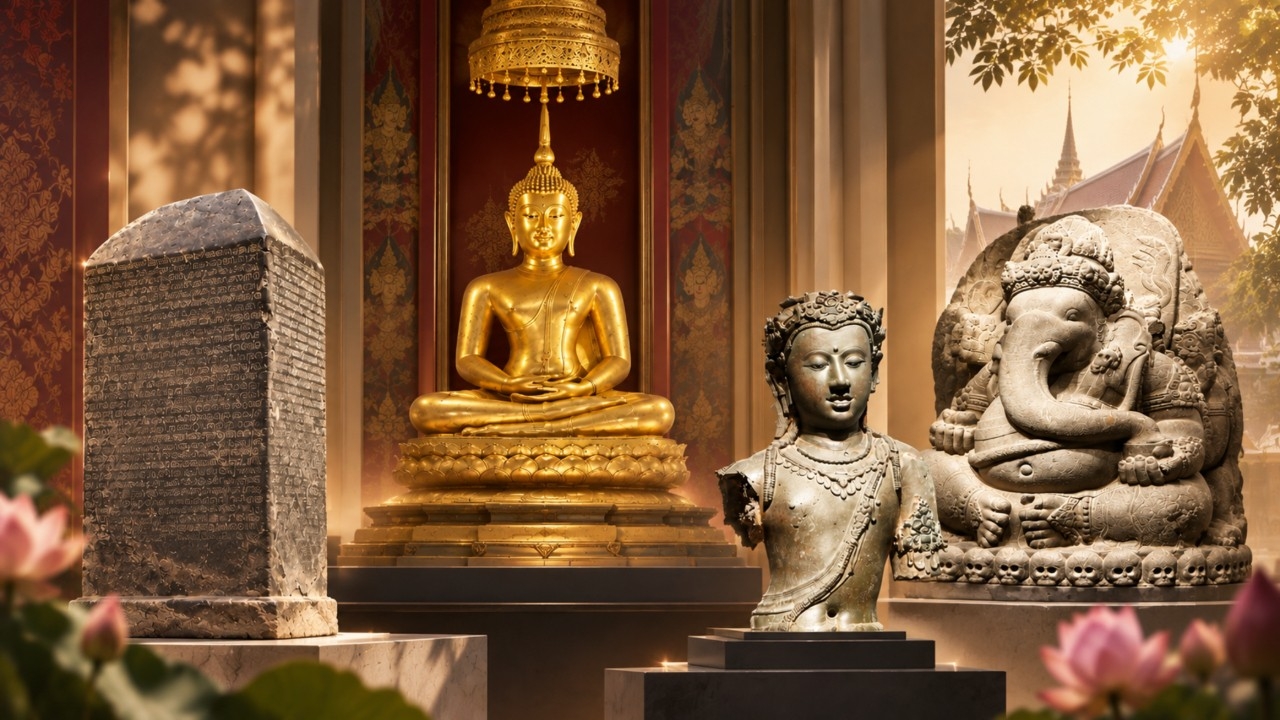
The “Ganesha” statue comes from Chantisinghasari, East Java, Indonesia. This Eastern Javanese art piece dates back to the 15th-16th Buddhist centuries and stands 172 centimeters tall. It is seated on a skull throne, adorned with skull motifs on various ornaments. The statue was brought to Siam in 1896 CE when the Dutch regent of Java presented it to King Rama V. It is now exhibited in the Srivijaya room of the Mahasurasinghanat building.

The “Great Victory Royal Chariot” was built in 1795 CE under King Rama I’s command. Measuring 18 meters long, 11.20 meters high, and weighing 13.7 tons, it was made to carry the royal ashes of the first monarch to the cremation site at Sanam Luang. The chariot was also used in many important royal ceremonies, symbolizing both supreme artistry and the royal traditions of early Rattanakosin. It is currently displayed inside the Royal Chariot Hall.

The “Bodhisattva Padmapani,” or Avalokitesvara with two arms, is Srivijaya art dating back to the 14th Buddhist century, discovered at Wiang Temple, Chaiya district, Surat Thani province. Although only the upper body remains, it still reveals artistic details for study. The Fine Arts Department suggests it may be the same statue mentioned in the Wiang inscription, reflecting ties between Srivijaya in the southern peninsula and the Sailendra dynasty of central Java.

The “Inscription Stone No. 1,” or King Ramkhamhaeng Inscription, is a renowned artifact familiar from textbooks. Discovered by King Rama IV in 1833 CE at the old Sukhothai palace mound, the text records the biography of King Ramkhamhaeng, events, customs of Sukhothai city, and the invention of its script in 1283 CE. The inscription is dated 1292 CE and was designated a UNESCO Memory of the World heritage in 2003.

“Luang Pho White Stone” is a Buddha statue in the preaching posture, crafted in Dvaravati style from the 13th-14th Buddhist centuries. Uniquely, it is assembled from five ancient parts: the head and upper torso from Wat Phraya Kong in Phra Nakhon Si Ayutthaya, and the chest, legs, and feet from Wat Phra Meru in Nakhon Pathom. Ancient artisans used wedge carving techniques to join the pieces. It is now displayed in the Praphas Museum building.

“Phra Phuttha Sihing” is a gilded bronze Buddha statue in the Sukhothai-Lanna style from the 21st Buddhist century. Legend says it was once enshrined in many important cities including Nakhon Si Thammarat, Sukhothai, Kamphaeng Phet, Chiang Rai, Chiang Mai, and Ayutthaya. In 1795 CE, Prince Maha Surasinghanat brought it from Chiang Mai to Bangkok, establishing it as the principal Buddha image of the Front Palace.

The “Bronze Shiva” sculpture dates to early 20th Buddhist century Sukhothai, serving as key evidence of Brahman-Hindu beliefs in Sukhothai society. Historically brought from the Brahman temple in Bangkok, the Fine Arts Department speculates it might be the “Phra Mahesuan” mentioned in the Wat Pa Mamuan inscription, which King Lithai ordered to be installed alongside Vishnu in 1350 CE. It is currently displayed in the Sukhothai room.

“Phra Hai Sok” is a Buddha statue in the Mara Vichaya posture, crafted in the Lanna Singha style from the 21st Buddhist century, corresponding to Lanna’s golden age. It features the diamond meditation pose, a rounded body, and a lotus base adorned with floral and peony motifs. The name “Hai Sok” relates to Lanna customs of naming Buddha images to signify the dispelling of misfortune and sorrow. Originally royal property used in ceremonies, it is now exhibited in the Lanna room.

The “Phra Thinang Butsabok Kern,” or Butsabok Royal Throne, was built during King Rama I’s reign. This wooden pavilion-style throne is intricately carved with giants, garudas, and celestial beings, gilded and inlaid with glass. Prince Maha Surasinghanat used it when receiving officials or conducting royal duties. Later, in King Rama III’s era, it was enshrined as the centerpiece in Phra Thinang Itsarawichai. It stands as a heritage reflecting the Front Palace’s history and early Rattanakosin craftsmanship.
For those wanting to experience history firsthand, try visiting the National Museum, Phra Nakhon. It is open Wednesday through Sunday, from 08:30 to 16:00 (closed Mondays and Tuesdays). ) Then seek out these 10 artifacts yourself. Sometimes standing before objects that have survived hundreds or thousands of years can bring history to life in a way that textbooks never can, making it feel closer and more real.
Photo and information credit:Public Relations and Communications Division, Fine Arts Department