

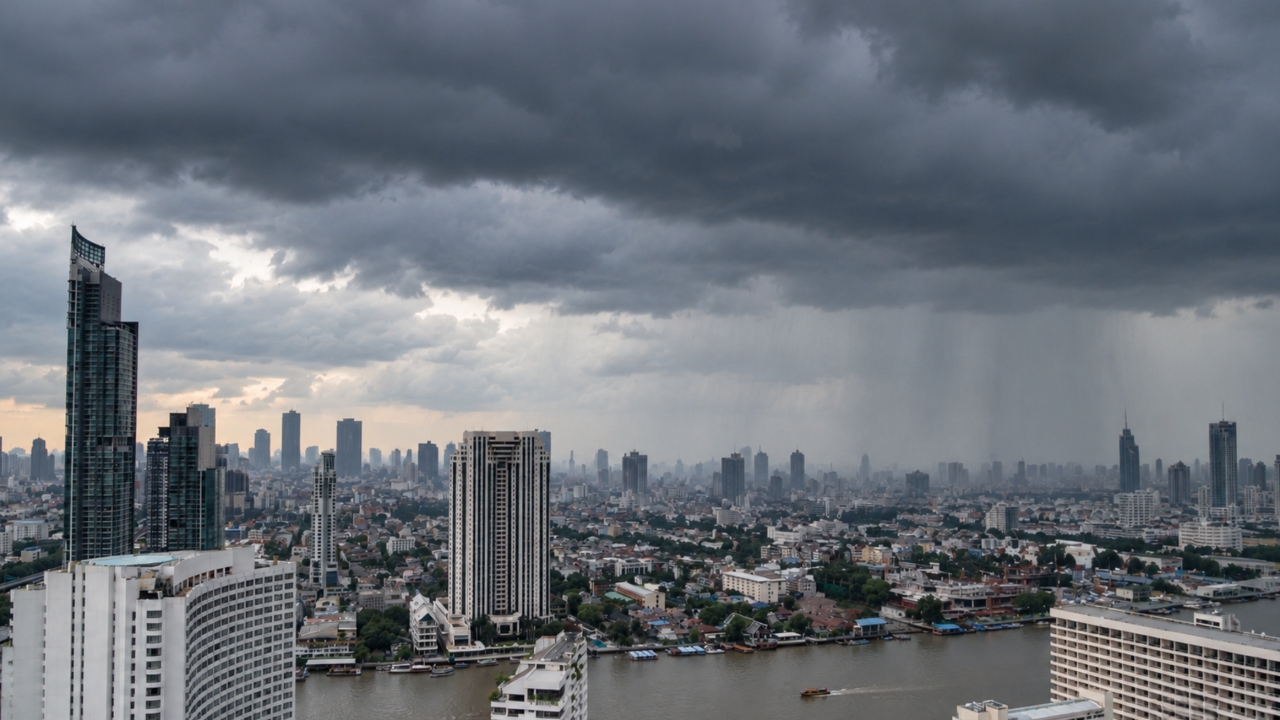
Bangkok Floods 2026 GMT+7 After many areas in Bangkok and its vicinity experienced continuous rain starting 25 Sep, resulting in flooding and traffic disruptions at various points, the term " stationary rain " gained attention as rain clusters repeatedly fell over Bangkok and surrounding areas for more than 30 hours.
Thairath Online invites you to learn about "stationary rain": how this phenomenon occurs, why rain repeatedly falls over the same area for extended periods, and why it increases the risk of severe flooding. stationary rain " station occurs, why rain repeatedly falls over the same area for extended periods, and why it increases the risk of severe flooding.
"Stationary rain" (English: Stationary Heavy Rain) refers to heavy or continuous rainfall remaining over the same area for a long time. It may be caused by slow-moving rain clusters or new rain clusters forming and passing repeatedly over the same location, causing continuous accumulation of rainfall.
The Meteorological Department explains that the rainfall from 25-27 September 2026 was caused by a strong low-pressure area moving along the monsoon trough, covering the lower central region including Bangkok and its vicinity. Along with a strengthening southwest monsoon, many areas experienced heavy to very heavy rain and accumulated rainfall.

On 26 September GMT+7, Assoc. Prof. Dr. Thon Thamrongnawasawat a marine and environmental scientist, explained Bangkok's rainfall situation onhis Facebook page, Thon Thamrongnawasawat,noting that the rotating rain clouds make forecasting difficult, with rain clusters cycling continuously for more than 30 hours, affecting Bangkok and surrounding areas with repeated rainfall.
Bangkok's continuous rain over 30 hours does not mean heavy rain nonstop without breaks, but that rain clusters form and cycle repeatedly over Bangkok and nearby areas for a long period.
This explains why rainfall may lighten or stop at times but soon returns; it's not just one rain mass, but atmospheric conditions continually support new rain clusters forming in the same area.
For rain to fall continuously for long, the atmosphere must have sufficient moisture, as water vapor is essential for cloud and rain formation. Meanwhile, the world is experiencing an intensified El Niño, raising global temperatures and affecting weather patterns and rainfall distribution worldwide.
Assoc. Prof. Dr. Thon explained that currently, atmospheric water vapor levels are high, combined with increased air and sea temperatures that raise moisture content. When temperatures rise by 1 degree Celsius, the atmosphere can hold about 7% more water vapor, which under suitable conditions can lead to large amounts of rainfall.
However, El Niño is not the sole direct cause of this stationary rain in Bangkok; multiple factors occurring simultaneously also contribute to rainfall and accumulation in Bangkok and its vicinity.

The concern with "stationary rain" is not just heavy rainfall intensity, but the continuously increasing water volume as rain repeatedly falls over the same area for a long time. If water inflow exceeds the drainage system's capacity, flooding or flash floods can occur.
For Bangkok, special attention must be paid to "sea level rise" because drainage connects to the Chao Phraya River and the Gulf of Thailand. High water levels at the outlet during heavy rain can slow drainage outflow. Therefore, the concern with "stationary rain" is not that rain falls nonstop at heavy intensity, but that rain lasts long and cycles over the same area, causing water to accumulate faster than it can drain. Combined with existing water or sea level rise, flood risk increases accordingly.
