

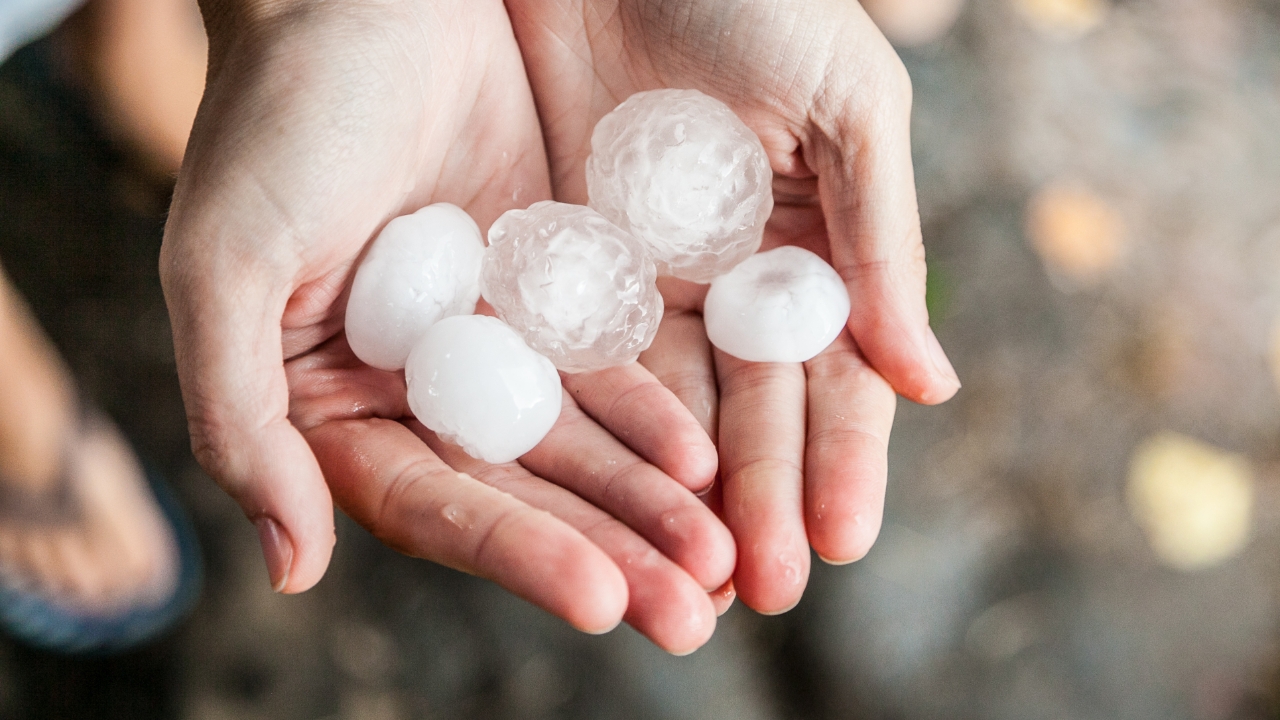
During heavy rain or thunderstorms, some areas may experience small ice pellets falling along with the rain, which are known as "hail." "hail" is a natural phenomenon occurring inside storm clouds with strong updrafts. Although Thailand has a hot climate, hail can still occur because the upper parts of the clouds have temperatures well below freezing. Hail " is a natural phenomenon that happens inside storm clouds with strong upward air currents. Even though Thailand's climate is hot, hail can fall because the upper parts of the clouds have temperatures far below freezing.
The Meteorological Department states that hail is usually seen in Thailand during thunderstorms in the hot season, especially from February to May, and is most common in the northern and northeastern regions.
Due to today's (1 Oct) thunderstorm in Bangkok, there were reports of "hail" falling in many areas including Ladprao, Chatuchak, Ratchadaphisek, and Chokchai 4 zones. Thairath Online explores what hail is, how it forms, why it often accompanies thunderstorms, its dangers, and whether hail can be collected to eat. hail falling . Thairath Online invites you to learn about "hail," how it forms, why it often comes with thunderstorms, how dangerous it is, and whether the hail that falls can be collected and eaten.

. "Hail" (English: Hail) is precipitation that falls from clouds in the form of ice pellets or lumps. Hailstones have diameters starting from about 5 millimeters or more, generally ranging from 5 to 50 millimeters, although they can sometimes be larger. When a hailstone is cut open, some may show alternating clear and cloudy ice layers because the ice grows by accumulating supercooled water droplets inside the cloud multiple times before falling to the ground.
Hail differs from "snow" even though both are solid forms of precipitation. Hail forms inside storm clouds with strong updrafts, while snow forms from ice crystals in clouds under different atmospheric conditions.
Explaining how "hail" forms.

The formation of hail can be simply described as follows:
Warm, moist air near the ground rises, creating a large thunderstorm cloud.
Updrafts inside the cloud carry water droplets to areas with temperatures below freezing.
The water droplets freeze and become small ice pellets.
These ice pellets collide with supercooled liquid droplets, which freeze upon contact and cause the hailstones to grow larger.
Strong winds can cause hailstones to be carried up and down inside the cloud, accumulating more ice layers.
When hailstones become too heavy for the updraft to support or when the updraft weakens, the hailstones fall to the ground.
Why do thunderstorms cause "hail"?

These clouds can produce several severe weather phenomena simultaneously, such as heavy rain, strong winds, lightning, thunder, and hail. So, if hail falls during heavy rain, it signals that there is strong vertical air movement inside the storm cloud capable of forming and suspending hailstones before they fall.
Is "hail" dangerous? Warning! Do not collect it to eat.
Although hail is ice, it is not recommended to collect and eat it because hail is natural precipitation that has not gone through any production or quality control like ice made for consumption. It may contain germs, chemicals, dust, smoke, or other particles from the air and can become contaminated after touching roofs, ground, or other surfaces.
Therefore, if hail falls on streets, roofs, or dirty areas, the chance of contamination increases. Even if the hail looks clear or clean, this does not guarantee it is safe to eat. If you want to consume ice, it is safer to choose ice made from clean water and produced under sanitary standards.

Information from:
Meteorological Department