

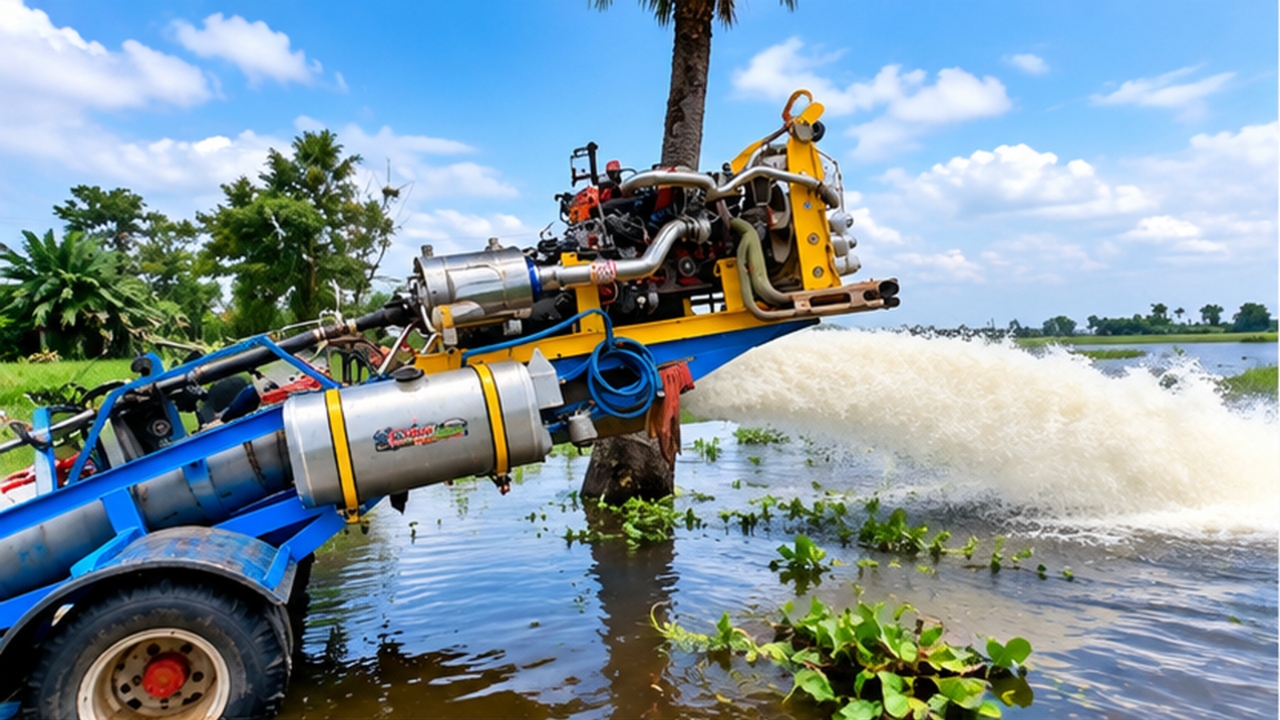
" Thosing Pipe " has become a crucial tool for accelerating floodwater drainage, especially in low-lying areas or spots with large water accumulation where existing drainage systems cannot cope—such as the 2026 Bangkok flood, where Thosing pipes were deployed in Khlong Chan and Romklao housing estates.
Although called “Thosing pipes,” they are not just large pipes; the system involves multiple components working together, including the engine, power transmission, impeller, and water discharge pipes.
Thairath Online invites you to learn about the “ Thosing water pump ”: what it is, how it works, and the behind-the-scenes features that make it the hero helping to speed up floodwater drainage this time.
" Thosing Pipe " is the name for a type of large water pump designed to rapidly move large volumes of water from one location to another. The system includes several components working together, such as:

Thosing pipes are widely used in agriculture and aquaculture, especially to pump water in and out of shrimp ponds, where large volumes need to be moved quickly. They have also been adapted for flood drainage and other emergency situations.
A notable example is the 2018 Tham Luang cave rescue, where volunteer teams used Thosing pipes with 16–20 inch diameter pipes capable of continuous operation for long periods, significantly reducing the massive water volume.

The basic principle of the “ Thosing Pipe " is to pump water from flooded areas and send it through large pipes to canals or drainage systems that can handle the additional water. This relies on the coordinated operation of the engine, power transmission, shaft, impeller, and discharge pipe.
When the engine runs, power is transmitted via the shaft to rotate the impeller, causing water to flow into the system and then be pushed through the pipe to a designated discharge point. The roles of each part can be simply described as follows:
Therefore, the efficiency of a Thosing pipe depends not only on pipe size but also on engine power, impeller design, system size, water levels, and site conditions, meaning each pump’s capacity varies based on specifications and real-world use.

When heavy rain causes large water accumulation and existing drainage systems cannot keep up, the Thosing pipe acts as an “ additional force " to accelerate water movement out of affected areas. Its main advantages include:
1. High volume water pumping – ideal for areas with large water accumulation needing rapid water level reduction.
2. Continuous operation – suitable for long-duration drainage tasks.
3. Mobility and easy installation at various locations – some models are mounted on trailers for easy transport to flood-affected zones. 4. Supports existing drainage systems
– especially where water inflow or accumulation exceeds normal drainage capacity. 5. Connects floodwater from communities or low-lying areas to canals that can handle and further drain the water.
However, it is important to understand that Thosing pipes do not make water “disappear” but serve to “relocate” water from unwanted flooded areas to places that can receive and drain it further.
Therefore, no matter how powerful the pump, if the discharge point cannot handle the water volume, drainage efficiency will be limited. For Thosing pipes to be effective, both “water to pump” and “space to discharge water” are essential. Seeing large pumps might suggest just placing them at flood points and turning them on fixes the problem immediately, but in reality, their use depends on site conditions and surrounding drainage systems. At least two key conditions must be met:

Thosing pipes are best for moving large water volumes and are typically used in areas with significant water buildup such as lowlands, basins, confluence points, or places where existing drainage is overwhelmed. When water levels drop, large pumps may not suit shallow or scattered water, requiring smaller pumps or other equipment to fit the conditions.
A critical principle is that the discharge location must be able to accept the pumped water. The water does not vanish but must be sent to canals, ponds, or other drainage routes. Before operation, it is necessary to check the water level in the receiving canal to ensure it can handle additional water and that the water can continue flowing through the system.
If any link in this chain fails—such as the receiving canal being too full, water not draining further, or backflow into the flooded area—the effectiveness of lowering water levels will be compromised.
In summary, why has the “Thosing” pipe become an essential helper after severe flooding?
The role of Thosing pipes is not to replace city drains, canals, or pumping stations but to serve as supplementary tools when large water volumes accumulate and must be moved quickly out of flooded areas.

Ultimately, flood reduction does not depend solely on how powerful a pump is but equally on where the pumped water goes afterward.
If there is a suitable pump for the water volume, correct placement, and a receiving canal or system that can handle the water,
"Thosing pipes" will serve as a critical force to speed up water level reduction and help areas return to normal sooner.
Read more articles Thosing pipes prove effective as water levels drop in Khlong Chan with cleanup starting in many areas. “Thosing pipes” help Romklao housing estate and Lat Krabang pull water into Pravet canal, Bangkok, accelerating flood recovery in the eastern side.