

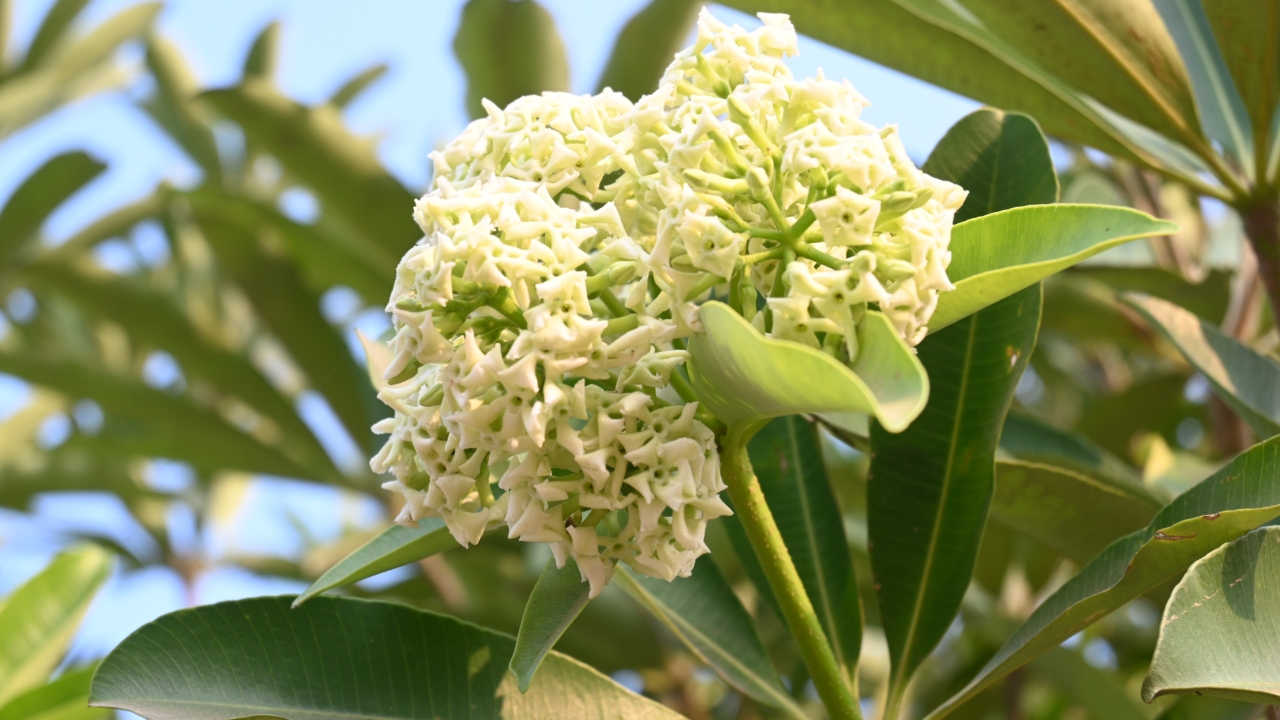
As the late rainy season transitions into early winter, besides the cooling weather, a familiar scent drifts on the breeze, especially in the evenings and at night. This is the smell of the "Alstonia" flower. Alstonia flower Some people find the scent pleasantly refreshing, while others find it pungent and quickly walk away. It has become a hallmark winter fragrance that both delights and irritates many every year.
The Alstonia tree officially known as Indian Devil Tree has the scientific name Alstonia scholaris (L.) R.Br., belonging to the Apocynaceae family. It is a large evergreen tree reaching about 12-20 meters tall, commonly found in Thailand and various parts of Asia.
A notable feature of the Alstonia tree is its tall, straight trunk with gray to grayish-brown bark that exudes white latex when wounded. Its leaves are simple and arranged in whorls of about 4-7 per node, with thick, obovate or elliptical shapes. The small flowers are pale greenish-white or light yellow, clustered at the ends of branches.

The name " Indian Devil Tree " is associated with greatness, honor, and respect. The word " Indian Devil " signifies a powerful leader, while " Devil " in traditional auspicious plant beliefs represents goodness and virtue.
The tree’s tiered branching, resembling a ceremonial umbrella, further connects it with dignity and honor. Historically, people plant it near homes to bring good fortune, believing it promotes respect and admiration for residents.
The reason for the Alstonia flower’s recurring winter fragrance is its blooming season from October to December, coinciding with late rainy season and early winter. When many Alstonia flowers bloom simultaneously on branch tips, their scent disperses strongly into the air, especially from large trees with abundant blossoms. Another key trait is that Alstonia flowers release a strong fragrance during evening to nighttime hours, a natural characteristic of some flowers that emit volatile compounds to attract pollinating insects. What does the Alstonia tree smell like? Why do some say it’s fragrant while others find it foul?
The scent of the Alstonia flower is unique, combining a rich, sweet aroma that some find pleasant but others perceive as overpowering or pungent. Thus, the tree is loved by some and disliked by others simultaneously.
Some describe the scent as akin to intensely sweet floral perfume, while others compare it to a sharp, greenish odor that can cause dizziness.

Differences in scent perception relate to variations in olfactory sensitivity, personal experience, and preferences. One person may associate the smell with the winter season pleasantly, while another may find it too strong and avoid walking near these trees.
The Alstonia tree’s medicinal properties: more than just shade. The Alstonia tree has a history of use in traditional medicine. Various parts have medicinal properties as follows:
Latex: relieves toothache, earache, and treats some wounds.
Leaves: reduce fever and relieve bleeding gums.