

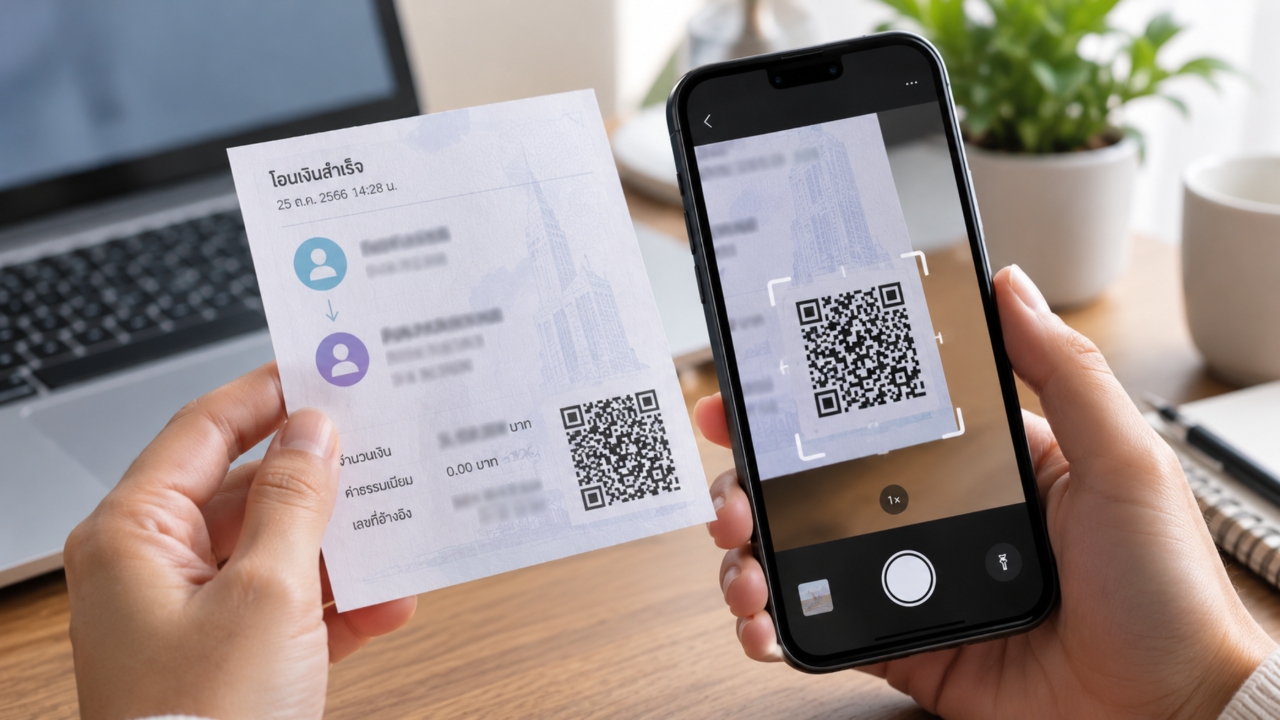
Nowadays, transferring money through banking applications has become commonplace, whether buying online, sending money to acquaintances, or receiving payments from customers. However, one thing to watch out for is "fake transfer slips." Fake transfer slips that scammers might use to falsely claim that payment has been made when the recipient hasn't actually received the funds. Simply trusting the image of a slip sent can lead to unknowingly becoming a victim.
Thairath Online recommends 5 simple steps to check for fake slips that you can do yourself. By verifying the QR Code on the slip through your banking app and checking the actual account balance, you can gain confidence before delivering goods or conducting transactions.
One way to verify a transfer slip is to scan the QR Code found on the payment proof, which allows you to check transaction details via supported banking applications. The steps are as follows:
Open your banking application.
Log into your mobile banking as usual.
Select the QR Code scan menu.
Access the menu for scanning or verifying transfer slips. Note that menu names may vary by bank.
Scan the QR Code on the slip.
Use your phone’s camera to scan the QR Code on the received payment slip.
Check the transaction details.
If the system supports and verifies the transaction successfully, it will display transfer information such as sender’s name, amount, and transaction date and time, according to the bank’s available data.
Compare the information with the received slip.
Make sure the details match. If discrepancies are found or the transaction cannot be verified, further checks should be done before trusting that the slip is valid proof of payment.

Besides scanning the QR Code, the recipient should directly check incoming transactions through their own banking app by reviewing the balance, received amount, and transaction history to confirm it matches the sender’s information.
If you have activated notifications for incoming funds via SMS or the bank’s LINE service, these can help verify transactions as well. However, ensure the messages come from official bank channels and avoid clicking suspicious links included in messages.
Fake slips may have altered details to appear as successful payments. Therefore, when receiving payment proof, watch for these warning signs:
However, these irregularities don’t always mean the slip is fake, as system limitations or processing delays can occur. It is advisable to further confirm with the bank to establish the facts.
Finally, remember that an image of a slip that looks real does not guarantee the transfer was successful. Direct verification through the bank’s system is the safest way to ensure security in financial transactions.