

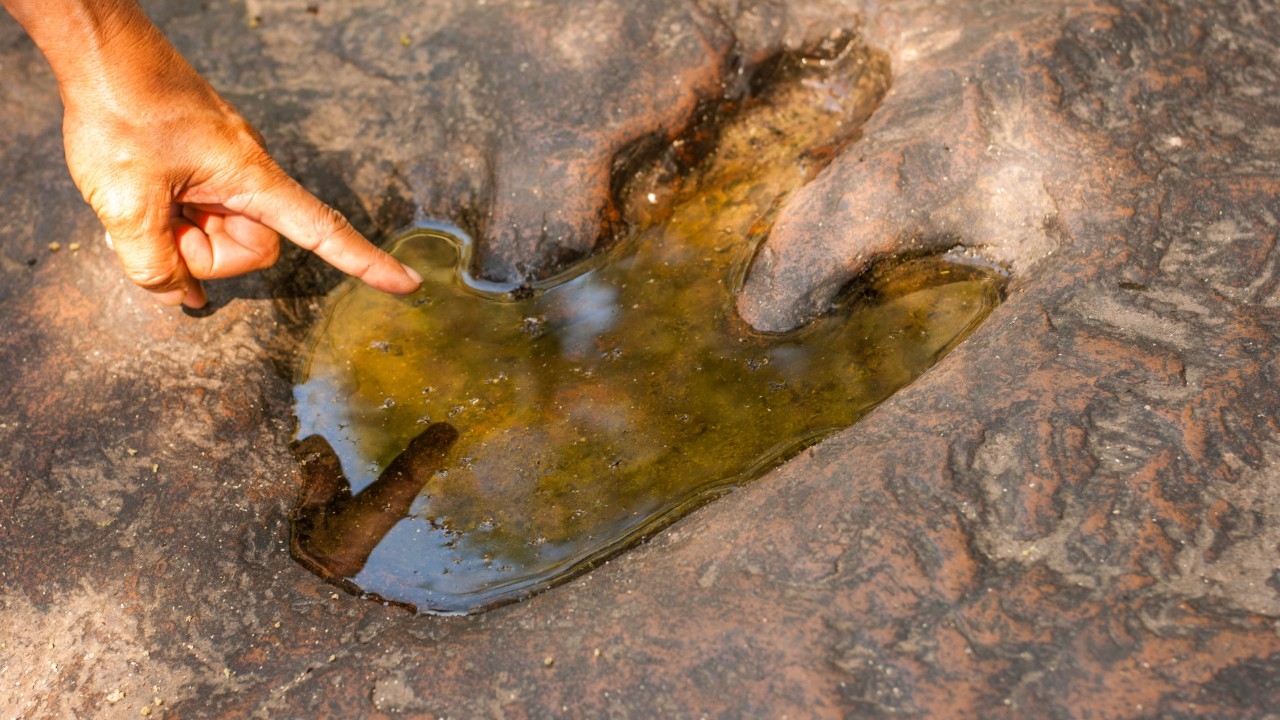
The discovery of " dinosaur footprints " at the stream near Tad Noi Waterfall within Phu Hin Chom That–Phu Phrabat National Park, Ban Phue District, Udon Thani Province, has attracted attention after tourists found strange marks on the rock surface. Preliminary assumptions suggest these could be carnivorous dinosaur footprints at least 120 million years old, pending expert verification.
This discovery raises the question: why do " dinosaur footprints " last for hundreds of millions of years, while human footprints can disappear within minutes? The answer may not depend solely on the dinosaur's weight but relates to geological processes. Thairath Online summarizes the explanation.
What causes dinosaur footprints? In fact, dinosaurs did not step directly on hard rock to make footprints, as many think. These traces formed when the area was soft, moist ground like mud or sand near rivers, floodplains, or ancient water sources.
As dinosaurs walked by, their weight pressed into the soft sediment, creating impressions shaped like their footpads and toes. If the sediment had just the right moisture, the imprint could hold its shape without collapsing or being washed away immediately.
Note: In geology, the preserved imprints of animals are called "footprints" (a technical term, not vulgar), such as dinosaur footprints. The term "footprint" is reserved for humans.

If new sediment later covered the footprint without destroying its shape, the impression could be preserved beneath layers of earth and gradually become a fossil.
Geologically, these footprints are classified as " trace fossils "—distinct from fossils of bones or teeth—because they evidence the activities of ancient life rather than body parts.

A dinosaur walks on wet mud or sand, its weight pressing down to create a footprint. If the ground is neither too wet nor too dry, the print is more likely to keep its clear shape.
As water drains from the sediment, the ground firms up, helping preserve the footprint's shape. The print need not be completely dry; the key is that it remains undisturbed until covered by new sediment.
Over time, sediment from water or natural processes gradually covers the footprint. Pressure and mineral cementation bind the grains into sedimentary rock like sandstone or shale, preserving the imprint inside.
After millions of years, uplift and erosion by rain, wind, or water wear away the rock layers, exposing the ancient footprints on the surface where they can be discovered today.

The main reason is that dinosaur footprints found today are not mere indentations in ordinary soil but impressions preserved within hard sedimentary rock layers, which are stronger and more durable than mud. Being buried under sediment for long periods protects them from erosion by wind, rain, and water, allowing footprints to survive for hundreds of millions of years.
However, not all dinosaur footprints become fossils. Most are washed away or trampled before sediment covers them. Even after fossilization, footprints can degrade once exposed due to natural weathering and erosion over time.

Dinosaur footprints are valuable not only for confirming the presence of ancient animals but also for helping scientists study past lifestyles and environments.
For example, measuring the spacing between footprints can estimate walking patterns and movement speed. Finding multiple trackways in one area may reveal whether animals passed through at similar times.

Additionally, footprint shapes can provide clues about weight distribution, movement, and the ancient ground's nature. Yet, interpreting complex behaviors like hunting or herding requires more evidence beyond a single footprint.
Dinosaur footprints are precious geological records that cannot be recreated. To preserve them for future generations, people should avoid stepping on, scratching, or touching the surfaces in ways that could cause damage.
Source of information : Department of Mineral Resources