

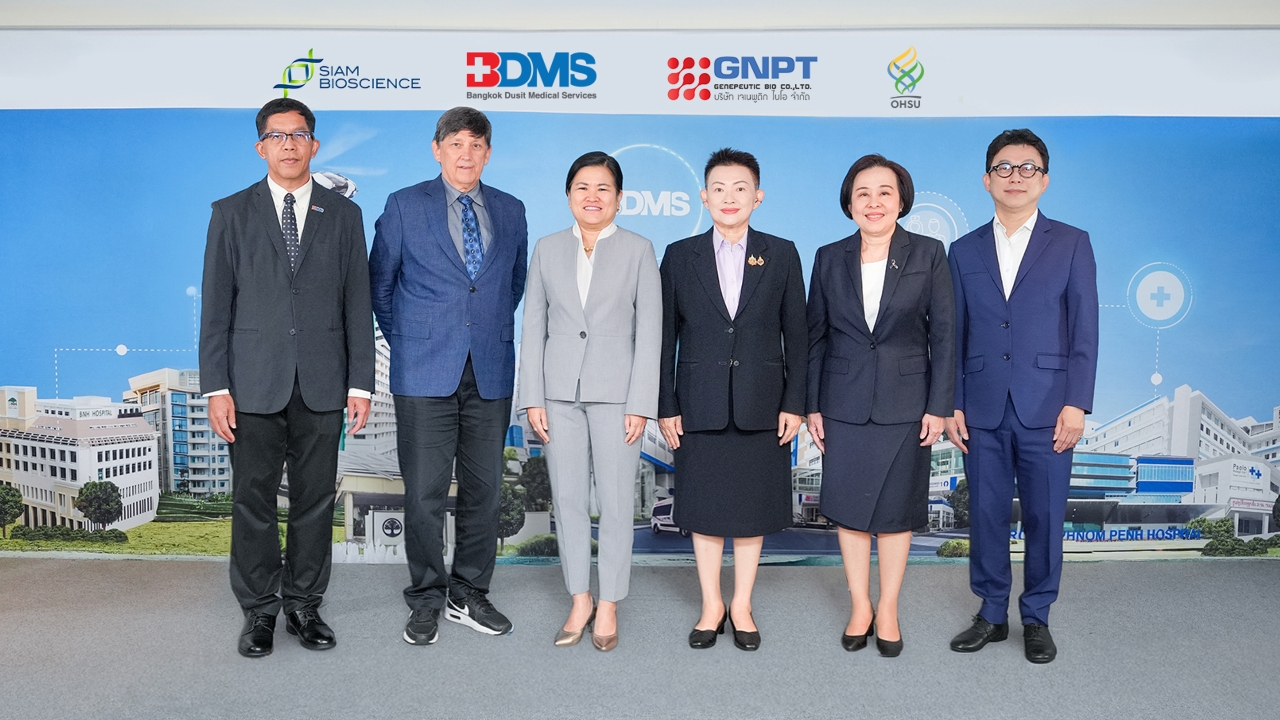
Bangkok Dusit Medical Services Public Company Limited (BDMS) is advancing collaborations in medicine and biotechnology with partners to further develop CAR-T Cell Therapy innovation, enhancing cancer treatment capabilities and driving sustainable development of Thailand’s biomedical innovation ecosystem.
This progress links clinical expertise, research and development of technology, and advanced medical product manufacturing capacity to translate innovation from the laboratory to real patient treatment, laying the foundation for expanding access to Cell & Gene Therapy (CGT) technology in Thailand and the ASEAN region.

One highlighted innovation advanced under this collaboration is CAR-T Cell Therapy, a cancer treatment technology using genetically modified T-cell immune cells designed to specifically recognize and destroy targeted cancer cells. This innovation represents a promising breakthrough for certain hematologic cancer patients, especially those with relapsed disease or who do not respond to standard treatments.

Dr. Kongkiat Kesaphet, Executive Director and CEO Group 6 of BDMS, shared the vision: “Current treatment advances go beyond drugs or surgery; we can now treat at the gene and cell levels (Cell & Gene Therapy).”
Currently, an estimated 1.5 million patients in Thailand require treatment using this technology, particularly those with specialized cancers and genetic diseases like thalassemia.
“The challenge is how to develop these technologies domestically to reduce dependence on foreign sources. Collaboration with various sectors—including medical schools, hospitals domestically and abroad, as well as Genepuetic Bio Company Limited (GNPT) and Siam Bioscience Group—is a crucial starting point for building a biomedical innovation ecosystem.” This aims to empower Thailand to sustainably develop and produce advanced medical technologies and become the ASEAN center for Cell & Gene Therapy. " Dr. Kongkiat added.

Professor Dr. Suradej Hong-Ing, a pediatric hematology and oncology specialist at Samitivej International Children's Hospital, emphasized that “This project is not as simple as it seems but represents a dream of the Thai medical community now realized. Developing CAR-T Cell Therapy from research to clinical use requires systematic, internationally standardized collaboration. GNPT plays a vital role in research, development, and production of Cell & Gene Therapy products, which involve complex processes and strict quality control.”

Dr. Surangkana Techapaitoon, Executive Vice President of Samitivej and BNH Hospitals and Director of Samitivej Sukhumvit Hospital, added, “As a physician and hospital representative, we have observed this treatment abroad for eight years, where costs reached tens of millions of baht, making it very difficult to implement in Thailand. But now, with the capability of Thai scientists and medical schools, we can produce CAR-T Cell products ourselves, which is highly encouraging and aims for the best outcomes.”
“Implementing this technology requires a supportive ecosystem, including skilled personnel and standardized protocols covering patient selection, cell collection, treatment, and patient monitoring and safety surveillance. Collaboration with foreign experts such as Oregon Health & Science University (OHSU) will enhance capabilities and enable rapid advancement without starting from scratch, supporting Thailand’s true emergence as a Medical Hub.”

World-Class Production at Accessible Prices Dr. Wantanee Watthana, Chairperson of Siam Biocell and Gene Company Limited, spoke about the production role, “A major challenge is making world-class quality treatment accessible to Thais at reasonable prices. Our collaboration with BDMS and GNPT focuses on developing CAR-T Cell Therapy and ATMP technology using internationally recognized GMP standards through a CDMO model. Currently, we have the capacity to produce for at least 500 patients, meeting Thai patient demand and aligning with government policies to attract foreign patients.”

Global expert Professor Richard T. Maziarz, Director of Gene and Cell Therapy Programs at OHSU Knight Cancer Institute and President of the American Society of Gene & Cell Therapy, praised Thailand’s potential at the press conference: “Based on U.S. experience, CAR-T Cell Therapy has proven effective in expanding treatment options for hematologic cancers, especially in patients unresponsive to standard therapies. I am impressed by the readiness of the hospital network and manufacturing capabilities in Thailand. The collaboration between OHSU and BDMS marks an important step in knowledge exchange and adapting world-class technology to suit Thai patient contexts and healthcare systems, leading to wider, safe, and sustainable treatment access.”
Regarding broad public access to treatment, executives stated that the current goal is to set treatment costs at about 3.5 million baht, with confidence that costs will decrease continuously as production scales up. The initial target is to produce 100 cases in the first year; if successful, Thailand will become a key global destination for CAR-T Cell Therapy treatment.
“This medical innovation is an investment in the future. If successful, not only will Thais receive advanced, affordable treatment, but it will also demonstrate to the world that Thai biomedical innovation can meet global standards,” Dr. Kongkiat concluded.