

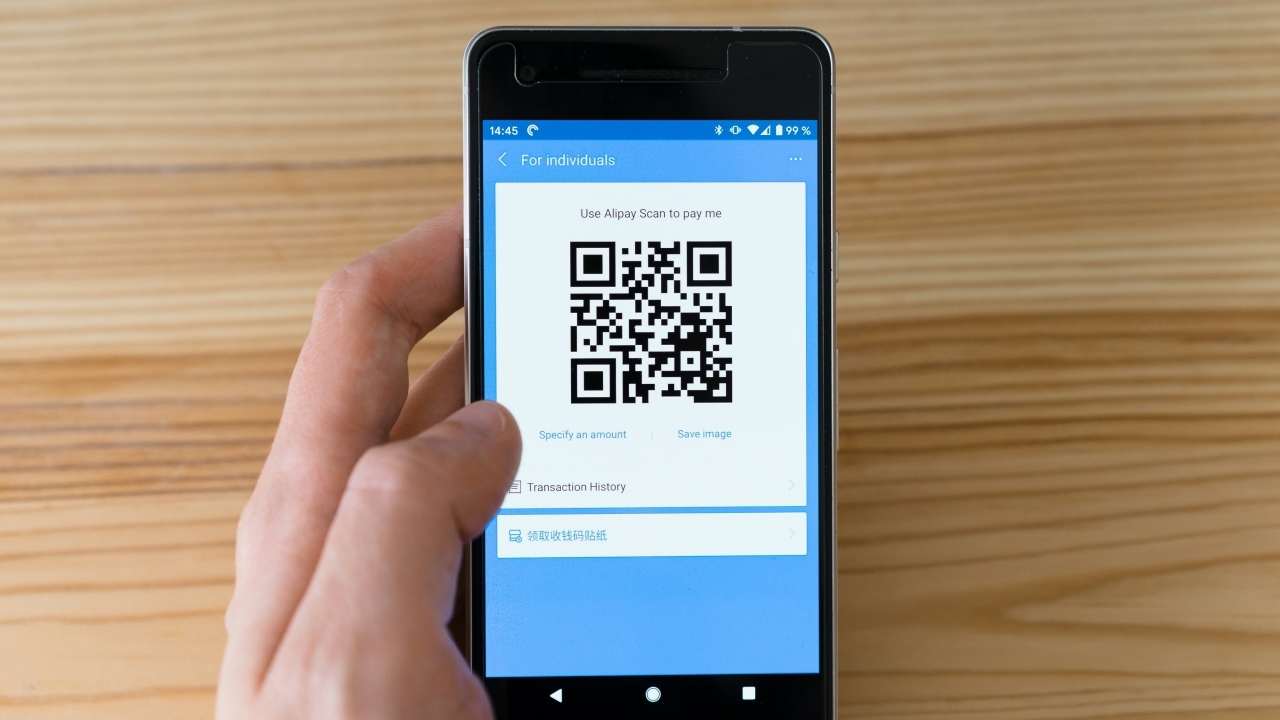
Tracing the legend of the two-dimensional code from DENSO WAVE's lab to a key mechanism driving a cashless society and a vital tool in combating the COVID-19 pandemic in recent years.
Today, it is undeniable that QR Codes have seamlessly become part of daily life, whether for scanning to pay for goods, accessing digital menus, or obtaining information at museums and public signs. This square with complex patterns has become a universal symbol for quick information access.
However, behind this innovation lies an interesting origin during Japan's economic crisis in the 1960s, when retail storesand supermarketsexpanded rapidly, causing employees to suffer injuries from manually writing prices and keying in data. This led to the development of barcode systems and POS machines.
Nevertheless, traditional barcodes had a critical limitation: they could store only 20 characters, which became insufficient for industrial needs in later years.

This challenge sparked DENSO WAVE, a subsidiary of DENSO CORPORATION, to accelerate development of a new data storage technology for the automotive industry, led by Masahiko Hara. Hara found inspiration during lunch breaks playing the board game"Go"(known as "Gomoku" in Japanese), which led to the idea of creating a two-dimensional code storing data vertically and horizontally, unlike barcodes that store data in one direction. Hara spent over a year experimenting to find the optimal ratio of white and black areas, settling on a 1:1:3:1:1 ratio. The design included square detection patterns or black modules that enable scanners to identify the code's position and orientation in 360 degrees without regard to scanning angle. As a result, the QR Code, launched in 1994, reads data 10 times faster than other codes and can store up to 7,000 numeric characters.

A key technical advantage of the QR Code over contemporaries was its resilience to damage; even if parts of the code were torn or stained, it could still be scanned and decoded. Another factor accelerating global spread was DENSO WAVE's decision to freely allow public use of the patented technology without fees. The arrival of camera-equipped feature phones in 2002 further enabled new marketing approaches like scanning coupons or accessing websites via mobile devices.
In Thailand, a significant turning point came in 2017 when the government promoted a cashless society through the PromptPay system, rapidly making scan-to-pay a mainstream behavior among Thais.
The QR Code's evolution peaked again during the COVID-19 outbreak in 2020, becoming essential for contactless living. It was used for digital check-ins to trace patient timelines and replaced paper menus to reduce disease transmission.

Although the pandemic has eased, global familiarity with QR Code technology has deepened. The code has evolved to version 40, adapting formats to diverse uses. It remains a core innovation tightly linking offline and online worlds until a more efficient technology emerges in the future.