

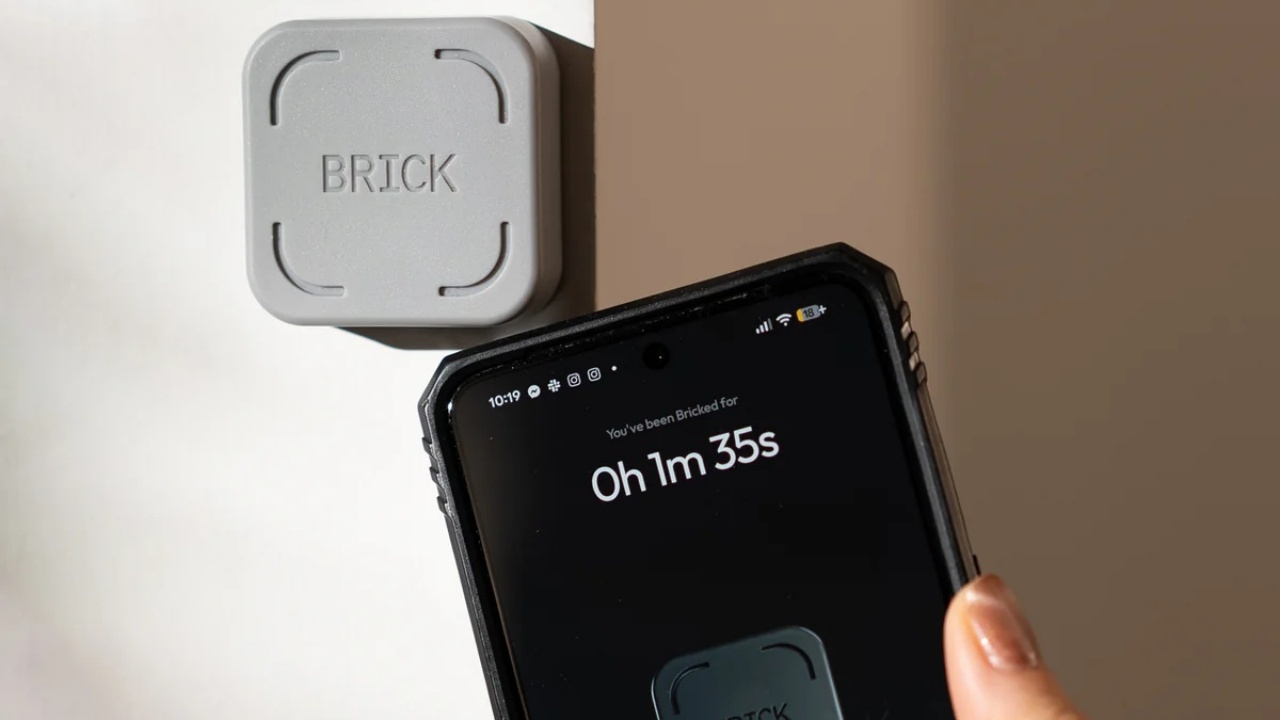
In a time when AI overwhelms the digital world, a group of consumers are willingly spending money on devices like Brick, Light Phone, and reMarkable to create obstacles for themselves in exchange for regained focus and lost time.
At the end of 2023, two computer science graduates in Wisconsin, USA, began selling a small device about the size of a tea bag, 3D-printed at home. They named it "Brick." They priced it at $59 USD (about 2,100 baht).
Using Brick is very simple: just tap your smartphone against the device, and pre-selected apps are immediately blocked. They can only be reopened by tapping the phone again. The core of this idea lies in "the placement." When Brick is attached to the refrigerator, anyone wanting to open social media must get up, walk to the kitchen, and tap the phone there. By the time they reach it, most people realize they actually don't want to open the apps at all.

Creating a $59 device to "reduce" the capabilities of a smartphone that costs thousands of dollars sounds contrary to what Silicon Valley has pursued for 20 years. Yet it works, as within a few months they sold over 2,000 home-produced units, sparking rapid growth in this product category—from Bloom's stainless steel cards serving the same purpose at $39, to Europe's Norma brand elevating the idea into a luxury product with a heavy stainless steel stand, no batteries, no monthly fees, priced around $70. The New York Times even predicted by the end of 2025 that function-reduced phones will become a new social status symbol.
For decades, the tech industry has competed on a single axis: "closing the gap" between desire and fulfillment. Amazon patented one-click ordering in 1999, Uber eliminated the need to call a taxi, Apple Pay lets you pay without a wallet, and now AI writes entire emails for us. Every advance has aimed to make everything easier and faster. So, the fact that consumers now seek to reclaim " discomfort" is a notable countertrend.
This phenomenon is reflected in the success of several hardware models—from minimalist smartphones like the Light Phone III priced at $699, which lacks even a browser or social media; to Switzerland’s Punkt brand selling about 50,000 simple phones annually; to the E-paper tablet reMarkable, which has no notifications but has generated over $300 million in revenue since 2022. What these companies sell, and consumers pay for, is " boundary-setting" in exchange for regained self-control and focus.

This idea aligns with the behavioral economics concept called the Ikea Effect, where people value items more when they assemble or create them themselves, like furniture we put together—even if imperfect, we feel it’s more valuable than ready-made products. In short, the effort invested changes both behavior and perceived value.
Strategically, the arrival of AI is driving the cost of producing digital content—whether text, images, music, or code—close to zero, creating an "overflow" on the internet. When such content becomes freely and widely available, qualities machines cannot produce—focus, self-restraint, and effort—become rare and increasingly valuable.
Ultimately, this consumer group is not rejecting technology but refusing the extreme convenience that makes every impulse effortless and every second designed to keep us glued to screens. The success of Brick, reMarkable, and Light Phone proves that "friction" once seen as a software flaw has become a key selling point. In an age of excess, the highest luxury may not be capability but the freedom and power to "say no." .
Source:Inc.