

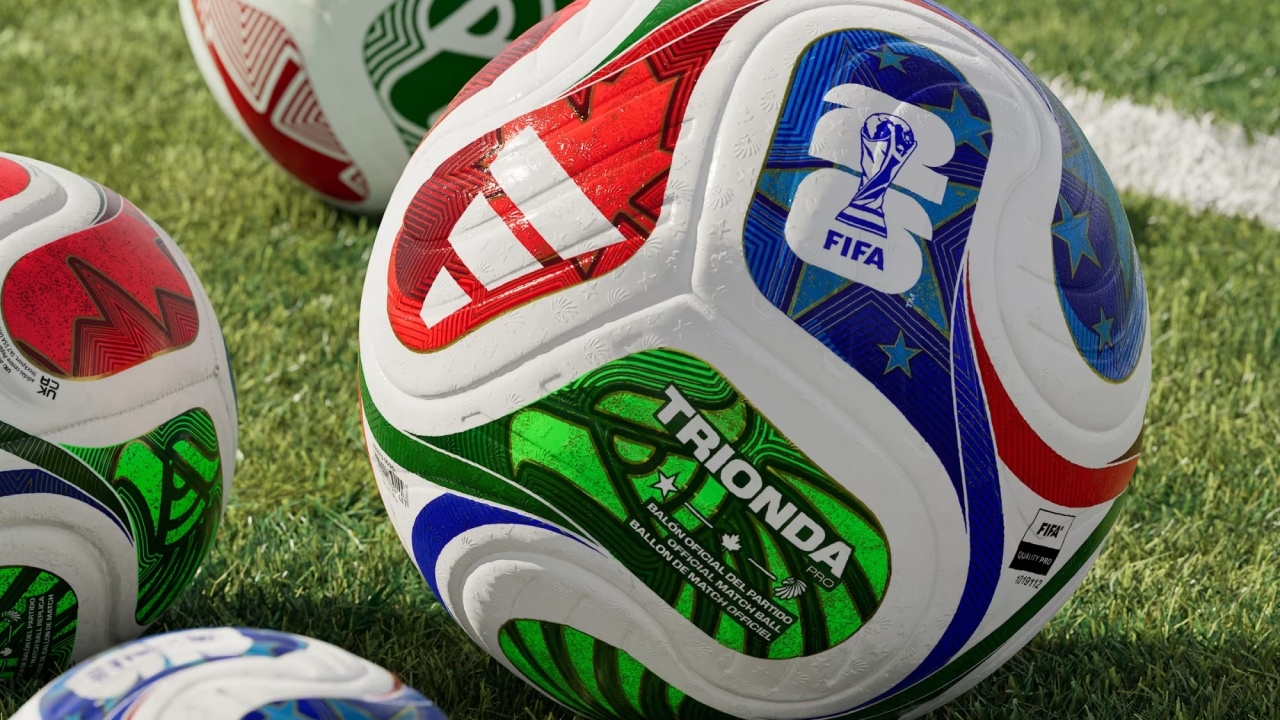
Research on the official football for the World Cup has found it affects acceleration, curve trajectory, and ball flight, alongside a redesigned VAR chip embedding structure.
The football used in the 2026 World Cup, named Trionda, is the first men’s World Cup ball in history to be made from only four panels. This design significantly alters how the ball cuts through air, accelerates, curves, and travels.
As is tradition for every World Cup, the tournament ball is unveiled with a design reflecting the three host countries: the United States, Mexico, and Canada. However, Trionda’s new four-panel heat-sealed and glued construction has raised concerns about its stability when used on the pitch.
John Eric Goff, a physics professor at the University of Puget Sound and co-author of research on football performance, explained in an article for The Conversation that reducing the number of panels to four shortens the total seam length, resulting in a smoother surface. This smoothness is crucial because the thin layer of air clinging to the surface determines where airflow separates, the size of ensuing vortices, and the amount of aerodynamic drag.
In the past, the Jabulani ball used at the 2010 World Cup in South Africa had similarly smooth surfaces, causing sudden changes in direction or abrupt speed drops mid-air. To address this, Adidas deepened the seams, added three deep grooves on each panel, and created a textured surface to enhance Trionda’s aerodynamic stability.
To test whether these changes effectively solved previous issues, Goff and his research team put the Trionda ball through wind tunnel tests to measure drag coefficients and analyze the critical drag crisis—an abrupt change in drag at certain speeds—comparing results with simulations of earlier World Cup balls.
Testing showed that Trionda’s critical drag speed occurs at about 43 km/h, lower than previous balls like Al Rihla (2022), Telstar 18 (2018), and Brazuca (2014), which ranged between 50-65 km/h, and well below Jabulani (2010), which reached 79-97 km/h.
This means Trionda’s rougher surface, compared to Jabulani, helps smooth airflow during short plays like corners or free kicks, increasing ball stability and reducing unpredictable swaying. However, at high speeds, the ball tends to lose distance more easily, so goalkeepers’ long kicks may drop slightly sooner than expected.
Goff noted that while the differences from previous balls aren’t huge, they’re enough for players to notice that long kicks might fall a few meters short of their intended targets.
Beyond surface texture, the research team also pointed out that integrating data connectivity technology affects the aerodynamics of this new ball.
Since 2022, World Cup balls have embedded chips transmitting real-time data to VAR and semi-automated offside systems. Previously, sensors were suspended near the ball’s core, but in Trionda, the sensor is embedded inside the inner structure of one panel, with weighted inserts in the other three panels to maintain balance.
The researchers clarified that their study cannot precisely predict ball behavior in every match since tests were conducted without spin, and real games involve many variables such as altitude, humidity, temperature, and air pressure that influence ball trajectory.
Nevertheless, this testing helps explain the physics behind spectacular goals or seemingly improbable striker errors, highlighting how every four years, new ball designs reveal the important role physics plays on the football field.
Source:Wired