

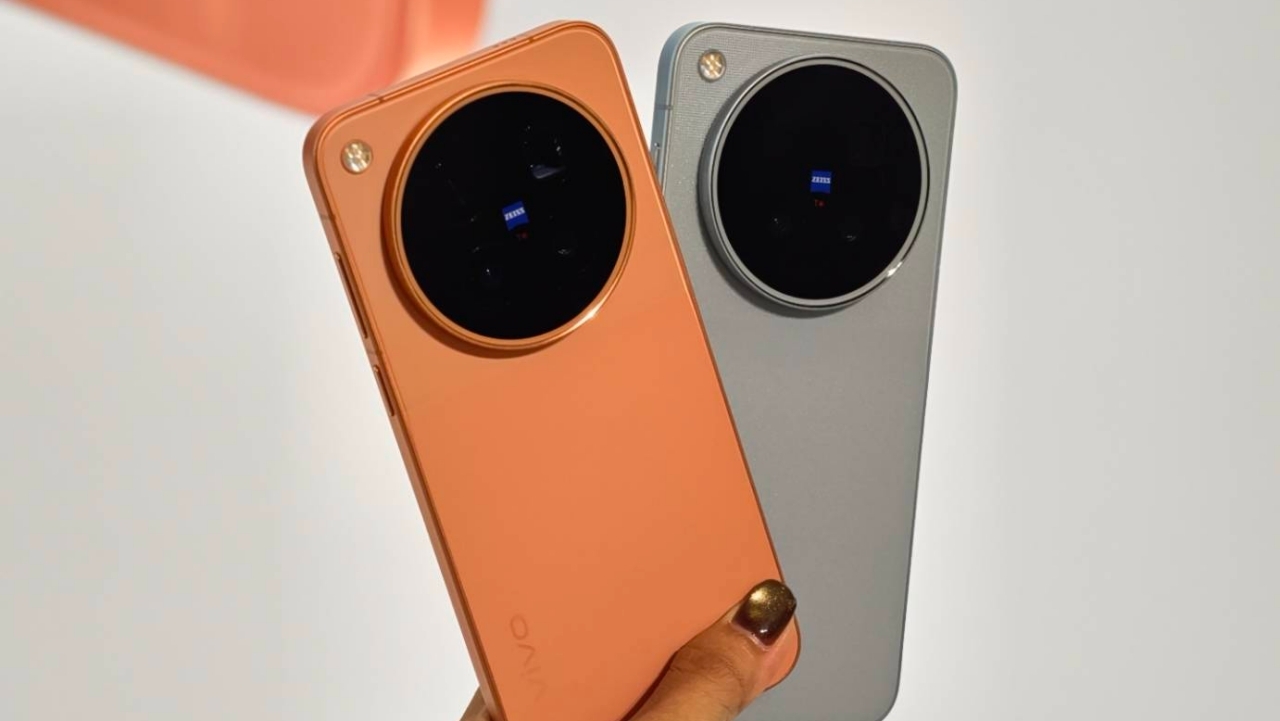
vivo officially launched the new X500 series smartphones, with the vivo X500 Pro Max as the current flagship model. Its main selling point is video recording, featuring a new main camera sensor capable of capturing video with a dynamic range of 17 EV. The device uses the Dimensity 9600 Pro chipset, MediaTek's first flagship 2nm chip.
In Shanghai, China, vivo introduced the X500 Series smartphones focusing on imaging quality developed in partnership with ZEISS. At the event, vivo noted that smartphone users increasingly use video and Live Photo features, but smartphone videos still face issues like shakiness and faces lacking bright tones. Therefore, vivo emphasized photography capabilities for the X500 Series launch.

The main camera on the X500 Pro Max is the ZEISS TrueDynamic with 50 megapixels, using a new Sony LYTIA L910 sensor co-developed with vivo. It measures 1/1.28 inches with an f/1.57 aperture and a focal length equivalent to 24mm. It features a 3-axis gimbal-style stabilization system.
This sensor employs LOFIC technology, which adds an overflow storage area beside each pixel to capture excess light that would normally cause bright parts of the image to wash out to white. This increases dynamic range for both stills and video. vivo states this sensor captures six times more light than the previous model.
Additionally, vivo upgraded the sensor's signal reading method from a two-level DCG used in the X300 Pro to a three-level TCG, improving light measurement accuracy across bright, mid, and dark areas. Noise during reading is reduced to 0.75 electrons, which vivo claims is the lowest ever in a smartphone camera. This helps preserve facial detail in backlit images.
Combined, the main camera achieves a video dynamic range of 17 EV, meaning it can capture brightness differences between the brightest and darkest points in a single frame by about 130,000 times, up from 14 EV in the X300 Pro. vivo emphasizes this is a real user-experienced value; the design target is 18.4 EV, comparable to professional cinematography cameras.

The X500 Pro Max’s ZEISS APO telephoto camera features a 200-megapixel resolution using Samsung’s 1/1.4-inch ISOCELL HP0 sensor with an f/2.67 aperture and a focal length equivalent to 85mm. vivo notes this is the same sensor used in the X300 Ultra.
Both the main and telephoto cameras offer CIPA 7.0 level stabilization and support ZEISS teleconverter lenses extending focal length to 400mm equivalent.
The 50-megapixel ultrawide camera uses a JN5 sensor sized 1/2.75 inches with a 15mm equivalent focal length, replacing the JN1 sensor from the previous model. vivo says this improves focusing performance. The front camera has a 50-megapixel resolution.
For video, the X500 Pro Max records Log format at a 17 EV dynamic range and can shoot slow-motion at 4K 240 frames per second. vivo states every frame is sensor-captured without interpolation. Autofocus tracking operates at 60 fps on both main and telephoto cameras. Features include Stage Mode 3.0 for concert filming and four microphones for audio recording.

Simultaneously, the vivo X500 Pro Max and X500 Pro are the first two smartphones to use MediaTek’s Dimensity 9600 Pro chipset, launched on 15 September. This is MediaTek’s first chip built on TSMC’s 2nm architecture. The CPU has eight all big cores with two high-performance cores. vivo states it collaborated with MediaTek on this architecture.
The X500 Pro Max features a 6.85-inch ZEISS Master Color display with 2K resolution (1440 x 3168 pixels), a refresh rate adjustable from 1 to 144 Hz, peak brightness of 4,400 nits, Dolby Vision support, and is protected by Armor Glass.
This display uses BOE’s new Q11 luminous material, making the X500 Pro Max the world’s first smartphone with a 2K Q11 panel. vivo says co-development of materials and display driver circuits with BOE reduces power consumption by 21% compared to previous models.
The specifications for the vivo X500 Pro Max sold in Thailand differ slightly from the Chinese version. The Thai model has a 7,800 mAh battery, while the China version has 8,000 mAh. Both support 90W wired and 40W wireless fast charging. Memory options include 12GB RAM and storage of 256GB, 512GB, and 1TB.
The phone measures 8.12 mm thick and weighs 229 grams, except the black color variant, which uses fiberglass material, making it thinner at 7.95 mm and lighter at 225 grams. The device has IP68 and IP69 water and dust resistance and features a 3D ultrasonic fingerprint scanner.

The device comes in four color options:
Availability may vary by region.

The vivo X500 Series runs on OriginOS 7, which includes the Origin Workbench feature for multitasking with multiple apps.

The vivo X500 Pro is a smaller model with a 6.36-inch 1.5K display, powered by the Dimensity 9600 Pro. It shares the LYTIA L910 main camera sensor with the X500 Pro Max but has 1.5-degree stabilization. Its telephoto camera uses a Sony LYTIA 610 sensor with 64 megapixels and an 85mm equivalent focal length. The battery capacity is 6,510 mAh.

The standard vivo X500 uses the Dimensity 9600M chipset with a 6.59-inch screen. Its main camera uses the Sony LYTIA 828 sensor, the same as in the X300 Pro. The telephoto camera uses the LYTIA 610 sensor, like the X500 Pro. The battery capacity is 7,500 mAh.
Details on availability in Thailand will be announced later by vivo Thailand.