

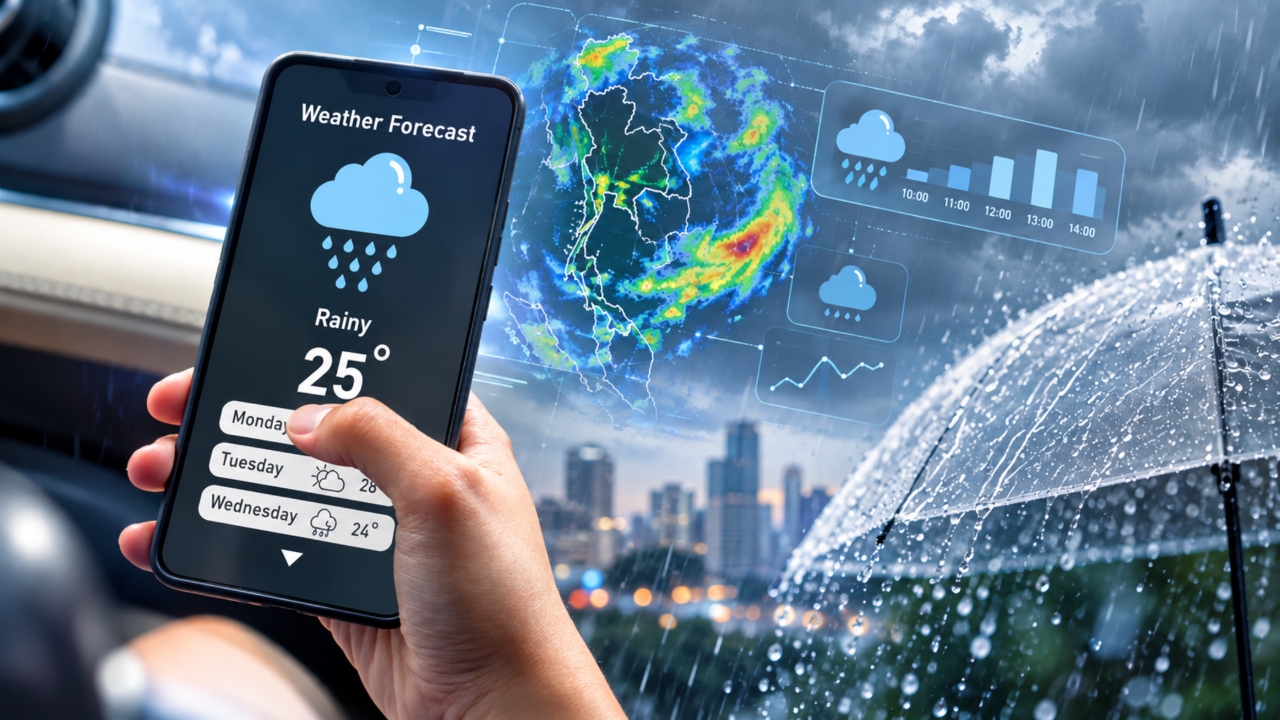
Checking the weather forecast before leaving home has become a routine for many, especially during periods of rapidly changing weather. Rain arriving earlier or later than expected by just a few hours can affect both travel and daily planning.
Recently, Google DeepMind and Google Research have launched WeatherNext 3, a new global AI weather forecast model that uses the latest weather data for predictions, updating forecasts every hour, increasing data resolution, and improving rain prediction accuracy. This technology has already begun to be integrated into various Google services.
WeatherNext 3 is a global AI weather forecast model developed by Google DeepMind and Google Research. Google describes it as its most advanced and accurate AI weather forecast model to date, and it is the company's first global weather model capable of generating new forecasts every hour throughout the day.

One highlight of WeatherNext 3 is its update frequency. The model uses global satellite imagery refreshed every hour combined with other weather data to produce new forecast sets hourly.
The benefit of more frequent updates is that the model can incorporate the latest weather conditions more quickly, especially for phenomena that can change rapidly, such as weather fronts, storms, or rain systems.
However, hourly updates do not guarantee 100% accurate predictions, as the atmosphere remains inherently uncertain and forecasts may change as new data arrives.
In addition to more frequent updates, WeatherNext 3 increases the spatial resolution of forecast data. Key surface variables like temperature and humidity are now available at 5-kilometer resolution, some surface variables at 10 kilometers, and atmospheric variables such as wind speed at 25 kilometers.
Overall, Google states that WeatherNext 3 provides global weather forecasts about five times more detailed than WeatherNext 2, which previously produced forecasts on a 25-kilometer grid every six hours.
This increased resolution helps the model better reflect differences in areas with complex geography, such as coastlines, valleys, or mountains, where temperature and humidity can vary significantly even within a few kilometers.

WeatherNext 3 can be applied to various areas, from agriculture, travel, and outdoor activities to energy management. It includes additional data for renewable energy, such as wind speed at 100 meters, cloud cover, and solar radiation, assisting in estimating power generation from wind and solar sources.
Regarding rain forecasting, which is notoriously difficult, WeatherNext 3 has been trained with high-quality rainfall data from NASA’s IMERG, as well as satellite and radar data to improve prediction accuracy.
Google states that for planning one day or more in advance, rain volume forecast accuracy can improve by up to 50%, especially in areas that were previously hard to predict.

Although WeatherNext 3 enables faster, more detailed, and more frequently updated weather forecasts using AI, it serves as a platform and tool for checking weather conditions and does not replace official meteorological agencies. For severe weather or warnings, it is essential to follow announcements from the Meteorological Department and official authorities.