

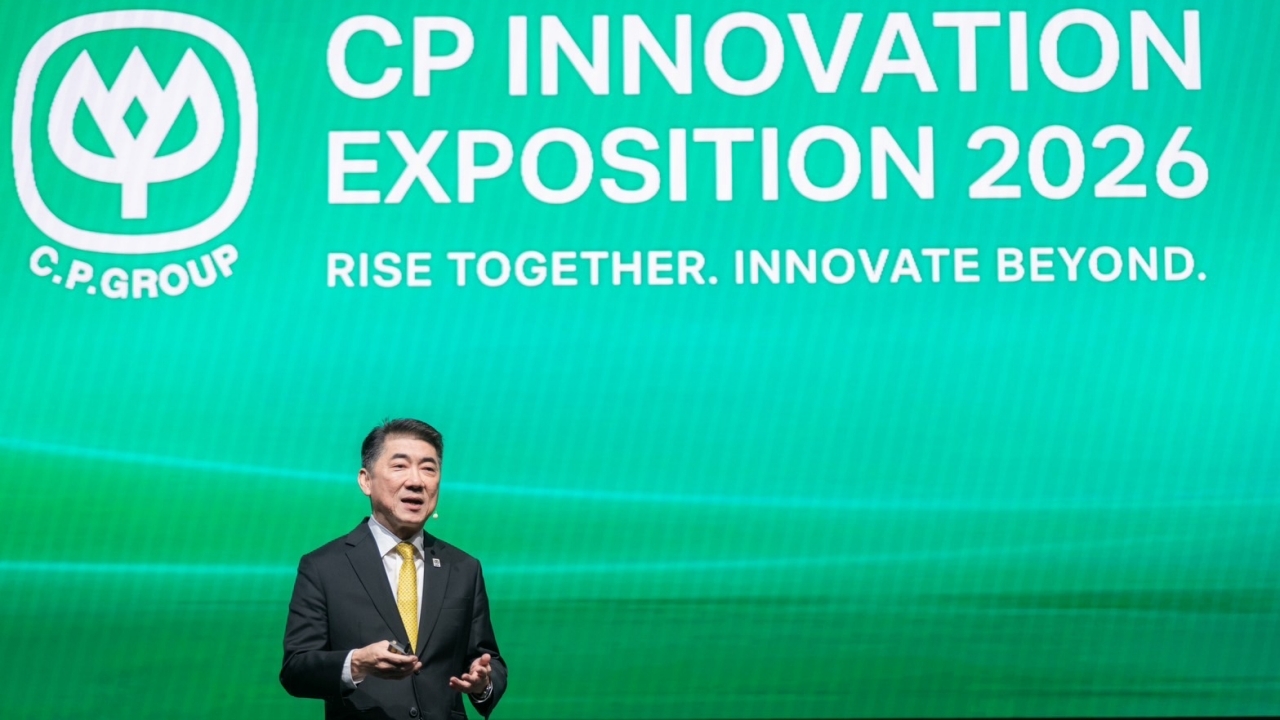
CPF has adopted a new role as a builder of national capabilities. Meanwhile, McKinsey points out that the key challenge of AI is leadership, not technology, itself.
Mr. Prasit Boondoungprasert, CEO of Charoen Pokphand Foods Public Company Limited (CPF), said at the Beyond Global Food: Innovating for a Food-Secure Future seminar during the CP Innovation Exposition 2026 at True Digital Park on 22 Oct 2023 that Thailand must shift its food industry growth engine from volume-based growth to productivity and value growth, using AI as a key tool throughout the food supply chain.
Mr. Hai Ye, senior partner at McKinsey & Company, stated that AI could revolutionize the food industry if used to manage volatility and connect decision-making from animal feed and farms all the way to consumer food products.

Mr. Prasit noted that Thailand has long been a major food exporter globally, but this status is primarily volume-based. The country has many farmers, yet actual sales and income remain relatively low, and productivity development in the industry has been slow.
Therefore, the next challenge is to use existing volume to create added value through three approaches: enhancing productivity so individuals can create more value using AI, automation, and digital technology; transforming commodities into value-added products and commercializing research; and expanding Thai values globally through market access, branding, free trade agreements, and worldwide networks.
Regarding AI's role, Mr. Prasit explained that CPF's value chain spans from upstream to downstream—starting with animal feed, farms, slaughterhouses, processing plants, and supply chains to the customer's table—allowing AI use at every step. This includes forecasting production and animal health on farms, automation, image-based quality inspection, predictive maintenance in factories, demand forecasting and traceability in supply chains, and developing personalized innovations and products for consumers by integrating data across the entire process. He sees AI as a top hope for boosting productivity and accelerating development of both animal feed and human food formulas.
Thailand must accelerate adaptation because Mr. Prasit predicts that in the next 10 years, food could become a strategic asset for countries due to three pressures: geopolitics, including war, polarization, and trade restrictions; climate change causing droughts, floods, and fluctuating yields; and countries prioritizing food sufficiency. He cited frequent severe flooding in Thailand and questioned how long traditional rice farming methods can continue.
At the same time, Mr. Prasit believes Thailand has a solid foundation to build on, including comprehensive agricultural and supply chain bases, biodiversity and research, export experience with safety standards and traceability, and global market connections—enabling Thailand to potentially become a global food security hub.
CPF aims to transform from a national food company into a National Capability Builder, committing that every new investment must simultaneously build new capabilities for Thailand alongside business returns. It plans to share and develop national capabilities in five areas: productivity, innovation, high-value exports, human capital, and elevating ecosystems encompassing farmers, SMEs, startups, and universities.
CPF showcased technologies supporting animal feed and breeding customers, ranging from basic services like electrical system inspections, pest control, and standards systems to Egg Digital, which reduces losses from cracked eggs; AI Vision for animal health analysis; Smart Energy for efficient power use; and Smart Farm Solution, which shifts farm management from relying on personal experience to data-driven control through automated environmental management, AI assistants diagnosing health and advising 24/7, and data analytics for improvements. Mr. Prasit said farm management previously relied on passed-down experience, which raised sustainability questions. CPF is therefore developing knowledge systems with customers and expanding platforms for wider use.
CPF places strong emphasis on ecosystem enhancement through its Partner to Grow program, supporting 5,500 partners according to data presented. Mr. Prasit stated that sustainable growth for CPF depends on sustainable growth across the entire supply chain.

Mr. Hai Ye, who began his career as a scientist in weather and agricultural forecasting, questioned whether AI in the food industry is merely a novel invention, an innovation transforming income and business, or a revolution changing work methods. He noted that the food industry has one of the most complex value chains globally and faces greater volatility than consumer goods sectors, which are easier to forecast. Organizations can control internal factors like operations, data structure, innovation investments, and product portfolios, but not geopolitical uncertainty, price fluctuations, or weather. He thus views AI fundamentally as a tool for managing uncertainty and volatility.
However, Mr. Hai Ye observed that most organizations have not realized business-level benefits from AI. Citing McKinsey’s 2026 survey, 80% of respondents said AI improved individual productivity, but only 6% qualified as high AI adopters. Most organizations use AI in isolated cases instead of redesigning cross-functional decision-making systems.
He added that when companies ask why they don’t see AI’s value, the issue is not technology but leadership, since AI is merely a tool and no one can predict which model will prevail.
Mr. Hai Ye noted that currently China has at least seven major AI models and the U.S. five. Organizations need not commit to a single model. He offered five leadership recommendations: set clear, ambitious goals; redesign cross-functional workflows end-to-end; cultivate AI-savvy leaders; make data accessible and trustworthy; and scale what works.
Another point Mr. Hai Ye emphasized is connectivity—excelling in just one part of the chain doesn’t give a company a true competitive edge. AI’s value lies in bridging gaps between steps, using consumer demand signals to guide upstream decisions back to farms and animal feed.
After the seminar, Mr. Prasit told reporters that the most important strategy for food security is technology, starting with the fundamentals like plant and animal genetics, which the CP Group has long developed for corn, shrimp, and pork. Then come automation and robotics, with AI layered across the entire supply chain to reduce system volatility through predictive problem-solving and to boost productivity in production and decision-making.
Regarding food security, Mr. Prasit admitted some concern about how prepared Thailand and ASEAN countries are for increasingly frequent environmental problems. Thais are accustomed to abundance—fish in water, rice in fields—and thus less aware of these issues, unlike Europe, which has long faced climate challenges. In the past 5–10 years, many countries have significantly increased focus on food security, especially when environmental or epidemic crises arise.
He cited reports of some investors buying agricultural land as a security asset. Nonetheless, Mr. Prasit sees Thailand’s location as an advantage, with less extreme climate fluctuations than Europe or parts of China, combined with growing global popularity of Thai food. CPF plans to expand its ready meal offerings in global markets accordingly.
The event also featured panel discussions with CPF, experts from Boston Consulting Group (BCG), food technology and biotechnology academics from Mahidol University, and lessons learned from CPF’s real-world AI implementations.