

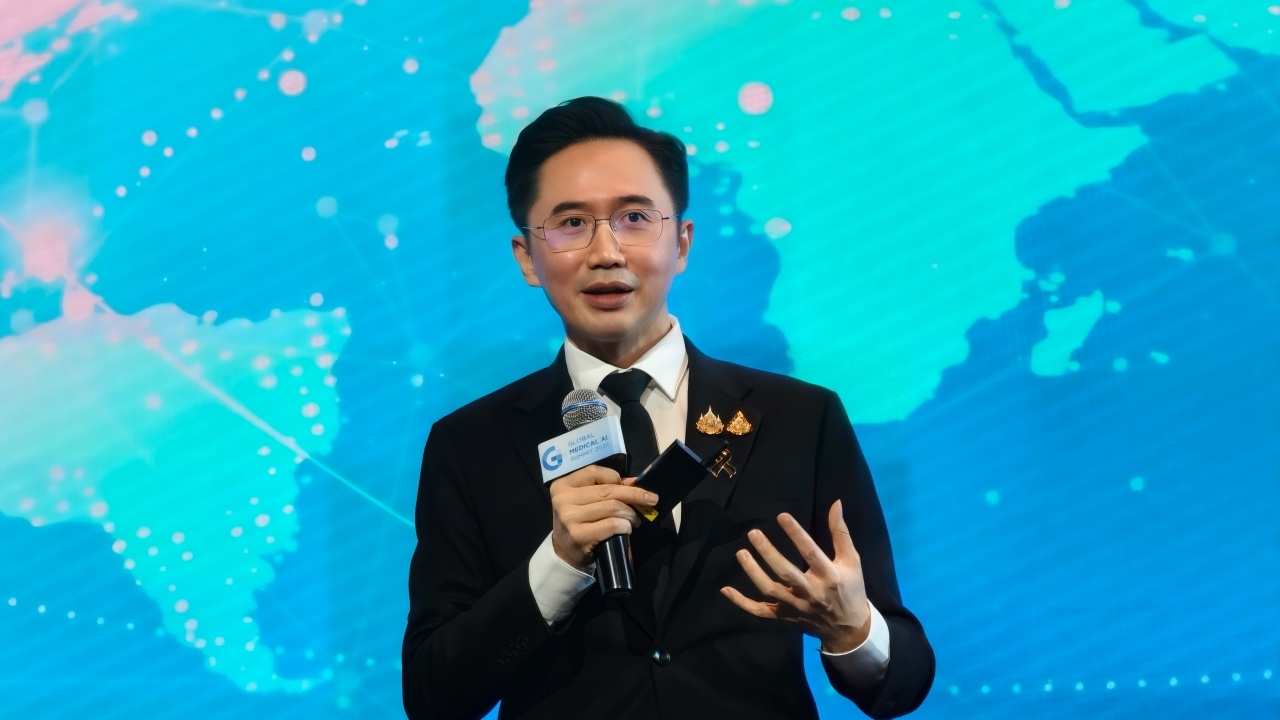
Deputy Prime Minister Yotsanan outlined seven missions of the National Strategic AI, using Thai clinical and population biology data as key advantages. Meanwhile, RISE's SEA HI Hub aims to reach 100 million patients within three years.
Yotsanan Wongsawat, Deputy Prime Minister and Minister of Higher Education, Science, Research and Innovation (MHESI), delivered a keynote titled "Opening the Gateway: The Future of Thailand’s Healthcare and Medical AI" at the Global Medical AI Summit 2026 on 30 October at the Grand Hall, True Digital Park. He stated that Thailand cannot compete by creating general AI but must develop problem-solving approaches to transform from an AI user into a global deep tech producer. He proposed a framework called National Strategic AI with seven missions: Medical Foundation Models, AI in Genomics and Precision Medicine, Generative Bio and New Drug Discovery, Human Digital Twins, AI in Brain and Neurotechnology, AI Cancer Detection, and Trusted Clinical AI Agents, all connected by Thailand Digital Biome as the central hub.

Yotsanan further explained that MHESI has established three national investment screening criteria: first, addressing unanswered scientific questions and creating new knowledge, rather than merely applying existing technologies.
Second, investments must leverage Thailand’s unique strengths, including clinical data, population biology, biodiversity, and domestic researchers' expertise. Third, outcomes must yield dual benefits: measurable improvements in Thai public health and the creation of globally competitive export industries.
The MHESI minister also discussed innovation promotion mechanisms from universities to market via 15 University Holding Companies (UHCs) nationwide, united as the UHC Consortium. This includes three main programs: UHC Synergy for co-investment, UHC Venture Builder for spin-off business creation, and UHC Innovation Catalyst to access capital markets and international partners. Supported by agencies like the National Innovation Agency (NIA) and the Stock Exchange of Thailand, these efforts align with MHESI’s New Growth Engine concept to position Thailand as a Medical AI Hub and one of the service sectors driving the country toward high-income status.

Supachai Pachariyanon, founder of RISE, in his talk "Thailand's Medical AI Through Global Eyes," echoed Yotsanan’s views, noting that although Thailand and ASEAN lack extensive personnel, funding, and infrastructure to develop foundational AI technology at the scale of the US, China, or Europe, they have the opportunity to lead in applying AI technology effectively in patient care to improve health outcomes.
Supachai added that medical AI is rapidly entering clinical practice, citing an American Medical Association (AMA) survey showing over 80 percent of US physicians now use AI in their work, up from 38 percent in 2023.
However, the main obstacles for medical AI companies are not technology itself but clinical evidence, integration with hospital workflows, business models clarifying payment responsibility, and physician trust. On average, companies take 12 to 18 months to sell their systems to hospitals.
Supachai gave an example of a San Francisco-based medical AI device company developing technology to replace echocardiograms. It conducted clinical trials in the US for six months without enrolling any patients, but after moving to Thailand under US FDA standards, it enrolled 50 patients within six weeks. Thailand has now become the company’s largest patient recruitment site. Additionally, RISE is assisting a San Diego biotechnology company using AI for cancer drug discovery to begin its first human trials in Thailand. This approach not only offers Thai patients access to new innovations but also generates work for domestic clinical research organizations (CROs) and provides Thai researchers opportunities to learn commercial translation of research.
These efforts are carried out through the SEA Health Innovation Hub (SEA HI Hub), a nonprofit established by RISE and SeaX Ventures to address three challenges for medical AI companies: clinical testing, hospital implementation, and regional business expansion. The hub connects public and private hospitals and medical schools across ASEAN and collaborates with regulators to expedite approvals. Supachai noted that in about nine months, the network includes 50 partner health systems reaching roughly 30 million patients, aiming to expand to 100 million patients within three years.
The Global Medical AI Summit 2026, organized by RISE and the Thailand Artificial Intelligence Entrepreneurs Association, gathered startups, investors, physicians, hospitals, and business partners in a single event featuring panels on AI use in hospitals, startup pitch contests, and innovation exhibitions.