

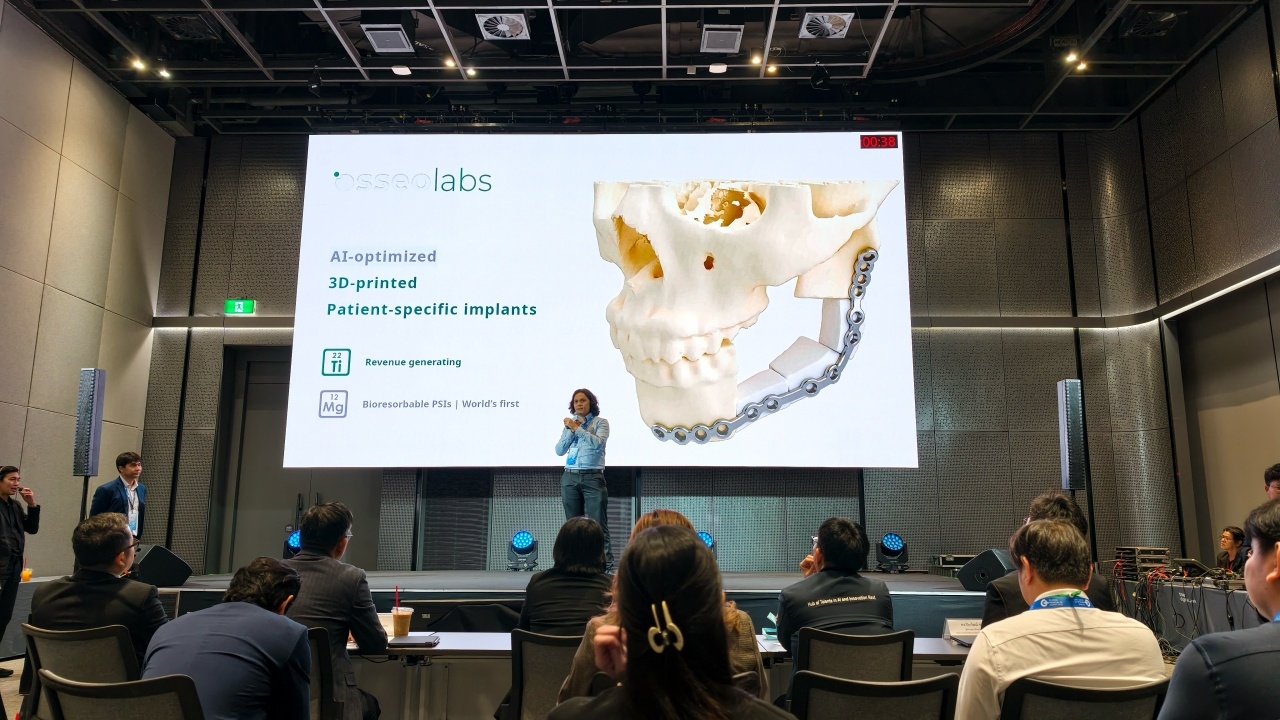
OsseoLabs uses AI to design patient-specific jaw fixation plates, reducing waiting time from 14 days to just 1-5 days.
OsseoLabs, a Thai medical technology startup, introduced OsseoVision.The softwareis an AI platform for planning surgery and designing personalized jawbone fixation plates. Presented at the Medical AI Pitch Competition during the Global Medical AI Summit 2026 on 30 Oct 2026 at True Digital Park, it claims to shorten the time from CT scanning to ready-to-use fixation plates and bone cutting guides from an average of 14 days to only 1–5 days.

In reconstructive lower jaw surgery, such as for tumor patients, surgeons typically use metal plates to hold the jaw during bone healing. The common method involves manually bending metal plates during surgery to fit the patient's jaw, which is time-consuming and less precise. Alternatively, patient-specific 3D-printed fixation plates require an average wait of 14 days after the CT scan.
A representative from OsseoLabs explained that the bottleneck is not the 3D printer but the design process. Each fixation plate and bone cutting guide must be designed manually by skilled biomedical engineers using general CAD software, which the company records as taking over 20 hours per case. Given this long wait, trauma patients needing surgery within a few days rarely get patient-specific plates and must use standard plates instead.
OsseoVision is a web-based platform that requires no software installation. Surgeons upload the patient's CT images, and the AI separates the skull, jaw, teeth, and nerve canal into 3D models, allowing doctors to visualize nerve positions that are normally invisible during surgery.
For tumor patients, the system includes another AI model that reconstructs diseased bone areas into normal bone images for planning. Once the surgeon sets the bone cut lines, screw positions, and plate placement, the system automatically generates the fixation plate and bone cutting guide designs within minutes.
OsseoLabs emphasized that every step involves human verification—3D models, design files, and printed parts are checked, and no design is sent to print without approval by qualified engineers. Since these relate to patient safety, parts are 3D printed from titanium and polymers in the company's cleanroom, certified by Thailand’s Food and Drug Administration and ISO 13485 medical device standards. The fastest production time is three days. Additionally, the company’s AI model for jaw structure segmentation holds Medical AI certification from the Artificial Intelligence Association of Thailand.

Currently, OsseoLabs’ services are used by 120 surgeons in 70 hospitals across Thailand, Malaysia, Singapore, and India, covering over 410 cases.
A representative said that the 1–5 day timeframe will enable trauma patients, such as motorcycle accident victims who should ideally undergo surgery within about 7 days, to receive patient-specific fixation plates in the future.
However, use for trauma cases is still under development, and presently the system supports only lower jaw reconstruction surgeries, with titanium fixation plates as the main revenue-generating product.

Regarding business plans, OsseoLabs is expanding into Vietnam and aims to enter the European market in 2027. The company plans to apply for US FDA Software as a Medical Device certification for OsseoVision in 2028. It is also in discussions with major global medical device manufacturers to license this technology.