

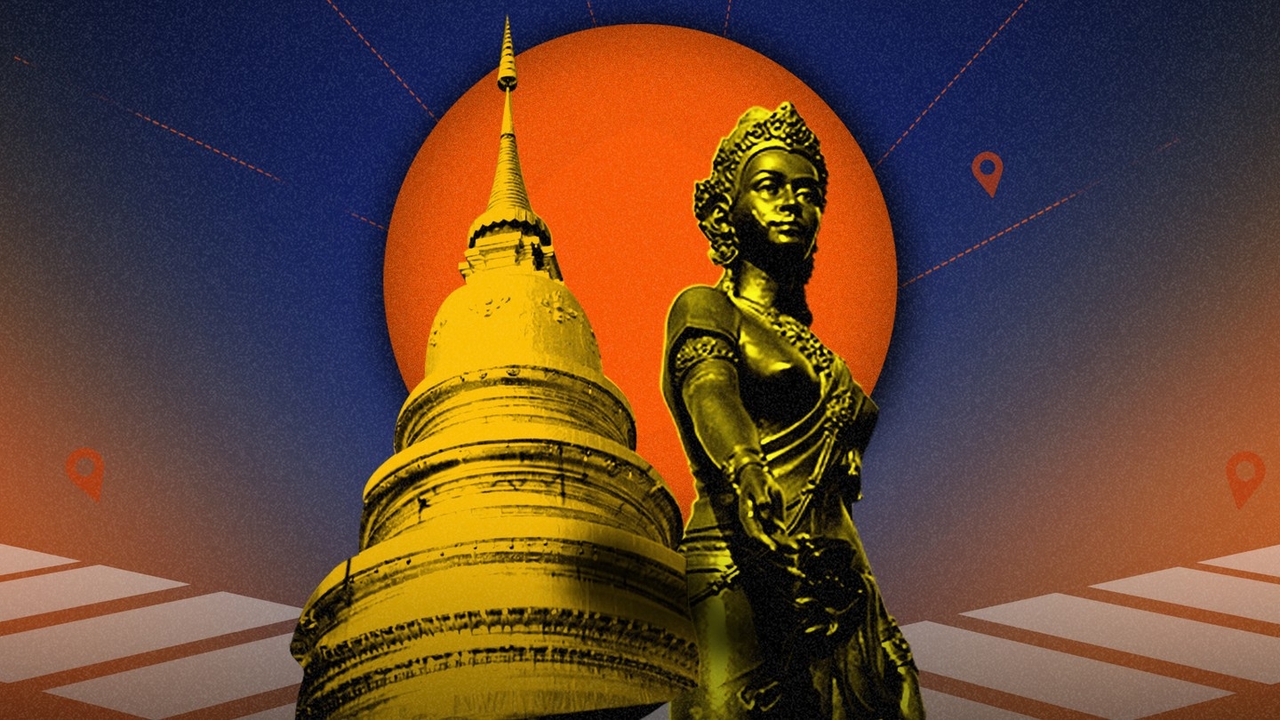
Lamphun Province, formerly known as "Nakhon Hariphunchai," is a city with a history spanning over 1,300 years. It is renowned for the story of Queen Chamthewi, the first female monarch, who skillfully laid the foundations for Buddhism and cultural arts that continue to flourish to this day. Follow the full story on the program “LokwiWalk,” airing every other Tuesday at 7:00 p.m. on YouTube: Thairath Studio.
Hariphunchai Stupa is the birth-year stupa for those born in the Year of the Rooster. Lanna people believe that before birth, a human soul resides at the stupa awaiting incarnation. At birth, the soul moves to the father’s crown for seven days, then enters the mother's womb. Upon death, the soul returns to the original stupa it came from.

These beliefs create a strong bond between the Lanna people and their birth-year stupas, linking the cycle of birth and death. Hariphunchai Stupa not only embodies the faith of Lamphun’s people but also connects to the legend of their first female monarch.
The land of Hariphunchai. This was the original name of Lamphun Province and the site of the Hariphunchai Kingdom. According to legend, the hermit Vasuthep founded the kingdom and invited the royal daughter of the Lavo Kingdom, Queen Chamthewi, to rule as the first monarch.
Queen Chamthewi’s history is recorded in chronicles and inscriptions and is considered a foundational Buddhist legend in northern Thailand. Her story relates to the founding of Hariphunchai and stems from local oral traditions, which vary in their versions.

Some legends say she was a commoner’s daughter born in Lamphun who studied in Lavo and later returned to govern Hariphunchai. This version is depicted in murals found in several Lamphun temples.
Another version, from the Pali Studies Thada, tells of the Buddha’s prophecy about the site for enshriningthe relics of Sarirathat.It recounts that hermits Vasuthep and Sukattan built the city of Hariphunchai. Hermit Sukattan requested Queen Chamthewi, the daughter of Lavo, to rule Hariphunchai. Later, when King Milakku attempted to seize Hariphunchai, her two princes fought to expand the kingdom and founded Khelang Nakhon, now known as Lampang.
The Lampang city website recounts that around 657 CE, hermits Vasuthep and Sukattan built Hariphunchai. The ruler of Lavo gave his daughter to govern the city. At that time, the queen was pregnant with twins and brought 500 doctors, scholars, artisans, wealthy people, and nobles with her, fostering prosperity and Buddhist development. She gave birth to twin princes: the elder “Chao Mahantayotkuman” ruled Hariphunchai, while the younger “Phra Antayotkuman” served as deputy ruler. Later, the younger prince was crowned ruler of Khelang Nakhon.
The territory of the Hariphunchai Kingdom mostly covers present-day Lamphun Province and dates back over 1,300 years. According to Lamphun’s official website and the Chamthewi legend where she is the Lavo princess invited by hermit Vasuthep to govern the city founded between the Kuang and Ping rivers, Queen Chamthewi was its first monarch. Later, Hariphunchai came under the rule of the Lanna Kingdom by King Mengrai the Great and eventually became part of Thailand during King Taksin’s era.

After the government reform in 1932,the last city ruler wasMajor General Chakkham Khajornsak, a modern and distinguished noble of his time. After his passing, no further city rulers were appointed. Lamphun was then reclassified as a province, governed by appointed provincial governors up to the present day.
The Queen Chamthewi Monument, located about one kilometer from the city hall in Lamphun, honors a woman famed for her beauty and wisdom, known as ascholar.She governed the city and sustained Buddhism in northern Thailand. Visitors often pray there for luck, career success, and love.

Beyond love prayers at Queen Chamthewi’s monument and other memorials, there is also “Ku Chang,” believed to be the burial site of the royal elephant that accompanied Queen Chamthewi. Located in Ku Chang subdistrict, Mueang District, Lamphun, it features a statue called Pu Kam Nga Khiao. It is believed that passing under the elephant’s belly brings good fortune.
All these stories compose the land of Hariphunchai through tales and people encountered on travels, spanning history since the founding of the Hariphunchai Kingdom. The love legend of Queen Chamthewi in this peaceful, inviting small city may hold the answers. Follow the program "LokwiWalk" every other Tuesday at 7:00 p.m. on YouTube:Thairath Studio