

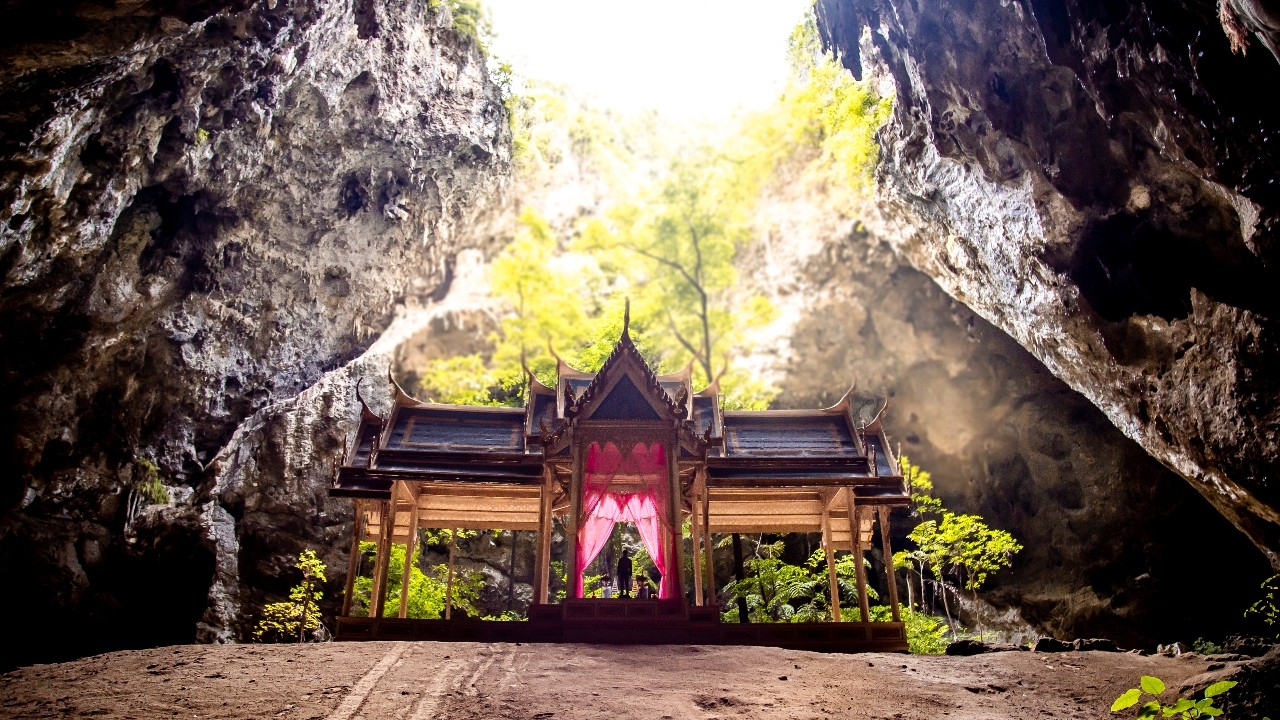
"Phraya Nakhon Cave" , is not just a world-class tourist spot famous for the palace light phenomenon but also has a long history connected to several Thai kings, especially as the site of the "Phra Thinang Khuha Kharuhat," a four-sided pavilion that has become the symbol of Prachuap Khiri Khan province today.
dates back to the early Rattanakosin period (likely during King Rama I's reign). The cave was named after "Phraya Nakhon," the governor of Nakhon Si Thammarat, who, while sailing to Bangkok, encountered a severe storm. He took shelter at Bang Pu Beach and discovered this large and unusually beautiful cave. Since then, it has been called "Phraya Nakhon Cave."
and the most distinctive feature of the cave is the Phra Thinang Khuha Kharuhat, which isa four-sided wooden pavilion,elegantly situated on a sandy mound in the middle of the cave. This pavilion was constructed during the reign of King Chulalongkorn (Rama V) in 1890. Notably, the king graciously ordered the pavilion's components to be made in Bangkok and sent for assembly inside the cave. Phraya Chonlayut Yothin supervised the work, and King Rama V personally lifted the pavilion's tiered roof. He also inscribed his royal cypher "จ.ป.ร." (J.P.R.) on the northern cave wall, which remains clearly visible today.
Phraya Nakhon Cave is a historic site visited by three Thai kings:
King Rama V, who visited four times and built the Phra Thinang Khuha Kharuhat,
King Rama VII, King Prajadhipok also visited and inscribed his royal cypher "ป.ป.ร." (P.P.R.) on the cave wall,
and King Rama IX, King Bhumibol Adulyadej visited on 22 June 1981.
For those planning to experience the wonder of "Phraya Nakhon Cave" in Prachuap Khiri Khan province in 2026, be well prepared. This is not just an ordinary cave; it requires the right timing and physical readiness. Thairath Online has summarized the complete guide, from travel tips to the golden moment of sunlight.
The highlight of visiting Phraya Nakhon Cave is witnessing the sunlight illuminating the Phra Thinang Khuha Kharuhat. The best times are:
Visiting Phraya Nakhon Cave requires passing two main points: "Bang Pu Beach" to "Laem Sala Beach" (rest stop before ascending to the cave)

Shoes are crucial: Flip-flops or flat fashion shoes are not recommended because some stones are slippery and sharp. Use sneakers with good tread or specialized hiking shoes.
Beware of local monkeys: Many crab-eating macaques live along the way and on the beach. Do not feed them and keep valuables and food securely stored to prevent snatching.
Managing drinking water: Bring at least one bottle per person but keep the area clean and always take plastic bottles back down to dispose of properly as per park policy.
Best timing: The sunlight shines through the pass to illuminate the pavilion most beautifully between 10:30 and 11:30 a.m. (season dependent). Arriving later means the light starts moving away from the key spot.
Crossing the beach: If choosing the boat around the cape (weather permitting), be cautious of getting wet when boarding or disembarking. Always check weather conditions with officials beforehand.
Phraya Nakhon Cave is not merely a scenic photo spot but a "natural museum" telling the story of Thai monarchs’ bond with the land. The journey, involving both boat and a 500-meter uphill walk, is like a test of faith to witness the most beautiful "light illumination" of a lifetime.