

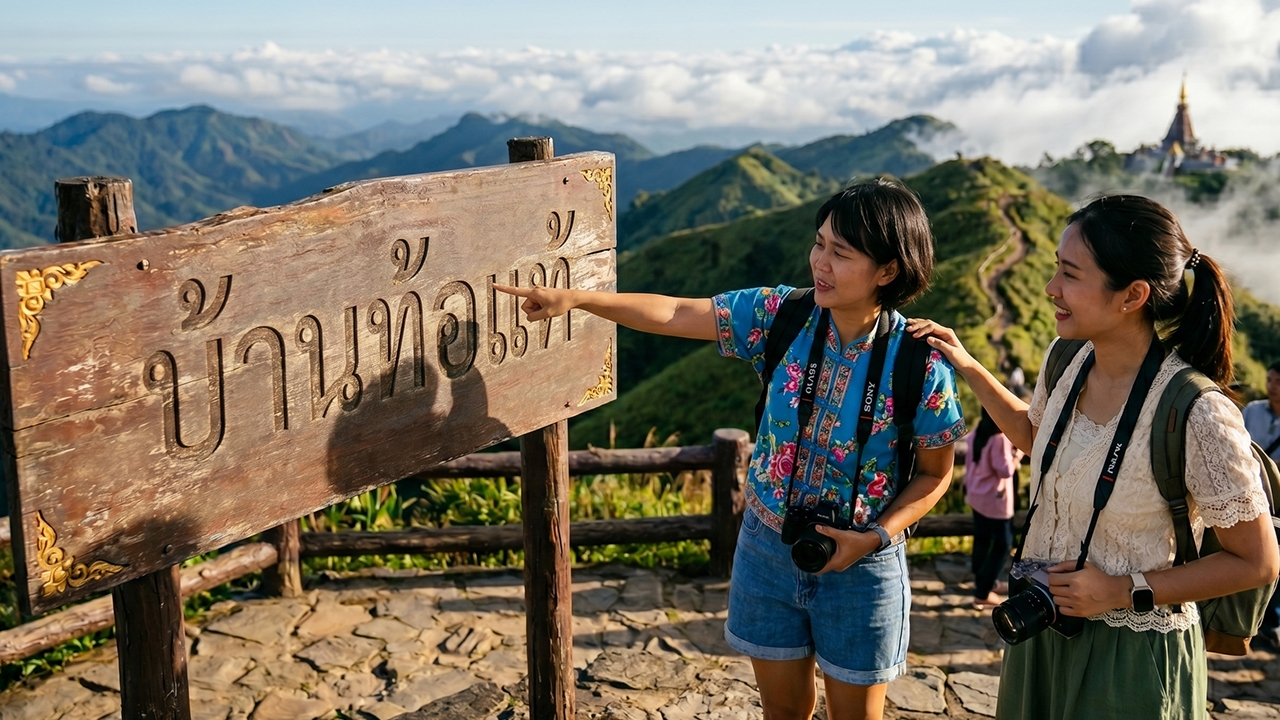
Have you ever opened a map or traveled in Thailand and been so surprised by a village or tourist spot’s name that you exclaimed, “Does this name really exist?” Today, Thairath Online will take you on a tour of seven unusual place names across Thailand that aren’t just funny or shocking—they reveal lifestyles, history, and stunning nature many might not know.
1. Ban Tho Tae (Phitsanulok Province)
Don’t lose heart just because of the name because "Ban Tho Tae" is located in Tho Tae subdistrict, Wat Bot district, Phitsanulok province, with a long history dating back to the era of King Naresuan the Great. It is said that in the past, soldiers marching through the area felt exhausted and "disheartened" or, alternatively, the terrain was difficult to access, causing discouragement. Today, it is a quiet community full of friendly smiles.
2. Pha Ham Hod (Chaiyaphum Province)
A thrilling tourist spot inSai Thong National Park,Nong Bua Rawe district,Chaiyaphum Province,this is a rocky cliff jutting out about 864 meters above sea level. The name comes from the height and the stomach-churning thrill of the cliff. A former provincial governor named it to challenge adventurous travelers.
3. Ban Tha Ja Haeo (Prachuap Khiri Khan Province)
Located in Pranburi district, Prachuap Khiri Khan, this village’s name might sound unlucky to romantics, but actually, “Haeo” refers to the wild garlic-like Huaew plants that once grew abundantly near the boat docks or water sources, leading locals to keep the name to this day.
4. Ban Nam Ok Hu (Mae Hong Son Province)
Situated in Thung Yao subdistrict, Pai district, Mae Hong Son, the name literally describes a physical feature because the village’s highlight is a natural spring that flows continuously from cracks or holes in the rocks throughout the year. The water is clear and serves as an important community water source.
5. Kaeng Khap Phuang (Nakhon Phanom Province)
A water attraction with a catchy name in Ban Phaeng district, Nakhon Phanom, this is a rocky rapid in the Mekong River that becomes clearly visible during the dry season. The term “Khap Phuang” is local dialect reflecting tightly packed rocks, creating a crowded appearance. It’s a popular spot for locals to relax and cool off.
6. Thanon Liap Nathi (Samut Songkhram Province)
This road is in Amphawa subdistrict, Amphawa district. The word “Nathi” means river or waterway, so the road’s name literally means a path running parallel to Amphawa canal. It reflects the historic settlement and lifestyle of Samut Songkhram’s people who depended on waterways and boat trade. Today, it’s a cultural street bustling with shops and traditional wooden homestays.
7. Soi Prae Phan (Prachuap Khiri Khan Province)
Soi Prae Phanis a key tourist route in Hua Hin, Prachuap Khiri Khan. The area hosts many well-known hotels, resorts, and restaurants. Visitors often take selfies with this sign, reflecting the settlement and expansion of an old family in the pioneering days of Hua Hin.
These places prove that“language”and“naming”by Thai people in the past often drew from stories, historical events, or natural surroundings of the time. Even though some names sound unusual now, they have become tourist attractions and part of the unique “Unseen Thailand” charm, inviting travelers to experience them firsthand.