

Step back in time to explore "Maha Charoen," a multicultural district linking Mahapruttharam, Charoenkrung, and Talat Noi over 2.6 km. Discover century-old architecture and a guide to legendary riverside eateries along the Chao Phraya River.
The term “Maha Charoen” is not just a name with auspicious meaning but a blend of the initial parts of two major roads: Mahapruttharam Road and Charoenkrung Road. This area marks a historic starting point reflecting Bangkok’s growth, from canal digging and the first roads, to Chinese settlers from diverse lineages, and the adoption of Western cultural influences that transformed it into a modern business center.
On the occasion of Yip In Tsoi’s 100th anniversary, they have partnered with the platform WABU to create a special Walking Tour themed “Maha Charoen: Past to Present, Connecting Time through Architecture.” Associate Professor Dr. Peerasri Powathong, a faculty member at Chulalongkorn University’s Faculty of Architecture and expert in architectural history, joins to interpret the city’s story through buildings, temples, and shrines along the route.
This walking route spans approximately 2.6 kilometers, taking about 37 minutes. It features 10 key stops that art and history enthusiasts should not miss.

An ancient royal temple dating back to the Ayutthaya period, originally named "Wat Tha Kwiang" as it served as a resting place for trade carts. It was later designated a royal temple during King Rama IV’s reign. Highlights include the ubosot’s doors and windows carved with oxen (representing the former name), elephants (symbolizing the former abbot Phra Athikarn Kaew), and angels holding the king’s crown (symbolizing King Rama IV).
A traditional Chinese medicine and herbal store passed down through more than four generations since 1924, located on Charoenkrung Road, Thailand’s first road.

Originally named "Can Ngentue" in Vietnamese, it is one of Siam’s first Vietnamese temples, evidence of early immigrants seeking royal patronage since King Rama I. The temple received royal support from King Rama IV and V, featuring ancient Vietnamese architecture and art inside.
Formerly a lathe workshop and wooden residence of a Cantonese Chinese family, now renovated by the third generation into a café, architect studio, and art event space while preserving the original wooden architectural structure. It won the Outstanding Architecture Award 2026 from the Association of Siamese Architects.

A more than 200-year-old Hokkien Chinese mansion of tycoon Phra Aphai Vanich, the founding ancestor of the Posayachinda family. It features a "courtyard house" style (Hokkien-Teochew) with terracotta tile roofs, colorful paintings of deities, and Chinese plasterwork, adapted for Thailand’s climate by raising the house on stilts like traditional Thai homes. It now operates as a café and diving school run by the eighth generation descendants.
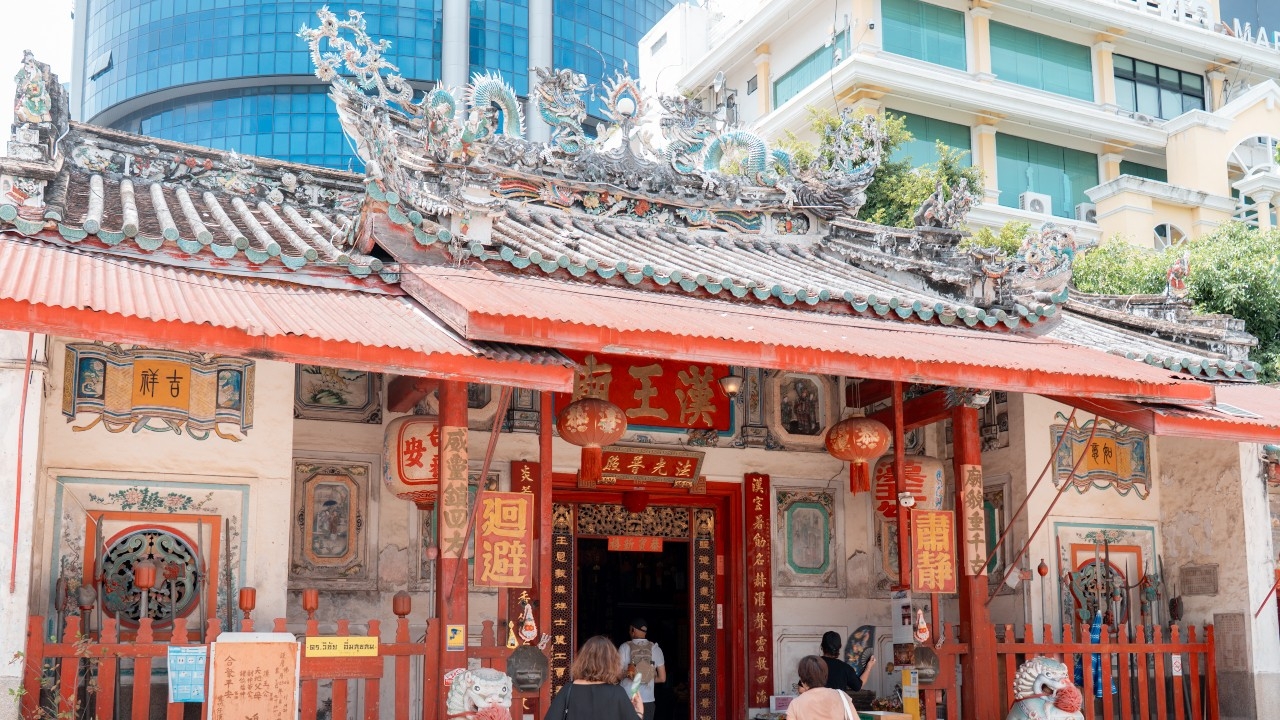
An old shrine by the Chao Phraya River, a spiritual center for the Hakka Chinese community, housing the "Hot Wong Kung" deity brought from China early in the Rattanakosin era. The shrine’s name refers to the Hakka community’s expertise as metalworkers, ship machinery repairers, and farriers in the area.
Thailand’s first bank office (originally Bank of Siam Limited), this three-story building was designed by Italian architect Annibale Rigotti in 1908 in Beaux Arts style. Recognized as an outstanding conservation building in 1982, it is still operational and a popular photo spot.

A Gothic-style Catholic church built by Portuguese Christian immigrants from Ayutthaya. The current church was constructed in 1891 in a Roman cross shape facing the Chao Phraya River, featuring exquisite stained glass crafted by Italian architect Joachim Grazi.
A historic alley named after Captain John Bush, an Englishman who was Bangkok’s harbor master during King Rama IV’s reign. This area was once the gateway to the wider world along the river, home to the Hong Kong and Shanghai Banking Corporation (HSBC), Louis T. Leonowens department store, and No.1 house, formerly the French liquor company’s office.
A seven-story modern shophouse complex from King Rama VII’s era, owned by Phraya Phakdi Noraset (Lert Sethabut). It formerly housed a hotel, shops, and a full-service department store. Opposite was Asia’s first U.S. import trade promotion center in 1964. Today, this area is part of Yip In Tsoi Co., Ltd., which has grown alongside Maha Charoen for over a century.
After exploring the historical architecture, it’s time to satisfy your appetite with a list of authentic legendary restaurants food lovers must try in this district.

Visiting and tasting food in Maha Charoen not only offers a valuable historical experience but also supports the circular economy, helping income circulate back to local communities and businesses to sustain this precious culture for the future.