

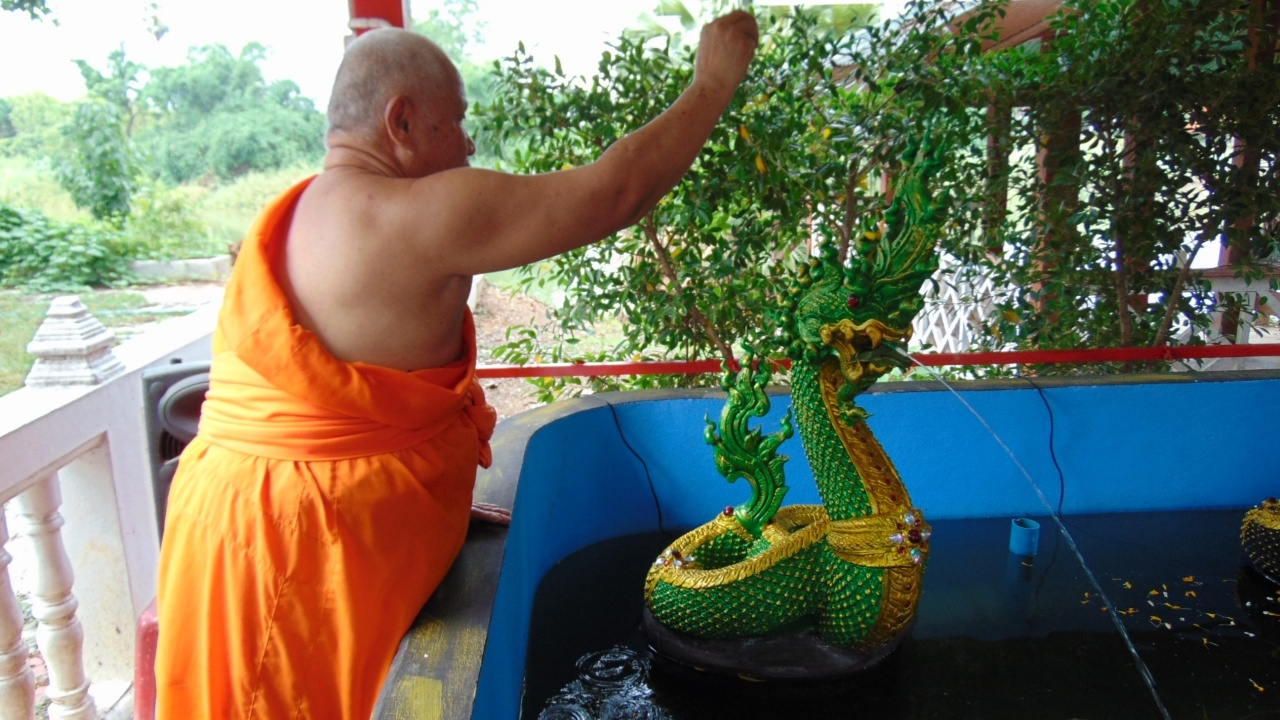
"Wat Phra Prang" shrine has built a shrine dedicated to "Pu Naga - Ya Naki" after "Luang Pu Sila" made a prediction, while lottery enthusiasts did not forget to ask for "lucky numbers this draw" to try their luck for the May 16, 2026 lottery.
On 14 May 2026 GMT+7, reporters reported that at the pavilion by the Yom River within Wat Phra Si Rattana Mahathat Ratchaworawihan (Wat Phra Prang), Village No. 6, Sri Satchanalai Subdistrict, Sri Satchanalai District, Sukhothai Province, a ritual was held to worship and open the eyes of two Naga king statues (Pu Naga and Ya Naki). According to legend, those who venerate the Naga kings will receive luck, wealth flowing in abundance, prosperous business, success in work, protection from all dangers, enhanced prestige, and blessings. Devotees funded and built the shrine, with Phra Thep Wachiravethi, Provincial Chief Monk of Sukhothai and abbot of Wat Phra Si Rattana Mahathat Ratchaworawihan, along with many disciples, attending the ceremony.
Phra Thep Wachiravethi revealed that around late February, when Phra Thep Watcharathammashopon, also known as Luang Pu Sila Sirichanto, a renowned Thai monk, presided over the ceremony to cut rattan for the lotus bud boundary at Wat Phlai Chumphon in Sukhothai city, he spoke with him and foretold that Naga kings guard Wat Phra Prang beneath the Yom River and wished for them to be enshrined in the pavilion beneath the Bodhi tree. This amazed him greatly because Luang Pu Sila had never visited Wat Phra Prang before.

After discussing this with the temple committee and devotees, some faithful individuals built the shrine for Pu Naga and Ya Naki and held a ritual today to worship and bring the statues up from the Yom River.
During the ceremony, under the blazing sun, a large cloud moved in to cover the sun, cooling the air for over half an hour until the ritual dance ended. Then the cloud slowly passed, and the bright sun returned. Everyone was astonished and believed this was surely the sacred power of "Pu Naga - Ya Naki."
Before leaving, some villagers prayed for luck and drew numbered ping-pong balls from a pot in front of the shrine, receiving numbers 3, 5, and 6. Consequently, lottery tickets with these numbers were quickly bought up and sold out.