

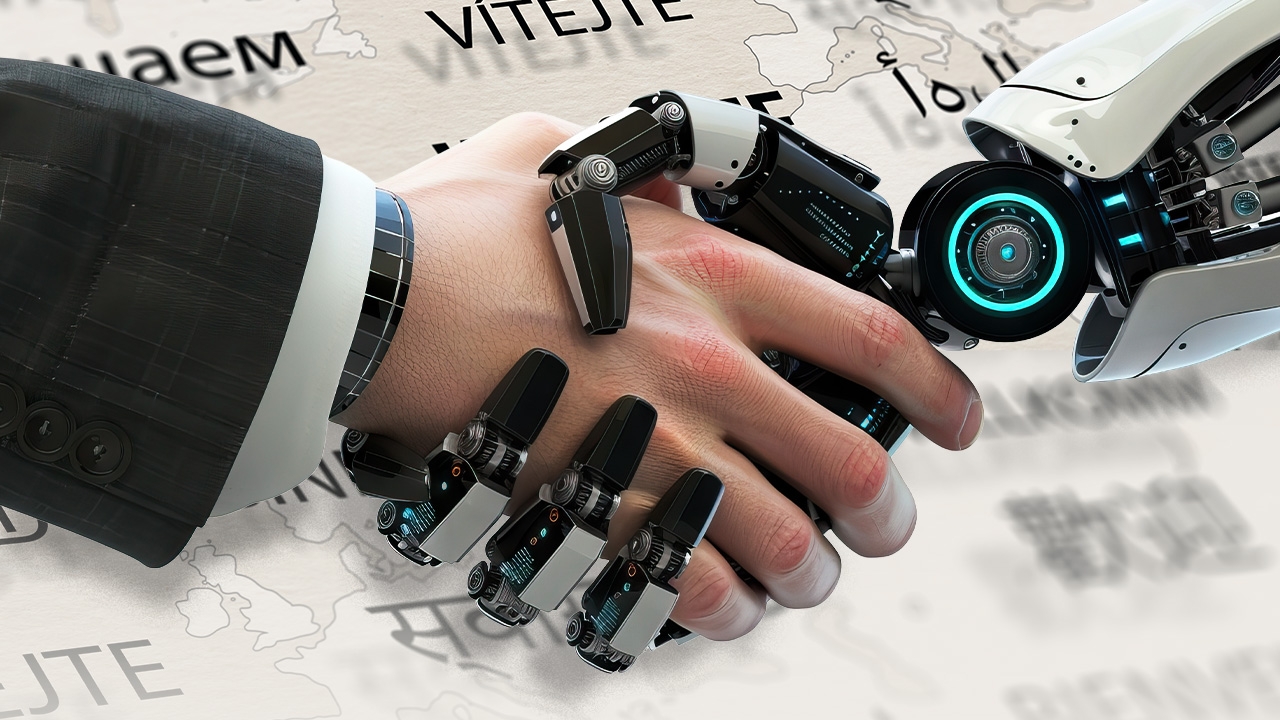
On a day when AI can write flawless emails, translate languages in real time, or quickly answer complex questions—especially in today’s work environment where AI performs tasks swiftly, including those that once required years of training—many people begin to question. "Are human language skills still necessary in this era?"
Thairath Money had the opportunity to speak with Educational Testing Service (ETS) a global educational assessment organization that develops and administers tests like TOEIC and TOEFL, conducting about 50 million tests annually across more than 200 countries. They reflect another reality: the faster AI develops, the more valuable human communication skills, especially English, become—not less so.
Pushkar Saran, a regional executive at ETS, who oversees Southeast Asia and the Asia-Pacific region, explains that in a world where AI plays a significant role, language learning is no longer just about understanding vocabulary or grammar. It is a crucial skill that helps workers remain competitive, adaptable, and maintain their humanity in a technology-driven world.
to understand why language skills remain important, one must look at the changes in the global labor structure.
In the past, most organizations had a "pyramid" workforce structure, meaning many entry-level employees formed the base and gradually rose to higher positions. The base typically involved repetitive or back-office tasks before moving up.
Pushkar Saran notes that this structure is now shifting from a pyramid to a diamond shape.
The diamond structure means AI replaces many lower-level roles, pushing employees to accumulate skills and move up from the base level. Consequently, lower-level jobs decrease while mid-level positions in the diamond expand rapidly.
Employees who once performed repetitive work are now pushed to more complex roles requiring collaboration, negotiation, contextual understanding, judgment, analytical thinking, and cross-team cooperation.
"Lower-level jobs will be taken over by AI, but negotiation, understanding complex details, high-level judgment, advanced thinking, working with international teams, and accessing global knowledge will become increasingly important skills in the AI era," Pushkar Saran said.
Therefore, as everyone handles more complex work, the cost of mistakes rises. If employees misinterpret AI results or cannot clearly explain key points to clients, the damage could be enormous. This makes communication skills a critical tool for organizations.
A common misconception is that AI can fully replace human communication.
Although AI can write eloquent emails or messages, in real scenarios such as face-to-face meetings, presentations, or interacting with clients from different cultures, AI’s advantage diminishes immediately.
Language is not just about arranging words correctly; it is a vital tool to influence others’ thinking, convey empathy, and build trust.
Pushkar Saran explained, "If I have to pause to use AI, you immediately know that what I’m saying isn’t coming from me but from AI. At that moment, trust, empathy, and our connection disappear."
Furthermore, in an AI-driven world, machines still cannot replace humans in many areas, such as ethical decision-making, analytical thinking, creativity, cultural understanding, empathy, and leadership.
These skills become even more valuable in the labor market when humans combine judgment with AI capabilities. The true value lies not in AI itself but in humans’ abilities to negotiate, persuade, and lead.
Beyond communication reasons, there is a technical rationale why language—especially English—remains necessary and the most important language in the AI era. This is because most leading AI models are trained primarily on English data, resulting in higher performance in processing English compared to other languages, particularly local ones.
According to MIT research studying AI use for public health questions, when users input questions in local languages such as Swahili, AI provides incorrect answers 20-30% more often than when using English, even for the same questions.
Although AI increasingly supports multiple languages, to fully access these tools' potential, understanding English remains a significant advantage. In other words, even as AI improves multilingual support, English remains the most advantageous language for maximizing AI’s capabilities.
Moreover, AI cannot replace the human language learning process. While AI can generate perfect text within seconds, it cannot function as a teacher that gradually develops foundations in pronunciation, vocabulary, grammar, and sentence structure over many years.
"AI can be a helper, but it cannot automatically make anyone an expert in listening, speaking, reading, and writing," Pushkar Saran said.
Additionally, according totheTOEIC Global English Skills Report 2026, the arrival of AI has made employers place even more importance on communication skills, revealing that
Even ETS uses AI to grade about 80% of speaking and writing tests, but human evaluators still review 20% to ensure accuracy where AI is not yet perfect.
In today’s work world, job security no longer means staying with the same company for life. Many studies show that future employment growth will come from "new careers" that never existed before rather than expansion of existing jobs.
When executives were asked to choose between "someone with deep specialized expertise but poor adaptability" and "someone who learns fast and adapts well, even without deep knowledge," almost all chose the fast learner.
As Pushkar Saran stated, "Technical expertise can become outdated, but the ability to learn new things always creates value."
The workers organizations will want in the future are those who can solve unprecedented problems using fundamental principles, have curiosity, can collaborate with AI, and possess communication skills that connect people across diverse cultures.
Ultimately, AI may take over repetitive tasks, but it also opens space for humans to do what machines cannot replace.
Language learning today is no longer just about vocabulary; it is about building skills that enable us to communicate, connect people, lead, and preserve humanity in an AI-driven world.
Follow the Facebook page Thairath Money at this link -https://www.facebook.com/ThairathMoney