

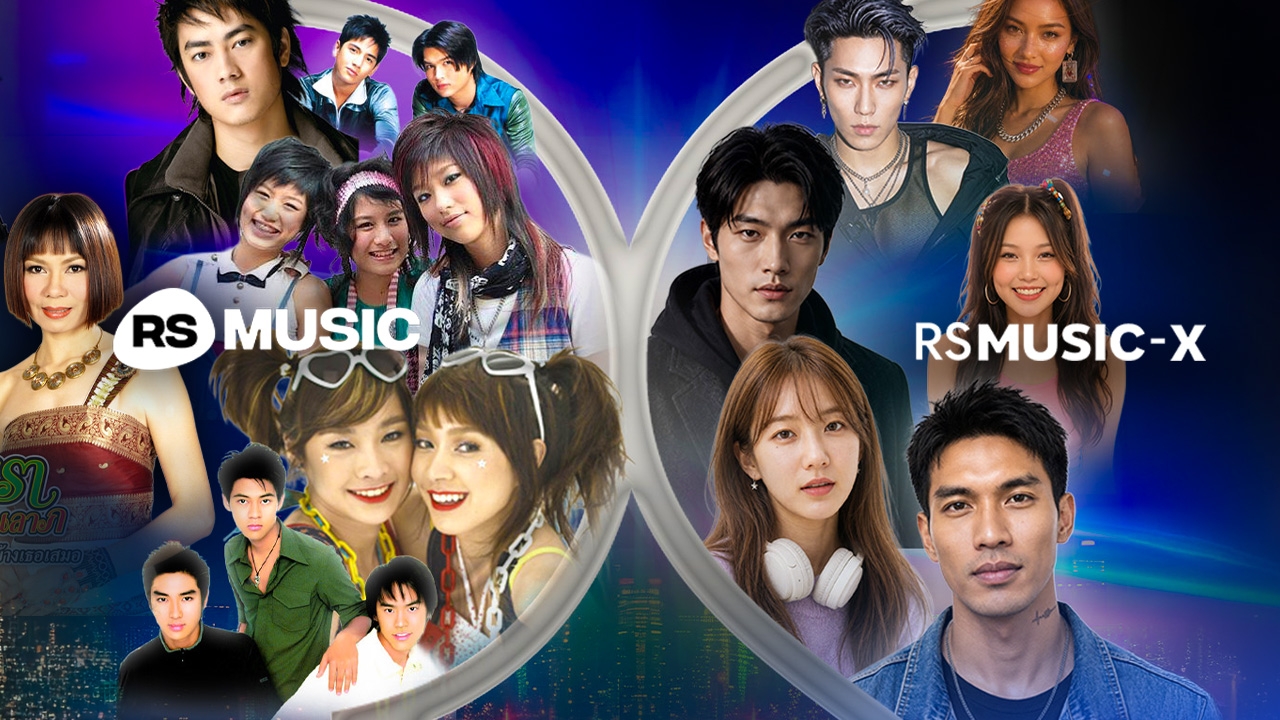
In the history of the Thai music business, few companies have transcended being just record labels to influence and shape the tastes of listeners nationwide. "RS" The music label of Hia Hor - Surachai Chesdachotisak is one such company.
Many people grew up with the voices of Itthi Plangkul; some remember the breakthrough of Ta Somchai or Dome Pakorn Lam, while another generation grew up with D2B, Kamikaze, K-OTIC, FFK, or artists from RSiam. Behind these artists stands a company once hailed as one of the "powerhouses of the Thai music industry."
For over 50 years, the company has created hundreds of artists, amassed a catalog of tens of thousands of songs, and grown into a major force in the Thai music industry. However, in an era where some music businesses struggle to survive on album sales alone, the legendary Thai label RS, having weathered numerous storms, is making another significant move by launching AI artists underRS Music X.
Instead of receiving praise as a technology pioneer, this project has sparked intense criticism and questions across global social media: Is the label that created music legends building the future of the music business, or is it experimenting with the legacy it has built over decades using AI?
Back in 1976, the Chesdachotisak siblings, Surachai Chesdachotisak and Kriangkrai Chesdachotisak, started their business with an investment of about 50,000 baht, launching a small operation called Rose Sound. They recorded music onto cassette tapes and sold audio equipment.
At that time, the Thai music industry was still in the vinyl era. Recording music on tape was a growing business aligned with the popularity of cassettes. Rose Sound gradually expanded from distributor to producing its own music works.
Later, in 1982, the company officially established RS Sound Company Limited (RS Sound) and began creating artists for the youth market, which had few competitors then, with acts like Kiriboon, Fruity, Rainbow, and Brandy becoming the foundation that made RS known as a label for the new generation.

From the late 1980s to the early 1990s, RS experienced rapid growth, including a name change to RS Promotion Company Limited (RS Promotion) and declaring itself a full-fledged entertainment company, no longer limited to music business.
During this period, RS produced continuous superstars such as Ta Somchai, Touch Na Takuatung, Dome Pakorn Lam, James Ruangsak, Pan Thanaporn, Lift & Oil, Raptor, Blackhead, Hi-Rock, Boyscout, among many others.
RS became the trendsetter for Pop, Rock, and Teen Idol music in Thailand, turning the competition with Grammy not just into a sales race but a cultural battle to dominate the country's pop culture, creating the memorable terms "Grammy kids" and "RS kids."
In 2003, a major milestone was achieved when the company was listed on the Stock Exchange of Thailand, reflecting the competitive music business landscape and evolving Thai music consumption habits that transformed a cassette shop and audio retailer into a major entertainment company named RS Public Company Limited.
RS maintained its business peak for over a decade, including launching Kamikaze, a label targeting internet-era youth in 2007, which became wildly popular. This era introduced many teenage artists like Wai Panyarisa, Kanomjeen Kulamas, Fay Fang Kaew, K-OTIC, Kiss Me Five, 3.2.1, with many songs reaching hundreds of millions of views later.
Additionally, RSIAM Company Limited (RSIAM) became another pillar of RS, focusing on luk thung and phleng phuea chiwit (Thai folk music) genres, creating famous luk thung artists such as Baw Wee, Pong Lang Sa On, Jintara Poonlarp, Baetoy RSiam, Kratae RSiam, and Ja RSiam. At one time, RS dominated the luk thung market alongside pop, marking another transformative era for the Thai music industry.
However, the music business success did not continue indefinitely. The arrival of the internet, copyright infringement through MP3 files, and the collapse of the CD market caused rapid revenue declines. The business model relying on album sales became obsolete.
RS had to make major adjustments, expanding into film (RS Film), radio (98 Cool FM, 88.5Z Pop), and television. During this time, RS acquired rights to broadcast the World Cup and Euro football tournaments, expanded satellite channels, and ventured into digital TV with Channel 8.
RS further expanded into health, beauty, product sales, and rebranded asRS Groupin 2020, defining a new business model called Entertainmerce, based on using media and entertainment to build an audience base before connecting to direct sales of products and services through various company channels and commerce platforms. This marked a major business transition for RS from a Music Company to a “Commerce Company.”
Despite efforts to grow through the Entertainmerce model, the commerce business faced intense competition, compounded by the impacts of COVID-19 and a slowing economy. The company’s financial results suffered continuous pressure, culminating in a net loss of 304.58 million baht in 2024 and investor confidence challenges.
Amid these challenges, the company revisited its core strength that made its name: itsmusic copyright catalog of over 10,000 songs,which, in the streaming era, has become an asset generating steady income through music listening, licensing, and diverse content extensions.
In 2023, RS attracted music fans again by announcing a renewed push into music through a joint venture with Universal Music Group, establishing RS UMG to jointly manage old music copyrights and promote Thai artists internationally.
This year marks a new strategic beginning as RS launched RS Music X, a project revitalizing RS’s hit song catalog by partnering with labels, artists, and producers from various companies to reinterpret songs for modern listeners. While many see this as a return to the music business, it actually signals the company’s shift from a record label that produces artists to a “Music IP Company” that leverages intellectual property (music catalog) to generate recurring revenue.
Instead of rushing to create new artists, RS chose to refresh over 10,000 songs accumulated over decades, spanning pop, rock, luk thung, and T-Pop eras, by collaborating with artists from various labels to expand the use of music copyrights beyond just listening.
Several projects demonstrate RS’s approach: not just releasing compilation albums but dividing into sub-projects paired with different labels or music genres. For example, RS Music X XOXO featured T-POP artists like 4EVE and ATLAS reinterpreting 1990s-2000s pop songs; RS Music X What The Duck involved indie artists such as THE TOYS, QLER, and YourMOOD rearranging RS hits with new vocals. Many songs achieved high streaming and viewing numbers, reviving popularity for RS’s catalog.
This business model aligns with global music companies increasingly valuing music catalog management, as long-term royalty income is more stable than relying solely on new artists. Especially in the streaming era, old songs gain renewed value by generating recurring revenue through Spotify, Apple Music, YouTube, TikTok, licensing, and reunion concerts.

After about two years of successfully revitalizing its catalog through RS Music X, RS took the next step—not just presenting new songs but creating “new format artists” in theArtist Iconproject, revealing six debut AI artists:
Tamin, Joy Joy, Aryn, Noir, Stella, and Luna.
This project’s distinction lies in that these artists were not discovered or developed via traditional auditions but were created using AI technology, which shaped their images, personalities, characters, as well as the universe and stories for each, later expressed through songs, music videos, and digital content platforms.
The first artist launched was Tamin with the single “Keep the Sun 2026,” a reinterpretation of a legendary song by Itthi Plangkul in a Lo-fi Boom Bap style blending contemporary music and rap, becoming one of the most talked-about topics on social media recently.
Why is the response divided?
Although AI and the music industry are currently hot topics, the debate is not solely about technology.
If a tech company or startup launched AI artists, it might be seen as a natural business innovation. But since RS, the owner of a culturally valuable music catalog, is doing it, audience expectations differ. Many see RS not just as a music company but as a guardian of Thailand’s musical heritage.
When the company chooses to launch songs like “Keep the Sun” via AI artists, questions arise not only about the appeal of the new version but whether the company is using technology to enhance the song’s value or merely leveraging cultural assets for marketing buzz.
Another term emerging is AI Washing—using AI as a marketing hook while the actual product value changes little. This question applies to Artist Icon: Are listeners truly interested in the AI aspect, or in the music quality? Without the AI label, would this work receive the same attention?
Ultimately, Artist Icon may be part of experimenting with a new business model rather than simply creating artists. Real artist development is not measured by initial views or launch criticism. Over 50 years, what truly created value for the music business was the relationship between artists and listeners—not just technology or platforms.
And that is the most critical challenge for RS Music X as the company transitions from a record label into a business fully driven by Music IP, Character IP, and AI. Sources
RS Read more in the BrandStory
column
https://www.facebook.com/ThairathMoney