

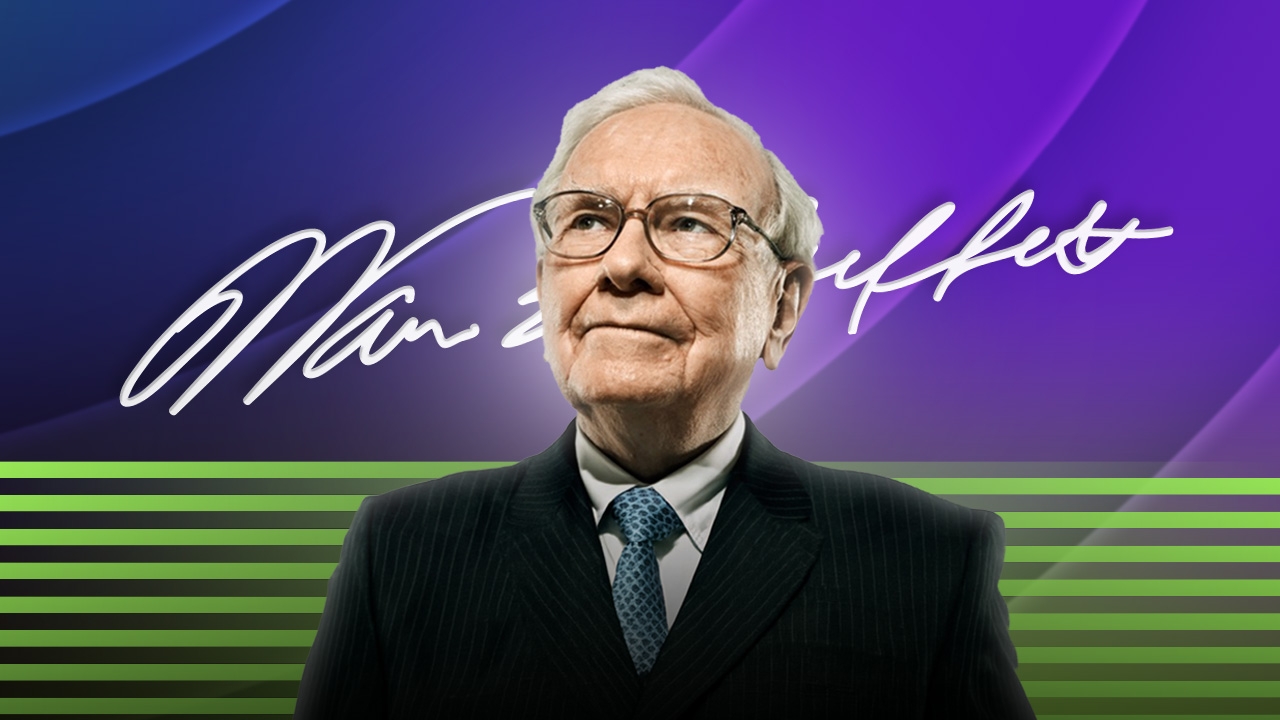
Warren Buffett is another name hailed as one of the greatest investors of all time. Many times when he shares his views, the market listens attentively. With over 80 years of investment experience, he is a highly successful figure who has inspired many.
He became the blueprint for Value Investing that many have long followed. However, as the world advanced into the technology era—first the dot-com period and later the AI era—the distinctive style of Grandpa Warren Buffett has gradually faded (according to his own words).
Recently, he gave an interview expressing that investing nowadays is not really "investing" but rather "gambling." The reason is that people focus on short-term speculation and quick profits instead of long-term holding like he has done for decades. Also, finding good, valuable stocks nowadays is very difficult.
Today, at 95 years old, Warren Buffett has stepped down as CEO of Berkshire Hathaway after a long tenure but still retains the chairman position. He lives a simple life with his family in the house he purchased in 1958 and continues to donate to charity, committed to his pledge to give back 99% of his wealth to society.
This article from Thairath Money in theHow to Make Moneycolumn takes a look back at the journey of this investment icon, exploring his upbringing, lifestyle, why he chose investing, how he built a great company, and how he continues to inspire people worldwide today.
Before Warren Buffett became one of the world’s most successful investors, his life did not begin with vast capital. However, he undeniably had advantages over many children. He started as a boy from Omaha, Nebraska, USA, who was passionate about making money from a young age.
Warren Edward Buffett was born on 30 August 1930 in Omaha. He was the second child in a family of three siblings and the only son. His father, Howard Buffett, was a stockbroker who later served four terms as a U.S. Congressman.
His father's profession opened the first door for Warren to experience the world of investing as a child. At just 11, he saved money and made his first investment in preferred stock by buying three shares of Cities Service at $38 each.
Buffett later recounted that the stock price fell after his purchase but then rose to $40, prompting him to sell for a small profit. However, the stock soared much higher afterward. This experience taught him a crucial lesson: trying to time stock purchases and sales is not a good investment method.
During his teenage years, he worked various jobs, including selling soda and delivering newspapers, using the money earned to invest in a farm in Nebraska. By age 14, he had saved enough to buy 40 acres (over 100 rai) of land, which he leased to others to generate additional income.
At 16, he enrolled at the University of Pennsylvania on his father's advice and was accepted. After two years, he transferred to the University of Nebraska, where he completed a business administration degree in just two years.
After earning his bachelor's degree, his father encouraged further education. Warren applied to Harvard University but was rejected, then enrolled at Columbia University instead.
At Columbia, he studied under Benjamin Graham, the legendary investor known as the “father of Value Investing.” This experience became a critical foundation shaping Warren Buffett’s career path toward Value Investing.
After graduating from Columbia, Buffett sought to work with Benjamin Graham but was initially rejected. Graham advised him to avoid Wall Street jobs, so Buffett returned to Omaha and began working at his father's brokerage firm.
In 1952, he married Susan Thompson and started a family. Three years later, Benjamin Graham changed his mind and invited Buffett to join his New York firm, marking a pivotal step toward Buffett’s legendary investment career.
Once settled in New York, Buffett applied the investment concepts learned at university. He believed in Value Investing, focusing on stocks priced below their intrinsic business value.
He deeply absorbed this philosophy but extended it further by seeking quality businesses capable of long-term growth.
In 1956, Buffett left his job, returned to Omaha, and founded his own investment company, Buffett Associates, with $100 of his own money plus about $105,000 from friends and family. By 1962, at age 30, he became a millionaire investor.
After meeting investor Charlie Munger in 1959, they collaborated to evolve Value Investing beyond buying cheap, declining companies for quick profits, focusing instead on quality businesses with growth potential and sustainable long-term returns.
One of their enduring successes was acquiring Berkshire Hathaway, a struggling textile mill with significant cash reserves, which became a global case study.
The turning point for Berkshire Hathaway began in 1962 when Buffett saw its large cash reserves but poor business performance. He decided to invest, becoming the largest shareholder and eventually controlling the company by 1965.
When he started investing, Berkshire Hathaway’s shares traded at about $8 per share, rising to nearly $20 by the late 1960s when he became CEO. By early 2026, Berkshire Hathaway Class A shares traded above $700,000 per share. The high price reflects Buffett’s desire that only serious, long-term investors who value the company hold these shares.
Initially, he tried to sustain the textile business but transformed Berkshire Hathaway into a holding company acquiring and holding stakes in other companies, establishing a foundation still maintained today.
A key cash generator was the insurance business. Buffett used profits from textiles to acquire other companies, notably buying National Indemnity, a life insurance firm.
He recognized the value of 'float'—money received from premiums that could be invested between collection and claims payout—acting as low-cost capital to generate additional returns.
Buffett invested this float in stocks, bonds, and acquisitions to generate profits, then reinvested returns, creating a cycle that continuously expanded Berkshire Hathaway’s empire.
In 1969, he closed his personal investment fund, offering investors Berkshire Hathaway shares instead of cash, then proceeded to acquire multiple insurance companies as subsidiaries under Berkshire Hathaway.
In 1972, he continued acquisitions, buying See’s Candies, which became a strong cash flow business supporting further investments.
He also invested in leading companies such as American Express, Bank of America, Coca-Cola, and Apple, focusing on firms with strong brands, sustainable competitive advantages, and long-term profitability potential.
He appointed Charlie Munger as vice chairman in 1978 to advise and co-manage, continuing a long partnership in investment decision-making.
His key strategy is “buy and hold,” investing in companies with excellent management, shareholder focus, high profit margins, and solid fundamentals, buying when shares are undervalued.
However, in 1985, he closed the last Berkshire Hathaway textile mill but continued expanding the company as a holding firm investing across diverse industries.
By early 2026, Berkshire Hathaway owned more than 60 companies and hada market valueexceeding $1 trillion, reflecting growth from a near-bankrupt textile mill to one of the world’s most influential and valuable companies under Buffett’s leadership.
Having become one of the world’s most successful investors, the question arises: what will Warren Buffett do with his immense wealth?
The answer is “Donate almost all of it” to charity and the public good.
In June 2006, he surprised the world by announcing he would give the majority of his wealth to the Bill & Melinda Gates Foundation to support public health, education, and social issues globally. This foundation is one of the largest and most transparent charitable organizations worldwide.
His donations were in the form of 10 million Berkshire Hathaway Class B shares, scheduled to transfer 5% annually until his death or if the foundation failed to meet conditions. He believed donating shares was valuable as their worth could increase if the stock price rose.
Besides the Gates Foundation, he also donated shares to other charities, mostly in Berkshire Hathaway Class B stock, including three foundations managed by his children and one established in honor of his first wife.
Recently, at 95, Buffett told CNBC he will continue donating until achieving his goals, holding firmly to the belief that people like him are lucky—born into supportive families, finding passion early, and enjoying good health—thus his duty is to give back to society.
“From my perspective, among 8 billion people on Earth, I might be one of the ten luckiest. I am lucky to have good health at 95 and to have found what I love early in life.” He added, “If my father had been a plumber, I wouldn’t have had the same opportunities. So, I consider myself incredibly lucky.”
Buffett also said that as he ages, he realizes many people are not as lucky as he is. This belief has shaped his view that philanthropy is a moral duty for the wealthy, leading him to pledge in 2010 to donate 99% of his assets during his lifetime.
CNBC estimates that shares he has already donated were worth nearly $48 billion at donation time but would be approximately $159 billion at current prices.
He also plans to transfer all remaining Berkshire Hathaway shares by 31 December 2034, requiring donations averaging at least $17 billion annually to his family’s four foundations, announcing he will stop donating to the Gates Foundation.
Currently, Buffett has stepped down as Berkshire Hathaway’s CEO but remains chairman, frequently offering advice and market insights, despite his reservations about the technology-era investment style.
According toForbes,Warren Buffett, with over 80 years in investing, has a net worth exceeding $139.3 billion, ranking as the 10th richest person globally.
Source: CNBC [1][2][3],Forbes,EBSCO,Investopedia,Yahoo! Finance
Follow the Facebook page: Thairath Money at the link -https://www.facebook.com/ThairathMoney